
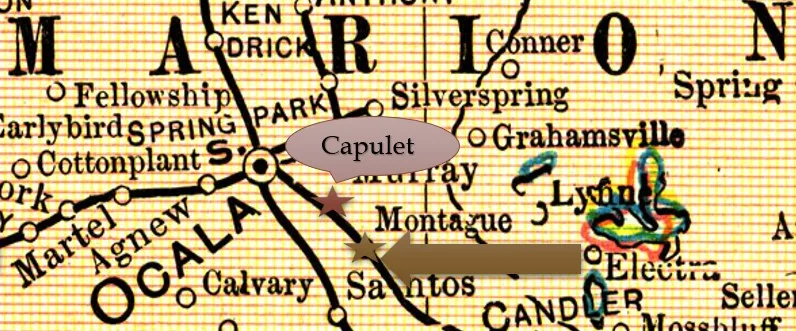
Some ghost towns whisper. Capulet hums a line of poetry and then disappears behind the trees.
Tucked somewhere between a forgotten crossroad and a memory, Capulet and her sister town, Montague, aren’t rivals in a Florida version of Romeo and Juliet. No tragic balcony scenes here. Just two little communities breathing the same pine-sweet air—named, curiously enough, by a man who loved Shakespeare.
According to local historian Sybil Browne Bray, it was S.S. Savage who chose the names. A literary nod? A joke lost to time? Maybe just a man with a flair for the dramatic. His grandson, Charles Savage Jr., said the bard-inspired names stuck around out of sheer affection.
But even Charles Savage III, born into the story, couldn’t unravel why his grandfather chose those names. That’s Florida history for you—charming, quirky, and half-buried under layers of oak leaves and unanswered questions.
Capulet’s Quiet Remains
Capulet didn’t need much: just a church, a school, and a borrowed post office over in Montague, a mile or so down the road. Montague, notably, was a predominantly Black settlement—a detail too often left out of the retelling. And while Capulet had no map marker, it had something more lasting: a cemetery that still breathes.
You’ll find it nestled near State Road 464 and Baseline Road, cloaked in trees and time. The Capulet Cemetery is the only breadcrumb left… unless you count the story of the 1928 tornado.
Legend has it, the storm flung a church clear across the field—but the pews? And the Bible on the pulpit? Still sitting calmly like they’d never moved at all. If that doesn’t give you goosebumps, I’m not sure what will.
🎥 Want to see more? Watch the video below for a deeper look into Capulet and Montague, Florida’s forgotten sister towns.
The Cemetery That Remembers
Walking through Capulet Cemetery is like thumbing through a chapter the state forgot to print.
The path is quiet. The air, heavy. Most of the graves are unmarked, but you can feel them—beneath your boots, beneath the moss. There’s this eerie illusion that the cemetery stretches farther than the eye can see, like the land remembers more than it reveals.
Where was the church? How many names have vanished from stone and memory? Was Capulet really no bigger than a city block?
Some graves bear the names of veterans, and a few newer stones dot the edges. Others are being slowly swallowed by undergrowth and storms. Broken fences. Leaning headstones. Nature nudging history into silence.
And yet—here it is. Still standing. Still telling stories to anyone willing to listen.
A Town That Slipped Through Time
Capulet doesn’t shout. It lingers.
It’s a nearly invisible dot on Florida’s map, stitched together by secondhand stories and graveyard whispers. But walking those grounds, you get the feeling it mattered. It matters. These were lives lived with quiet dignity—teachers, preachers, farmers, children—and all they ask is to be remembered.
So take the detour. Let your GPS get a little lost. Bring flowers if you’d like, or just a quiet thought. Capulet is waiting, tucked in the woods, where history and mystery still hold hands.
To see all of the pictures I took in Capulet, click here.
If you see this after your page is loaded completely, leafletJS files are missing.