
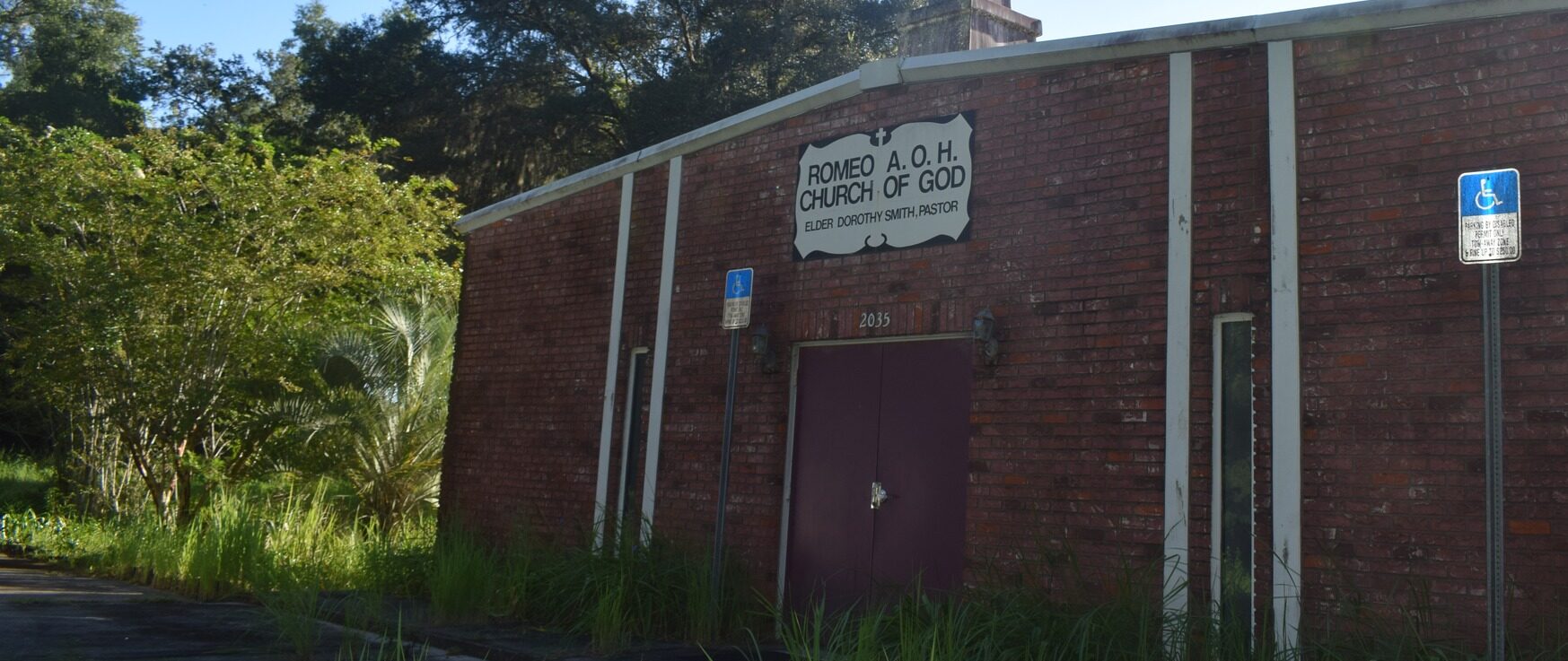
In Marion County, beneath Florida’s pines and sprawling oaks, there is still a place called Romeo.
The town is gone.
But Romeo isn’t.
And that distinction makes this one of my favorite kinds of ghost towns.
You won’t arrive to find abandoned streets lined with collapsing storefronts. There isn’t a preserved downtown waiting beneath the vines. Instead, Romeo survives as a rural community north of Dunnellon, where pieces of the past are scattered among modern roads, private property, old graves, a church, and a few industrial remnants.
You have to know what you’re looking for.
And, because apparently Florida couldn’t resist a little Shakespearean drama, Romeo once had a neighboring community called Juliette.
Yes.
Romeo and Juliette.
Florida did that.
Before Romeo Became a Ghost Town
Romeo’s documented history stretches back to the 1850s, when this part of western Marion County was home to a small agricultural community.
Unlike some Florida ghost towns that sprang almost overnight around a railroad, mine, or lumber operation, Romeo appears to have developed more quietly. Farms and families came first, and the community gradually acquired the institutions that turned a collection of homesteads into a recognizable place.
By the late nineteenth century, Romeo had its own post office.
Postal records show Thomas G. Martin becoming postmaster on January 17, 1888. The office closed in May 1893, with mail sent to nearby Blue Spring, but Romeo wasn’t finished. The post office reopened in December 1894.
That little post office would help keep Romeo’s name alive for another six decades.
And then there was the railroad.
By the early twentieth century, Romeo sat along the Atlantic Coast Line Railway west of Ocala. The railroad and what is now U.S. 41 created a transportation corridor through this otherwise rural part of Marion County.
Romeo was small.
But it was on the map.
Just How Small Was Romeo?
This is where the historical record gives us one of my favorite little windows into the community.
A 1925 Florida business directory described Romeo as a village of just 30 people.
Thirty.
That’s not a town where everybody probably knew everybody.
That’s a town where everybody knew exactly who borrowed the shovel and hadn’t brought it back yet.
Despite its tiny population, Romeo had a Baptist church, telephone service, express service, and a post office. M. H. Noble was listed as the postmaster.
It wasn’t a bustling metropolis.
It wasn’t even a particularly large village.
Romeo was simply one of the countless little communities that once stitched rural Florida together—places where a church, post office, railroad stop, store, and handful of families could give a patch of countryside an identity of its own.
And then there was the name.
Romeo and Juliette: Florida’s Star-Crossed Ghost Towns
A few miles south was another community—Juliette Ghost Town, Romeo’s wonderfully named neighbor and eventual partner in one of Marion County’s most enduring legends.
The connection has inspired a local legend that has followed the two places for generations.
According to the story, a young man from Romeo fell in love with a young woman from Juliette. Their families opposed the relationship, creating a Florida version of Shakespeare’s star-crossed lovers.
It’s a fantastic story.
It’s also probably a legend.

Historical accounts have repeated variations of it for decades, but there doesn’t appear to be documentation proving that an actual Romeo-and-Juliette romance gave the communities their names.
And somehow, I like that better.
Because the documented history is already strange enough.
Two neighboring Florida communities really were called Romeo and Juliette.
And eventually, both faded from the map.
Sometimes history doesn’t need us to add anything.
It’s perfectly capable of being weird all by itself.
And because apparently Marion County wasn’t finished with Shakespeare yet, there was also a community called Capulet. Because of course there was.
The Marion County Prison at Romeo
One of the most intriguing pieces of Romeo’s history survives not on the landscape, but in a photograph.
Historical images preserved by the State Archives of Florida document the Marion County Prison at Romeo during the early twentieth century.
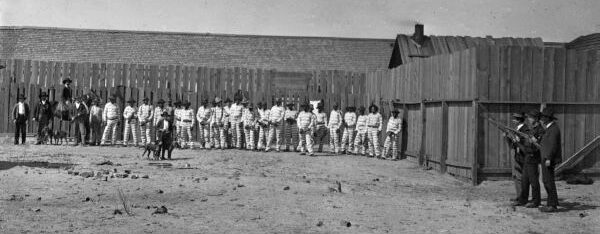
And that’s where I need to separate what we know from what we don’t.
The prison existed.
Beyond that, the historical record I’ve found is surprisingly thin.
I haven’t found reliable documentation supporting some of the more dramatic stories associated with the facility, and I don’t want to turn an unanswered question into a fact simply because it makes a better ghost-town story.
Instead, that photograph becomes something even more useful:
a lead.
Somewhere behind that image is another piece of Romeo’s story waiting to be uncovered.
And you know me.
I do love a historical rabbit hole.
Romeo Begins to Fade
There doesn’t seem to have been one dramatic event that killed Romeo.
No catastrophic fire.
No hurricane that erased the community overnight.
No single industry whose collapse emptied the town.
Romeo simply became less necessary.

Romeo wasn’t alone. Communities like Montague followed their own paths from established Marion County settlements into places most Floridians now drive past without ever knowing they existed.
That’s a fate shared by countless small American communities.
Transportation changed. Mail routes consolidated. People traveled farther for work, shopping, school, and services. Tiny rural communities that once needed their own post offices and stores gradually became absorbed into larger regional networks.
Romeo’s post office survived until 1955, when its mail service was transferred to Ocala.
For a community that had maintained its own postal identity since the nineteenth century, that was a pretty significant ending.
The people didn’t all vanish.
The land wasn’t abandoned.
But the independent community called Romeo slowly became history.
Which brings us to the strange thing about visiting it today.
Looking for a Ghost Town That Isn’t Quite Gone
When I went looking for Romeo, I wasn’t expecting a perfectly preserved abandoned town.
Good thing.
Because that is definitely not what I found.
I programmed an address in the old Romeo area into my GPS and headed north of Dunnellon along U.S. 41.
And then the hunt began.
This is the kind of ghost-town exploration I love because nothing announces itself.

There isn’t a giant sign saying:
WELCOME TO ROMEO — POPULATION: GHOSTS.
You have to look.
Old roads.
A cemetery.
A church.
Industrial remains.
Things that seem ordinary until you understand what used to surround them.
And, occasionally, things that make you pull over because your history radar starts screaming.
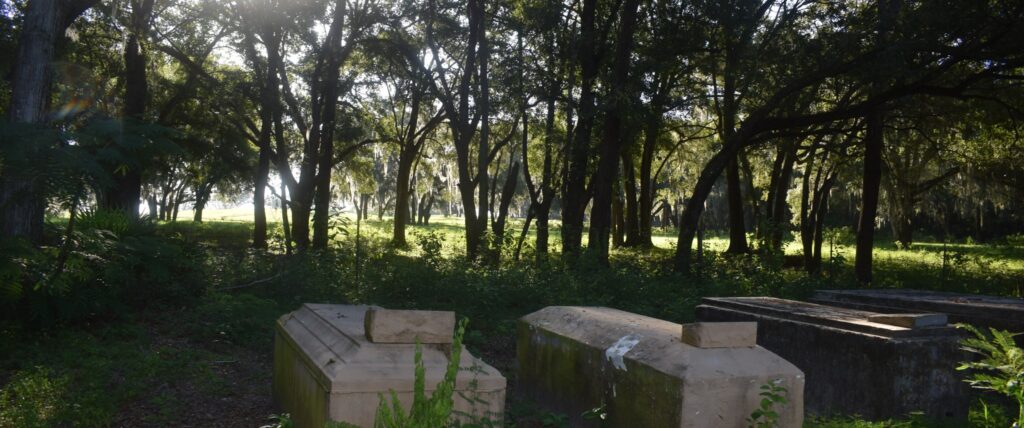
Romeo Cemetery
One of the strongest connections to the old community is its cemetery.
Walking through an old cemetery changes the way I understand a ghost town.
Maps give you place names.
Directories give you population numbers.
Post office records give you dates.
Cemeteries give you people.
Every marker represents someone who knew Romeo not as a ghost town, but simply as home.
They knew its roads before pavement.
They watched trains pass through.
They collected mail from the Romeo post office.
They attended church, worked farms, raised children, buried family members, and lived ordinary lives in a place that history would eventually label “forgotten.”
Standing among those graves made Romeo feel less like a vanished settlement and more like a community whose story had simply outlived its buildings.
The Old Church
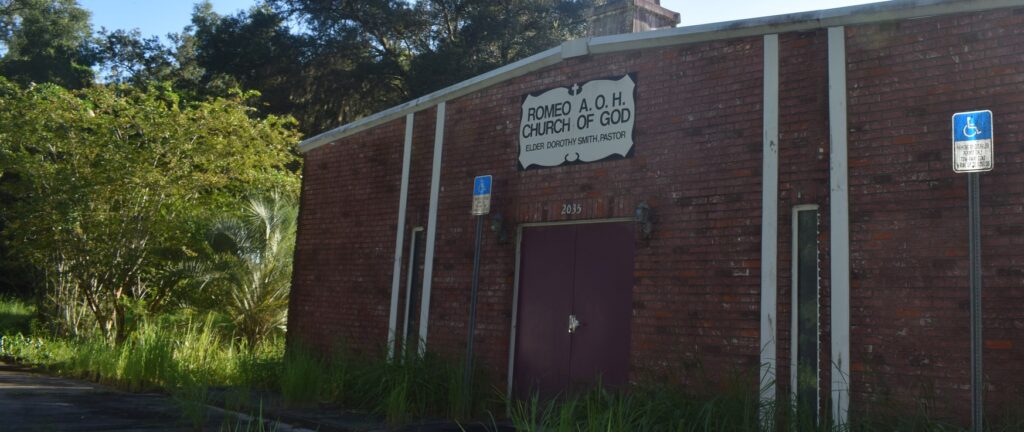
Nearby, I found one of the places that stuck with me most: the old church.
Trees and vegetation surrounded the building, and when I looked through a window, I could still see curtains hanging inside.
That got me.

There is something unsettling about an abandoned-looking building when the little domestic details remain.
A collapsed wall tells you something is gone.
A curtain still hanging in a window makes it feel like someone might come back.
I walked around the property filming what I could while trying to piece together where this building fit within the larger Romeo story.
And, as always, I stayed where I could legally explore.
Ghost towns are fascinating.
Trespassing charges are considerably less charming.
The Charcoal Furnaces Along U.S. 41
Then there are the structures that look as though they should belong to Romeo’s earliest days—but apparently don’t.
Near U.S. 41 and the railroad are the remains associated with an old charcoal operation.
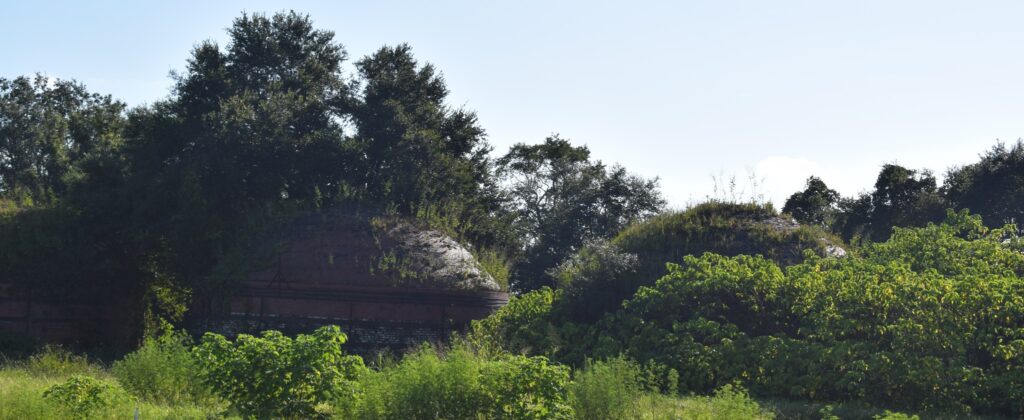
The surviving furnace-like structures are some of the most visually striking remnants in the area. Sources describing the site connect the charcoal plant itself to the 1960s, meaning it actually came after Romeo’s traditional boom years.
That makes them an interesting reminder of something we tend to forget when talking about ghost towns:
History doesn’t stop when a town declines.
People continue using the land.
New businesses arrive.
Old structures are repurposed.
Later generations leave their own ruins beside earlier ones.
So while the furnaces help create the atmosphere of Romeo today, I wouldn’t use them as evidence of the nineteenth-century settlement.
They’re another layer of the landscape.
And Romeo has a lot of layers.
The Things I Didn’t Expect to Find
I also encountered old vehicles tucked among the trees.
Rusted metal.
Vegetation growing around them.
The sort of things that immediately make my camera come out because apparently I am physically incapable of passing an abandoned object without documenting it.

But I’ve learned something since my earliest ghost-town explorations:
Old doesn’t automatically mean original.
Those vehicles may tell us something about later life in the Romeo area, but without documentation connecting them to the historic community, that’s exactly where their story should stay.
They’re interesting.
They’re atmospheric.
They’re part of what I experienced.
But they aren’t evidence just because they look good on camera.
And that difference matters.
Is Romeo Really a Ghost Town?
Technically, Romeo hasn’t disappeared completely.
The name still identifies an unincorporated community in Marion County.
People still live in the surrounding area.
Modern homes and roads exist where generations of Floridians have continued living long after Romeo’s post office disappeared.

So if your definition of a ghost town requires a completely abandoned settlement, Romeo may not qualify.
But if a ghost town can be a community that lost the institutions, businesses, and identity that once made it a town?
Romeo absolutely belongs in the conversation.
That’s one of the things exploring Florida has taught me.
Our ghost towns aren’t always rows of abandoned buildings slowly collapsing into the earth.
Sometimes they’re hiding underneath places that never stopped living.
Visiting Romeo Today
If you go looking for Romeo, remember that this isn’t an abandoned tourist attraction.
It is a living rural area containing historic sites, private property, roads, homes, and remnants from different periods.
Explore from public roads and places where access is permitted. Don’t enter abandoned structures or cross fences simply because something looks old. Florida vegetation can also conceal holes, debris, snakes, insects, and all manner of things eager to turn your historical adventure into paperwork.

Bring water.
Wear sturdy shoes.
And most importantly, bring patience.
Romeo isn’t the kind of ghost town that reveals itself all at once.
You have to reconstruct it.
A cemetery here.
A church there.
A railroad corridor.
An old photograph of a prison.
A postmaster’s name in a century-old directory.
Thirty residents recorded in 1925.
And somewhere a few miles down the road, another vanished community named Juliette.
Piece by piece, the town starts appearing again.
Why Romeo Matters
Romeo will never compete with Florida’s grand historic districts.
There aren’t blocks of restored nineteenth-century buildings.
There isn’t a museum interpreting every chapter.
There may never be enough surviving evidence to answer every question about the community.
But that’s precisely why places like Romeo matter to me.
Most history wasn’t made in mansions or battlefields.
It happened in tiny places.
Places with thirty residents.

Places where somebody sorted the mail, somebody opened the church doors on Sunday morning, somebody waited beside the railroad, somebody planted a field, and somebody knew every person buried beneath those old stones.
Eventually, the post office closed.
The businesses disappeared.
Romeo faded.
But it never vanished completely.
Its name survived.
Its cemetery survived.
Pieces of its landscape survived.
And more than a century later, somebody with a camera came looking for it.
Maybe that’s the real story of Romeo and Juliette.
Not that two towns were destined to disappear.
But that some places manage to linger long after the world stops calling them towns.
Romeo wasn’t built to last forever.
Neither is any town.
But as long as someone keeps asking what happened here, a place isn’t entirely forgotten.
Some places disappear from the map. Their stories shouldn’t.
Join the Travel Made Personal mailing list for more forgotten towns, hidden history, strange roadside discoveries, and the places most travelers never know are there.
Come wander off the map with me.
If you see this after your page is loaded completely, leafletJS files are missing.
It is not often that one comes across an article depicting a part of history, particularly about a town that is no longer in existence! Your story makes fascinating reading and the description you give about your visit to this ghost town is vivid to the imagination. I, and I am sure many people are not aware of the existence of such a place called Romeo but thanks to your findings, you have brought the ghost town to “life”. Your article also gives a glimpse of what it is like to have an exploring and inquiring sense of adventure. Thank you for sharing this fascinating experience.
Hi, Tandi! Thanks for the feedback, I truly appreciate it. I do enjoy exploring various parts of our history all over the country and I’m happy to share those experiences for those that can’t or won’t explore them. If you loved Romeo, be sure to check out Juliette!
This was a fascinating read about Romeo, Florida! I had no idea there was such a rich history behind this ghost town. It’s intriguing to think about how places like Romeo once thrived and are now nearly forgotten.
I’m curious—are there any remaining structures or landmarks in Romeo that visitors can still see, or is it mostly overgrown now? Also, do you think there’s a chance for ghost town tourism to grow in this area, similar to other ghost towns in the U.S.?
I’ve visited a few ghost towns out West, and it’s always such a unique experience. This article has definitely piqued my interest in exploring more of these hidden historical gems in Florida. Thanks for sharing!
Hey there, thanks for the feedback! Romeo does have an abandoned church still standing, along with a nearby cemetery. I also found some abandoned vehicles but I wasn’t able to verify if they were abandoned before or after Romeo was. Romeo is pretty overgrown at this point, but not so much that you’re not able to explore it. I do think there is some opportunity for ghost tourism in this area, there are a lot of abandoned ghost towns and cemeteries in the Withlacoochee Forest area that I am planning to explore. I hope you do get out and explore some old Florida history, would love for you to share your explorations with us!
Wow, your exploration into the ghost town of Romeo, Florida was absolutely captivating! The mix of historical insights and eerie descriptions really painted a vivid picture. I’m curious, did you feel any particular vibe or presence while wandering through those abandoned places? Also, were there any local legends or spooky stories you heard about Romeo that you didn’t include in the article? It would be fascinating to hear more about the lore surrounding this ghostly locale. Thanks for sharing such valuable content!
Gabriel John
Hi Gabriel, thanks for the feedback! I was a little nervous in Romeo because there were a few residents that lived nearby who were watching me part of the time. But aside from that, I didn’t feel any eerie vibes while I was exploring Romeo. I haven’t found any spooky stories about Romeo either, which is surprising since the Marion County prison was located there at one point. However, there is a local legend about Romeo & Juliette being based on two star crossed lovers who’s tale ended tragically on account of their parents being enemies. You can check that out at Juliette Ghost Town.