

Tybee Island, Georgia | TMP Haunts
Some ghost stories begin with a murder. Others begin with a tragedy. But the stories surrounding the Tybee Island Lighthouse unfold against a much larger backdrop: nearly three centuries of storms, war, destruction, and survival.

Standing near the mouth of the Savannah River, the distinctive black-and-white tower has guided ships through Georgia’s coastal waters for generations. Its history stretches back to the earliest days of the Georgia colony, and portions of the lighthouse standing today survived the American Civil War.
But according to local folklore, the lighthouse may be home to more than history.
Visitors have reported unexplained footsteps, mysterious figures resembling former lighthouse keepers, and even the apparition of a little girl who supposedly warns people climbing the staircase not to go any farther.
Naturally, we had to investigate.
Although, as it turned out, Dusty and I didn’t need any supernatural assistance deciding when to stop climbing.
Our knees handled that assignment perfectly well.
Third Time’s the Charm
The Tybee Island Lighthouse had been on my list for quite some time, but actually getting inside had become something of an ongoing challenge.
Our first attempt was during a trip with Dusty. We arrived approximately five minutes before closing, which meant we weren’t getting in.

On my second attempt, I was traveling with my son. Unfortunately, the lighthouse was undergoing renovations, and portions of the property were closed.
Since admission was $15 per person, we decided we’d rather return when we could explore the entire site.
And that’s exactly what we did.
This time, Dusty and I arrived around 2 p.m., giving us plenty of time before closing. Everything was open, the weather was cooperating, and after two previous failed attempts, we were finally going to explore the Tybee Island Lighthouse and Museum.
We purchased our tickets and headed straight for the lighthouse.
There was just one small obstacle.
One hundred and seventy-eight steps.
Before There Was a Lighthouse
The story of the Tybee Island Lighthouse begins in the earliest years of Georgia’s colonial history.
In 1733, James Oglethorpe established the colony of Georgia, with Savannah becoming an important settlement along the Savannah River.
But navigating the coastal waters wasn’t always easy.
Shifting sandbars, dangerous currents, and the unpredictable Atlantic coastline made a reliable navigational landmark essential for vessels approaching the river.

Oglethorpe recognized the problem and ordered the construction of a navigational marker on Tybee Island.
Completed in 1736, the original structure was approximately 90 feet tall. Technically, it wasn’t a lighthouse at all.
It was a daymark, a tall structure designed to help sailors identify their position during daylight hours.
There was no lantern at the top.
No beam sweeping across the water.
Just a towering landmark standing against the coastal horizon.
Unfortunately, the Georgia coastline had other plans.
A storm destroyed the first structure in 1741, and a second tower, completed the following year, eventually fell victim to coastal erosion.
In 1773, another tower was constructed farther inland.
This one would prove considerably more resilient.
And portions of it would survive one of the most destructive periods in American history.
When the Light Went Dark
When the American Civil War began in 1861, Tybee Island became strategically important because of its location near the entrance to the Savannah River.
Just upriver stood Fort Pulaski, whose massive brick walls were supposed to protect Savannah from an approaching enemy. But the Civil War would change both the fort and the lighthouse forever. During our visit to Fort Pulaski National Monument, we explored the defenses that Union forces ultimately breached using powerful rifled artillery, forever changing the future of coastal fortifications.
Nearby Fort Pulaski guarded the approach to Savannah, and Confederate forces initially occupied Tybee Island as part of the region’s coastal defenses.

But as Union forces advanced, Confederate troops withdrew from the island.
Before leaving, however, they faced a problem.
The lighthouse.
A functioning lighthouse could help Union vessels navigate the waters approaching Savannah, making it a potentially valuable asset to the enemy.
So Confederate troops made a remarkable decision.
They burned their own lighthouse.
The wooden staircase and upper portion of the tower were destroyed, and the valuable Fresnel lens was removed.
The beacon that had guided vessels safely through these waters was deliberately extinguished.
But the tower wasn’t completely destroyed.
Approximately 60 feet of the original masonry structure survived.
Those surviving walls would eventually become the foundation of the lighthouse standing today.
And I find that extraordinary.
When visitors step inside the Tybee Island Lighthouse, they’re not simply exploring a reproduction of something that once stood here.
They’re entering a structure that incorporates masonry that survived the Civil War.
Rebuilding a Beacon After the War
Following the Civil War, efforts began to restore the lighthouse.
Rather than demolish the surviving portion, engineers incorporated the remaining 60 feet into the reconstructed tower.
The new lighthouse would rise to approximately 145 feet, with improvements designed to make the structure more resistant to fire.
But the rebuilding process brought another tragedy.
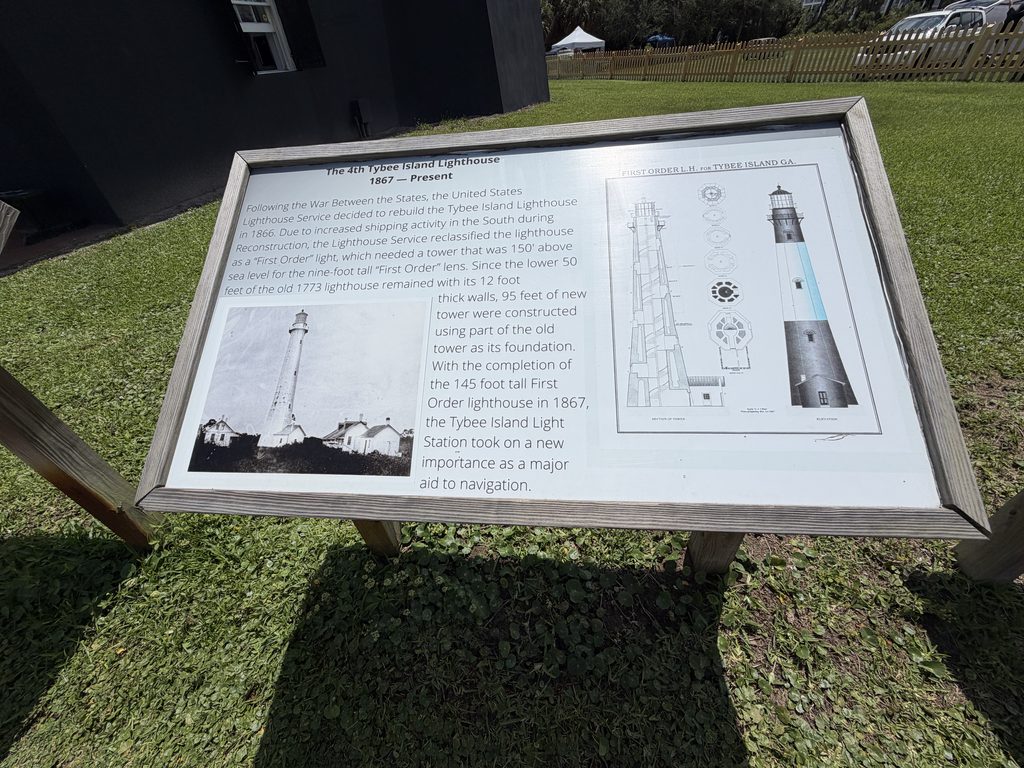
In 1866, a cholera outbreak struck members of the reconstruction workforce.
The foreman and four mechanics died, temporarily interrupting the project.
Eventually, construction resumed.
On October 1, 1867, the lighthouse returned to service, equipped with a powerful First Order Fresnel lens.
The light that had been extinguished during the Civil War once again illuminated the Georgia coastline.
Today, the Tybee Island Light Station remains one of the most remarkably preserved historic light stations in the United States.
But its history isn’t the only thing drawing curious visitors to the property.
There are also the ghost stories.
The Little Girl on the Stairs
One of the more unsettling legends associated with the Tybee Island Lighthouse concerns a mysterious little girl.
According to versions of the story, visitors climbing the lighthouse staircase have reportedly encountered the apparition of a young girl.
Sometimes she’s described as appearing on the stairs.
Other accounts describe her running downward toward visitors, seemingly warning them not to continue climbing.

It’s an eerie image.
A child appearing inside a historic lighthouse, desperately trying to stop someone from reaching the top.
But who was she?
That’s where the story becomes less certain.
I couldn’t establish a documented historical identity for the girl or verify a specific death at the lighthouse that would explain the legend.
Some retellings attempt to connect the apparition to tragedies in the lighthouse’s past, but those connections remain speculative.
And that’s an important distinction.
The lighthouse’s destruction during the Civil War is documented history.
The deaths during reconstruction are documented history.
The little girl on the staircase is folklore.
That doesn’t make the story any less interesting. It simply means we shouldn’t present speculation as historical fact.
Of course, there’s something rather amusing about this particular legend when I consider our own visit.
Because Dusty and I also climbed those stairs.
And we also decided we shouldn’t go any farther.
Our Very Short Climb to the Top
I’ve always wanted to climb to the top of a lighthouse.
There’s something about the idea of standing high above the coastline, looking out over the water from a place that generations of lighthouse keepers once called their workplace.
So when we finally entered the Tybee Island Lighthouse, I was excited.
We started climbing.
And climbing.
And then…
We reached the second landing.

That was enough.
Our knees had officially filed formal complaints.
Now, I could probably have forced myself to continue. But the problem wasn’t simply getting to the top.
It was getting back down.
And we still had quite a bit of traveling and exploring ahead of us.
I knew there was a strong possibility that climbing all 178 steps would significantly affect my ability to enjoy the rest of our trip.
So we turned around.
Was I disappointed?
Absolutely.
Do I regret the decision?
Not at all.
In fact, by the time we reached the bottom, one of my knees was already feeling shaky and unstable.
It was an extremely unpleasant sensation, especially when navigating additional steps.
I had to be extra careful because it felt like my knee might give out.
So apparently, we made the right decision.
And if the little girl really does warn visitors not to keep climbing, she didn’t need to bother with us.
Our knees delivered the message loud and clear.
Not today, Satan.
The Lighthouse Keepers Who Never Left
The mysterious little girl isn’t the only apparition associated with the Tybee Island Lighthouse.
Other ghost stories describe figures resembling former lighthouse keepers, unexplained footsteps, whistling, and unusual activity inside the historic houses.
Some accounts describe the sounds of someone walking when no one is visible.
Others involve doors that seem to move or the impression that an unseen person is nearby.
Given the nature of lighthouse keeping, it’s easy to understand how these stories developed.
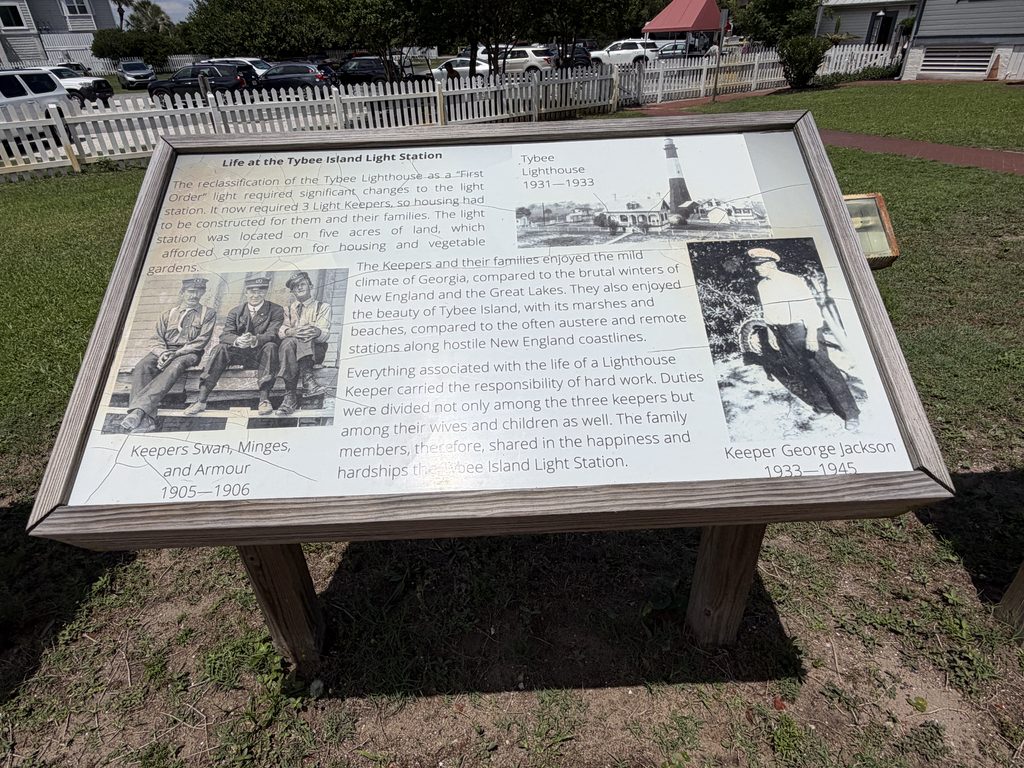
For generations, keepers and their families lived on the property, maintaining the light and ensuring ships could safely navigate the surrounding waters.
Their responsibilities required constant attention.
The work could be demanding, repetitive, and isolating.
And the lighthouse wasn’t simply a workplace.
It was home.
But while stories of lingering keepers make for compelling folklore, I couldn’t establish a documented connection between the reported apparitions and any particular deceased keeper.
We know people lived and worked here.
We know the lighthouse witnessed extraordinary events.
What we don’t know is whether any of those people remain here in spirit.
And that uncertainty is part of what makes the stories fascinating.
Exploring the Historic Keeper’s Houses
After our abbreviated lighthouse climb, we continued exploring the property.
The historic keeper’s houses offered an opportunity to see another side of lighthouse life.
These weren’t simply buildings associated with maintaining a navigational light.
They were places where families lived, worked, and experienced everyday life along the Georgia coast.

Unfortunately, our visit had one significant complication.
People.
So. Many. People.
Now, I realize this is a popular historic attraction, and obviously everyone else has just as much right to explore it as we do.
But I much prefer visiting historic places when they’re quiet enough to take my time, read the exhibits, appreciate the details, and imagine what life might have been like there.
That wasn’t particularly easy on this visit.
Instead, we found ourselves hanging back, waiting for groups to move through the rooms so we could explore without feeling crowded.
At one point, an older staff member in one of the houses made me feel a little uncomfortable.
I couldn’t point to anything specific that happened. There was just something about the way he looked at us and spoke to us that I didn’t particularly like.
But I also recognize that by this point, I was physically tired, overstimulated, and dealing with an unhappy knee.
My tolerance for additional human interaction was running dangerously low.
So I’m not assigning anything paranormal to that experience.
Sometimes a strange feeling is just a strange feeling.
And sometimes you’re simply done with people.
I was rapidly approaching the latter.
Thankfully, it didn’t ruin our visit.
We continued exploring and appreciating the historic buildings.
And then we made our way into the gift shop.
Where something extraordinary happened.
A Historic Moment in the Gift Shop
I bought zero books.
ZERO.
I realize this may come as a shock to anyone familiar with my tendency to leave historic sites carrying approximately half their gift shop inventory.
But it’s true.
Not one book.
Of course, that doesn’t mean I escaped without spending money.
We bought pins.
We bought magnets.
And then…
We discovered something that may have permanently changed the future of Travel Made Personal.
LIGHTHOUSE PASSPORTS!
Apparently, there’s a whole lighthouse passport program where visitors can collect stamps from participating lighthouses.
A little book.
Full of lighthouse stamps.
From places you’ve actually visited.
Do you understand what this means?
I have an entirely new collection to pursue!
Suddenly, every future trip needed to be reevaluated.
Are there lighthouses nearby?
Can we visit them?
Can we get our passports stamped?
This is going to become a problem.
A wonderful, expensive, historically educational problem.
And I’m completely fine with that.
While the woman in the gift shop was stamping our new passports, she also told us about a particularly intimidating bridge we’d have to cross traveling from Georgia into South Carolina.
Now, Dusty and I had already crossed what felt like approximately 47,000 bridges during our travels through Georgia.
And we weren’t particularly enthusiastic about adding another enormous one to the itinerary.
I couldn’t immediately remember which bridge she meant.
But based on her description, I was fairly certain I didn’t want to meet it.
Apparently, the next potential haunting on our itinerary involved transportation infrastructure.
Wonderful.
Battery Garland and Fort Screven
Our visit wasn’t finished when we left the lighthouse grounds.
Across the road stood another historic attraction included with our admission: the Tybee Island Museum, housed inside Battery Garland at Fort Screven.
Although the lighthouse’s military history reaches back to the Civil War, Fort Screven belongs to a later chapter of American coastal defense.
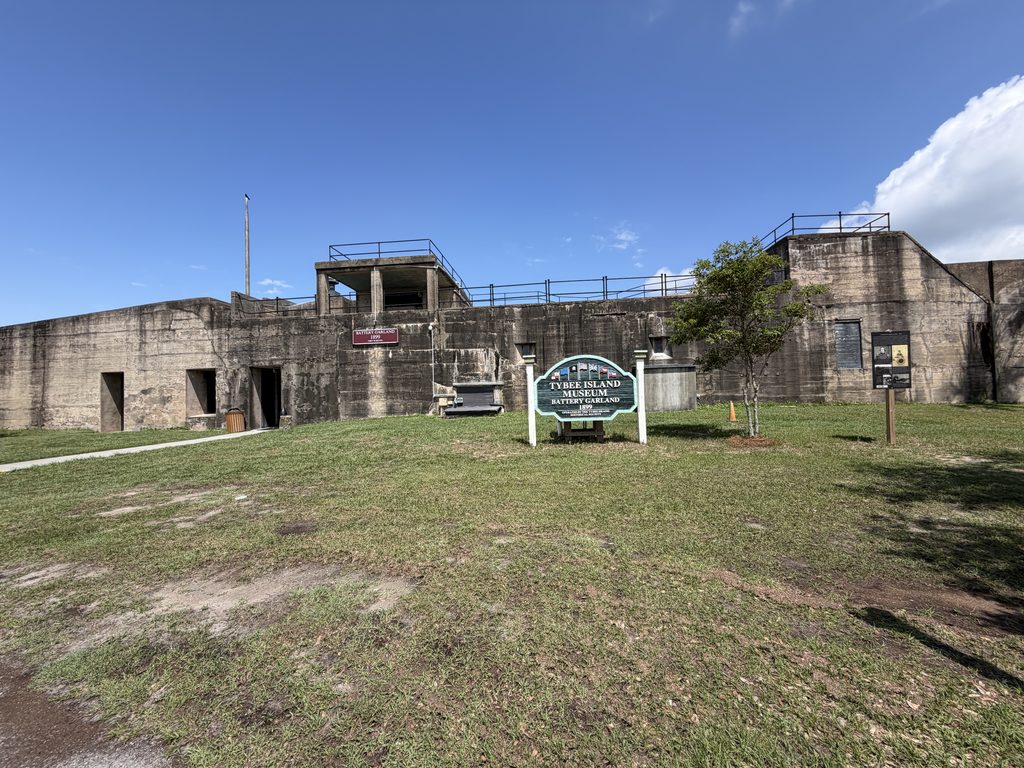
The fort was established during the late nineteenth century as part of efforts to modernize the nation’s coastal fortifications.
Battery Garland was one of the gun batteries constructed to defend the approaches to Savannah.
Unlike the older masonry forts that had proven vulnerable to increasingly powerful artillery, these newer coastal defenses incorporated concrete construction and modern military engineering.
Fort Screven eventually included several batteries and served through the era of both World Wars.
Today, Battery Garland has been repurposed as a museum, preserving the history of Tybee Island and its military significance.
Naturally, we wanted to explore it.
Unfortunately…
There were more people.
And more stairs.
SO MANY STAIRS.
By this point, our knees had progressed from filing formal complaints to actively threatening mutiny.
We explored the museum, but moved through it more quickly than I normally would.
Not because it wasn’t interesting.
We were simply exhausted.
We’d already done quite a bit of walking that day, and our bodies were making it abundantly clear that they were ready for a break.
But we made it through.
Mostly intact.
And with our newly acquired lighthouse passports safely in our possession.
So I considered the visit a success.
Is Tybee Island Lighthouse Really Haunted?
The Tybee Island Lighthouse certainly has the kind of history that inspires ghost stories.
Nearly three centuries of coastal life.
Structures destroyed by storms and erosion.
A lighthouse deliberately burned during the Civil War.

A reconstruction project interrupted by deadly disease.
Generations of keepers and their families living beside the Atlantic.
It’s an extraordinary collection of historical events associated with one relatively small stretch of Georgia coastline.
But does that mean the lighthouse is haunted?
Not necessarily.
The reported apparitions, phantom footsteps, and mysterious sounds remain stories rather than verified evidence of paranormal activity.
And despite the title The Ghosts Born From War, there’s no documented reason to conclude that the reported spirits originated during the Civil War.
The little girl’s identity remains uncertain.
The supposed keeper apparitions haven’t been reliably connected to particular historical individuals.
And the documented cholera deaths don’t establish a connection to either legend.
We encountered a similar blending of documented history and paranormal folklore at the Old Franklin County Jail in Chambersburg, Pennsylvania. Known in local legend as the Cross Key Hotel, the jail witnessed the Civil War era and accumulated its own collection of ghost stories. Like Tybee Island Lighthouse, its history is fascinating enough without needing to prove that anything supernatural remains.
But perhaps the relationship between history and haunting isn’t quite that straightforward.
Maybe places with extraordinary histories naturally inspire extraordinary stories.
Maybe generations of people passing through the same buildings leave behind memories that gradually become folklore.
Or maybe there really are things we don’t yet understand.
I can’t tell you which explanation is correct.
What I can tell you is that Tybee Island Lighthouse doesn’t need a ghost story to be fascinating.
Its documented history is remarkable all on its own.
Planning Your Visit to Tybee Island Lighthouse
If you’re planning a trip to Tybee Island, the lighthouse is absolutely worth including on your itinerary.
The historic light station offers an opportunity to explore the lighthouse, keeper’s houses, and associated buildings, while admission also includes the nearby Tybee Island Museum at Battery Garland.

A few things worth knowing before you go:
- Location: 30 Meddin Drive, Tybee Island, Georgia.
- Lighthouse climb: The tower has 178 steps. Be prepared for a physically demanding climb, especially if you have knee or mobility limitations.
- Historic buildings: Allow time to explore the keeper’s houses and other exhibits throughout the property.
- Battery Garland: Don’t overlook the museum across the road. It’s an entirely different chapter of Tybee Island’s history.
- Crowds: This is a popular destination. If you prefer quieter historic sites, consider visiting during less busy periods.
- Lighthouse passports: If you collect lighthouse stamps, bring your passport! And if you don’t have one yet, you may discover a new hobby.
Admission prices, operating hours, and access restrictions can change, so check the official Tybee Island Light Station website before visiting.
And one final piece of advice:
You don’t have to climb all 178 steps to appreciate the lighthouse.
Sometimes knowing when to turn around is the smartest decision you can make.
Even if your knees have to explain it to you.
What Stayed With Me
When I think back on our visit to Tybee Island Lighthouse, I don’t think about anything paranormal.
We didn’t see the little girl.
We didn’t encounter a ghostly keeper.
We didn’t hear unexplained footsteps or experience anything I would consider supernatural.
What stayed with me was the lighthouse itself.

The fact that part of the tower survived the Civil War.
That people deliberately extinguished its light to keep it from helping an approaching enemy.
That workers returned after the war to rebuild it, only to face another tragedy.
And that despite everything, the lighthouse eventually returned to doing exactly what it had been built to do.
Guiding people safely through dangerous waters.
There’s something deeply meaningful about that.
It reminded me of another place we explored along the South Carolina coast: the Old Sheldon Church Ruins. Although the circumstances were different, both sites bear the marks of America’s turbulent past. One was rebuilt and returned to service, while the other remains a hauntingly beautiful ruin, preserving its history in the walls that survived.
The same structure that once became a casualty of war ultimately returned to being a symbol of safety.
And generations later, people still come here to admire it, climb its stairs, and learn its history.
Even if some of us don’t make it particularly far up those stairs.
Final Thoughts
Our third attempt to visit Tybee Island Lighthouse was finally successful.
We explored the historic light station, wandered through the keeper’s houses, visited Battery Garland, and learned more about the history of this remarkable piece of Georgia’s coastline.
We also discovered lighthouse passports, which means I’ve apparently volunteered us for an entirely new category of future adventures.
And although I didn’t make it to the top of the lighthouse, I don’t regret turning around.
There will be other lighthouses.
Other staircases.
Other opportunities to stand high above the coastline and look out across the water.

One day, I’ll make it.
But what matters most to me about Tybee isn’t the view from the top.
It’s the history preserved in the walls below.
Because this lighthouse has endured storms, fire, war, and the passage of centuries.
And through it all, people kept finding reasons to rebuild it.
Maybe the ghost stories are nothing more than folklore.
Maybe something really does linger on those stairs.
But either way, the Tybee Island Lighthouse reminds us that history doesn’t always disappear when the people who lived it are gone.
Sometimes it survives in brick and mortar.
Sometimes it survives in stories.
And sometimes…
the past just keeps climbing the stairs.
Have you visited Tybee Island Lighthouse? Did you make it to the top, or did your knees have other plans? And what do you think about the stories of the little girl and the lighthouse keepers? Share your experience in the comments!
For more haunted history, forgotten places, and the occasional travel misadventure, explore the TMP Haunts series from Travel Made Personal.
👻 Love haunted history and forgotten places?
Join the Travel Made Personal mailing list for more fascinating history, ghostly folklore, hidden gems, and real adventures from the road. From haunted lighthouses to forgotten battlefields, there’s always another story waiting to be discovered.
📬 Subscribe and let the next adventure find you!

If you see this after your page is loaded completely, leafletJS files are missing.