

From Civil War prisoners and underground dungeons to ghost stories and an unforgettable skeleton key, explore the history of Chambersburg’s Old Franklin County Jail.
Some historic places capture your imagination before you’ve even made it through the front door.
For me, the Old Franklin County Jail in Chambersburg, Pennsylvania, was one of those places.
Not because I saw a ghost.
Not because something mysterious happened.
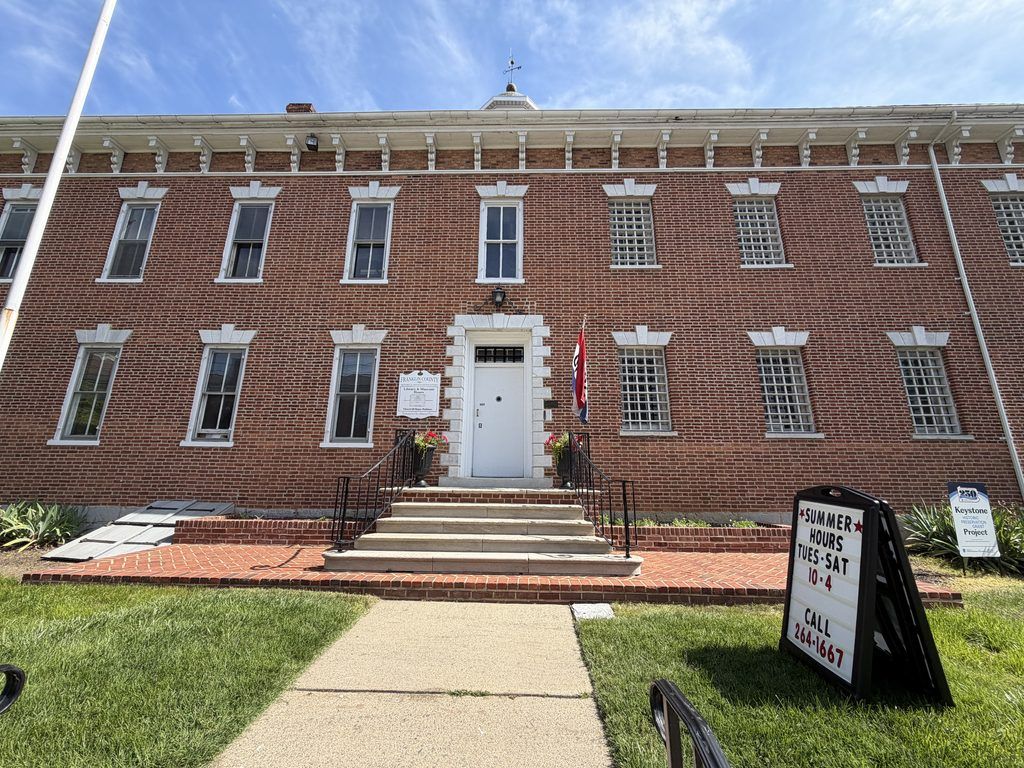
But because the front door was absolutely magnificent.
A huge, thick, heavy metal door, complete with an enormous skeleton key and a circular peephole that looked exactly like something you’d expect to find in a nineteenth-century jail.
I loved that door.
And as it turned out, that was only the beginning.
Behind it waited more than 150 years of history, Civil War connections, tiny jail cell entrances, prisoner graffiti, underground dungeons, gallows, and a collection of ghost stories that have earned the old prison a reputation for being haunted.
Oh, and a volunteer tour guide who tried to convince me that the Wi-Fi router was a ghost detector.
Welcome to the Old Franklin County Jail, affectionately nicknamed the Cross Key Hotel.
Arriving at the Old Franklin County Jail
Dusty and I arrived about half an hour before the jail opened.
Rather than wander off looking for something else to do, we settled into the truck and talked until opening time.
We’re pretty good at killing time together.
When the doors finally opened, we headed inside, and I immediately found something that made my little history-loving heart ridiculously happy.
The entrance.
This wasn’t some ordinary modern doorway leading into a historic building.
It was an enormous metal jail door.

The kind of door that makes you stop and imagine how many people had stood on either side of it over the years.
Attached to it was a huge skeleton key, which our guide identified as the original key used to unlock the door.
Naturally, I wanted it.
I mean, who wouldn’t want a giant nineteenth-century jail key?
There was also a large circular peephole, probably two or three inches across, with a little metal plate that could swing open so whoever was inside could see who was waiting outside.
Such a simple feature.
But I absolutely loved it.
Sometimes the smallest historical details are the ones that bring a place to life.
And this door set the scene beautifully.
A Jail Built in 1818
The Old Franklin County Jail was constructed in 1818, making it one of the oldest surviving buildings in Chambersburg.
It served as Franklin County’s jail until 1970, spanning an extraordinary 152 years of local and national history.
The original structure included living quarters for the sheriff and his family alongside the jail facilities.
Imagine raising a family in a building that also housed people accused or convicted of crimes.
Talk about an unusual work-life balance.
As the county grew, so did the need for additional space. An annex was constructed in 1880, expanding the jail’s capacity and creating the complicated arrangement of corridors, staircases, and cell blocks visitors can explore today.
The complex was surrounded by a limestone wall approximately 20 feet high.
Those walls were designed to keep prisoners inside.
But they would also become witnesses to one of the most destructive events in Chambersburg’s history.
The Jail’s Connection to John Brown and the Civil War
The Old Franklin County Jail wasn’t simply a local prison.
Its history intersects with some of the most turbulent years in American history.
John Brown’s Raid on Harpers Ferry
In October 1859, abolitionist John Brown led an unsuccessful raid on the federal arsenal at Harpers Ferry, hoping to ignite a broader uprising against slavery.
Among the men who participated was Captain John E. Cook.
After the raid failed, Cook escaped but was eventually captured in Pennsylvania.
He was held at the Franklin County Jail before being returned to Virginia, where he was tried and executed for his participation in the raid.
His imprisonment connects this relatively small Pennsylvania jail to one of the events that intensified national tensions before the Civil War.
The Burning of Chambersburg
Five years later, Chambersburg experienced devastation on a massive scale.
On July 30, 1864, Confederate forces under Brigadier General John McCausland entered the town and demanded a ransom.
When the demanded payment was not provided, Confederate soldiers set much of Chambersburg ablaze.
Hundreds of buildings were destroyed.

Homes, businesses, and livelihoods disappeared in the flames.
But the Old Franklin County Jail survived.
While much of the surrounding town had to be rebuilt, the jail remained standing.
Today, walking through its corridors means walking through a building that witnessed the Civil War firsthand.
Not a reconstruction.
Not a replica.
The real thing.
And I find that absolutely fascinating.
Getting Lost in Mr. Dan’s Maze
Our tour guide was a wonderful volunteer named Mr. Dan.
And let me tell you, Mr. Dan was fantastic.
The museum was still getting everything opened for the day when he introduced himself and began showing us around.
He had a great sense of humor, a wealth of historical knowledge, and a knack for making the darker parts of the jail’s history entertaining without diminishing their significance.

The building itself was an absolute maze.
We crossed hallways, went through one doorway and emerged somewhere completely different, climbed stairs, descended other staircases, and turned so many corners that I quickly lost track of where we were.
At some point, I had absolutely no idea how to get back to the front entrance.
Which, when you think about it, probably isn’t the worst design feature for a jail.
Dusty and I have always been fascinated by old prisons, jails, and asylums, so we were thoroughly enjoying ourselves.
And then we discovered something neither of us had encountered before.
Why Were the Jail Cell Doors Only Four Feet Tall?
Some of the original jail cell entrances were only about four feet tall.
Four feet!
Mr. Dan explained that the unusually short openings were intended to make it harder for prisoners to rush or attack guards when entering or leaving their cells.
Anyone passing through had to bend down and maneuver through the doorway.
And naturally, Dusty and I had to try it.
We both squeezed our way into the cells.

There’s something fascinating about physically interacting with historic architecture.
You can read about nineteenth-century jail conditions all day long.
We’ve explored other historic jails, including the Old St. Johns County Jail in St. Augustine, Florida, but those four-foot-tall cell entrances were unlike anything we’d encountered before.
But when you have to duck your head and squeeze through a tiny doorway just to enter a cell, you gain a different appreciation for the building’s design.
For a moment, it was easy to imagine what those cramped spaces must have felt like to the people confined there.
It was one of my favorite details of the entire tour.
Although I have to admit, I was pretty happy to be able to walk right back out.
The Writing on the Walls: Prisoner Graffiti and an Unexpected Poem
Inside one of the cells, Mr. Dan showed us something that immediately made Dusty and me grin at each other.
Writing on the walls.
In areas where the paint had peeled away, pencil inscriptions left by former prisoners were still visible.
Some appeared to be tally marks, possibly counting the days spent in confinement.

Others were words and messages.
And one was a poem.
Now, the reason Dusty and I exchanged grins was that we had visited the Historic Haile Homestead in Florida, where the family famously wrote on the walls of their home.
Apparently, we have a habit of finding historic buildings where people treated the walls like notebooks.
But this particular poem was something else.
Mr. Dan recited it for us, and I couldn’t stop smiling.
The Drunken Man and the Pig
The poem, signed Don Haugh on the jail wall, told the story of a drunken man who stumbled into a gutter.
While he was lying there, a pig wandered over and settled down beside him.
A passing woman observed that you could always judge a man by the company he kept.
And the pig?
Well, apparently even the pig had standards.
It got up and walked away.

I laughed.
Because of all the things I expected to discover inside a historic jail cell, a poem about a judgmental pig was not on the list.
But the humor also made me think about the people who had been imprisoned here.
They weren’t simply names in court records.
They were human beings.
Some were frightened.
Some were angry.
Some were counting the days until they could leave.
And apparently, at least one had a pretty good sense of humor.
Those little pencil markings are more than graffiti.
They’re pieces of individual lives that somehow survived.
The Gallows Behind the Jail
Outside the building, within the old limestone walls, stood another reminder of the jail’s darker history.
The gallows.
Executions were once carried out on the jail grounds, and several condemned prisoners were hanged here during its years of operation.

The gallows visible today are a reconstruction, but they commemorate a place where executions actually occurred.
One of the last men executed at the jail was William Reed, who was hanged in April 1912 after being convicted of murder.
Standing in that courtyard, it’s difficult not to imagine the atmosphere surrounding an execution.
The condemned prisoner.
The sheriff.
The witnesses.
And the knowledge that someone was about to die.
The reconstructed gallows are an unsettling reminder that the history of criminal punishment wasn’t always confined to courtroom proceedings and prison sentences.
Sometimes it ended right there in the jail yard.
And while the structure itself may have been rebuilt, the history of what happened on those grounds remains very real.
Descending Into the Dungeon
Now we come to what was probably our favorite part of the entire tour.
The dungeon.
Beneath the Old Franklin County Jail are five domed dungeon cells, where prisoners considered particularly difficult could be confined.
Iron rings embedded in the walls and floors were used to shackle prisoners.
Some of those rings remain visible today.

The dungeon was everything I hoped an old underground jail would be.
Cracking walls.
Crumbling bricks.
Uneven floors.
Aged surfaces that seemed to hold onto every one of the building’s two centuries.
It wasn’t polished or prettied up.
And that’s exactly why I loved it.
Exploring places associated with confinement always makes me think about the people who lived through their history. From the prison cells of Chambersburg to the sprawling grounds of Central State Hospital in Georgia, these places hold stories that are far more complicated than their reputations suggest.
There is something about standing in an authentic historic space that no modern recreation can duplicate.
You can see the passage of time.
You can feel the confinement of the architecture.
And you can imagine how very different the experience would have been for someone who didn’t have the freedom to leave.
But according to local ghost stories, some of those prisoners might still be there.
Is the Old Franklin County Jail Haunted?
Today, the Old Franklin County Jail is known not only for its history but also for its paranormal reputation.
The Franklin County Historical Society, which operates the museum, allows paranormal groups to investigate the building and has shared accounts and purported evidence collected during previous investigations.
Reported experiences include unexplained noises, disembodied voices, shadowy figures, and unusual sensations.

The underground dungeon is frequently mentioned in these stories.
Investigators have reported hearing strange sounds and capturing what they believe to be electronic voice phenomena, or EVPs.
Others have claimed to encounter shadowy figures in the building.
We encountered a similar blend of documented history and paranormal folklore during our visit to the Trans-Allegheny Lunatic Asylum in West Virginia, where the stories of former patients are often intertwined with reports of unexplained activity.
Of course, reported paranormal activity is not proof that ghosts exist.
Old buildings can produce strange sounds, shadows can be misleading, and recordings can be interpreted in different ways.
But the stories have become part of the jail’s modern identity.
And Mr. Dan was more than happy to introduce us to its supernatural side.
Mr. Dan’s Ghost Detector
While we were exploring the dungeon, Mr. Dan told us that paranormal investigation groups frequently visited the jail.
Then he pointed toward a little white circular device mounted on the wall.
He explained that whenever a ghost was present, the device would begin flashing blue.
Now, I must have been giving him my most spectacular bullshit grin.
Because he looked at me, started chuckling, and admitted:
“Okay, it’s just our Wi-Fi.“
I lost it.

I absolutely loved that man.
And I have to say, if you’re going to tour a historic jail with a reputation for paranormal activity, having a guide with a sense of humor makes the experience even better.
Unfortunately, our own investigation didn’t produce anything supernatural.
No mysterious voices.
No shadowy figures.
And no flashing blue lights that couldn’t be explained by the internet connection.
But we had an amazing time anyway.
The Underground Railroad Connection
One of the more intriguing stories associated with the jail involves the Underground Railroad.
According to a local tradition preserved by the Franklin County Historical Society, the jail’s dungeon may once have sheltered freedom seekers escaping slavery.
It’s an interesting possibility, especially given Franklin County’s location near the Mason-Dixon Line and the area’s documented connections to antislavery activity.

However, the story should be treated as local tradition rather than established historical fact.
That distinction is important.
The Underground Railroad was a real network of people who risked their freedom and safety to help others escape enslavement.
Its history deserves careful research rather than assumptions based on hidden rooms or unusual architectural features.
Whether the jail itself played a role remains a question worth investigating.
And that’s one of the things I love about historic places.
Sometimes the stories lead us to answers.
Sometimes they lead us to more questions.
Why Was It Called the Cross Key Hotel?
Just when I thought the Old Franklin County Jail couldn’t possibly give me another fascinating detail, Mr. Dan shared one more.
And it might be my favorite of them all.
High above the building is a weather vane featuring two enormous crossed skeleton keys.
Those keys inspired the jail’s nickname:
The Cross Key Hotel.

I. LOVE. THAT.
Think about it.
This was a place surrounded by towering stone walls, with dungeon cells beneath the building and gallows standing in the yard.
And somebody decided to call it a hotel.
It’s dark humor at its finest.
And it’s such a wonderfully memorable piece of local history.
We had entered through that enormous metal door with its giant skeleton key.
And above the entire building, two more skeleton keys marked the Cross Key Hotel.
A place where people checked in for all kinds of reasons.
Some stayed briefly.
Others stayed considerably longer.
And according to the ghost stories…
A few may never have checked out.
Our Favorite Stop of the Day
By the time our tour ended, Dusty and I were both completely delighted with the Old Franklin County Jail.
It had been an incredible experience.
The history was fascinating.
The architecture was wonderfully unusual.
Mr. Dan was an excellent guide.

And the dungeon was everything we’d hoped it would be.
We spent plenty of time taking photographs, although unfortunately we didn’t capture any video during our visit.
Naturally, we also stopped to pick up a few souvenirs before leaving.
One of my purchases was an old rusty nail that I believe may have been associated with the original building materials.
I’ll have to check the information that came with it to be certain.
At that point in the trip, our collection of trinkets was accumulating in the back of the truck, waiting to be sorted through when we finally got home.
But that’s part of the fun of traveling.
You collect photographs.
You collect souvenirs.
And, most importantly, you collect stories.
The Old Franklin County Jail gave us plenty of all three.
Planning Your Visit to the Old Franklin County Jail
The Old Franklin County Jail is located in downtown Chambersburg, Pennsylvania, and is operated by the Franklin County Historical Society.
Today, the historic building serves as a museum and houses historical collections and research resources.

Visitors can explore portions of the former jail, learn about its history, and see surviving architectural features from its years of operation.
Location: Chambersburg, Franklin County, Pennsylvania
Historic construction: 1818
Jail operation: 1818–1970
Notable features: Original jail cells, underground dungeons, prisoner writings, reconstructed gallows, and crossed-key weather vane
Official website: Franklin County Historical Society
Before visiting, check the Historical Society’s website for current tour schedules, admission information, accessibility details, and special events.
If you enjoy historic prisons, Civil War history, unusual architecture, or haunted places, this is absolutely a stop worth considering.
And if Mr. Dan happens to be your guide, tell him his ghost detector still makes me laugh.
Final Thoughts: The Stories That Never Left
The Old Franklin County Jail was, without question, our favorite stop of the day.
And it wasn’t because we experienced anything paranormal.
We didn’t.
It was because the building had so much character.
Every hallway led somewhere unexpected.
Every cell held another detail.

The dungeon gave us a glimpse into the harsher realities of nineteenth-century imprisonment.
The prisoner graffiti reminded us that even in confinement, people found ways to express themselves.
And the crossed skeleton keys above the roof gave the entire place a wonderfully ironic nickname.
For 152 years, people entered the Old Franklin County Jail under circumstances very different from ours.
Some were frightened.
Some were desperate.
Some were awaiting trial.
Others were serving sentences.
And a few never walked out alive.
Today, the building preserves their history.
Its ghost stories suggest that some may still linger within its walls.
Whether those stories represent genuine paranormal encounters or simply the powerful atmosphere of an old prison is something I can’t answer.
But I do know this:
A place doesn’t have to be haunted to hold onto the people who once lived there.
Sometimes their stories are still written right on the walls.
And sometimes…
those stories involve a drunk man, a gutter, and a pig with remarkably high standards.
Watch Our TMP Haunts Adventure
Want to explore the Cross Key Hotel with us?
In our TMP Haunts episode, we step inside the Old Franklin County Jail to discover its Civil War connections, underground dungeons, prisoner graffiti, gallows, and the ghost stories that have become part of its legacy.
🎃 Watch the Old Franklin County Jail episode on YouTube
Would you investigate the Old Franklin County Jail after dark?
Would you head for the historic cells, the gallows yard, or the dungeon?
I already know where I’m going.
Straight to the dungeon.
Although I’m checking the Wi-Fi before believing anything starts flashing blue.
Until next time, keep exploring the stories hiding in plain sight.
🔑 Love discovering the strange, fascinating, and sometimes haunted stories hiding in historic places? Join the Travel Made Personal mailing list for more forgotten history, ghostly legends, unexpected adventures, and a little mischief from the road—delivered straight to your inbox! 👻

If you see this after your page is loaded completely, leafletJS files are missing.