

The forgotten story of Pennsylvania’s Grand View Ship Hotel and an unexpected discovery along the historic Lincoln Highway.
Sometimes the most fascinating places aren’t the ones we plan to visit. They’re the ones that catch our attention just long enough to make us pull over.

We were driving through Pennsylvania’s Allegheny Mountains on our way to our hotel when we rounded a curve and spotted a scenic overlook. A brick wall bordered the roadside, beyond which stretched a breathtaking view of rolling mountains, green valleys, and distant ridgelines.
And there were rocks.
Really interesting rocks.
Naturally, we stopped.
We got out to stretch our legs, take photographs, and enjoy the scenery. But while looking around, we noticed something unusual across the highway.
There were ruins.
Not the remains of anything particularly large. Just a tiny building perched near the edge of the mountain. It appeared to have a front door, a side door, and even a garage door, although the entire structure wasn’t much bigger than a shed.
We had absolutely no idea what it was.
But when you stumble across mysterious ruins beside a mountain road, there’s really only one thing to do.
Investigate.
What we didn’t realize was that we had just discovered the site of one of Pennsylvania’s most extraordinary roadside attractions.
A massive ship-shaped hotel that once appeared to sail above the Allegheny Mountains.
And its story began long before we came around that curve.
The Lincoln Highway: America’s Road to Adventure
To understand why someone would build a giant ship on the side of a mountain, we first have to understand the road that brought travelers here.
In 1913, the Lincoln Highway was established as America’s first transcontinental highway designed for automobiles. Stretching from New York City to San Francisco, it represented a remarkable new era of freedom and exploration.

For the first time, Americans were beginning to discover the possibilities of traveling across the country in their own vehicles.
But early automobile travel was nothing like today’s interstate experience.
Roads were often rough, winding, and unpredictable. Trips that now take hours could require days, and travelers needed places to stop for fuel, food, lodging, and repairs.
Entrepreneurs quickly recognized the opportunity.
Restaurants, tourist cabins, gas stations, souvenir shops, and roadside attractions began appearing along major automobile routes.
Some offered simple conveniences.
Others offered something extraordinary.

In Bedford County, Pennsylvania, the Lincoln Highway climbed through the Allegheny Mountains, passing a scenic location known as Grand View Point.
From this mountaintop overlook, visitors were promised views extending across three states and seven counties.
It was already a natural stopping place for travelers.
But a Dutch immigrant named Herbert Paulson believed it could become something much more.
A Castle Above the Alleghenies
Herbert Paulson was a former tool-and-die maker with an ambitious vision for the mountainside property.
By 1927, he had established a hotel at Grand View Point. The building eventually took on the appearance of a castle, rising several stories above the winding Lincoln Highway.
It was an impressive sight.

Perched along the mountainside, the hotel offered travelers a place to eat, rest, and admire the spectacular scenery.
But Paulson wasn’t satisfied with simply operating another roadside hotel.
He wanted to create a destination people would remember.
According to the story associated with the hotel, his inspiration came from watching fog settle into the valleys below.
When thick clouds filled the lowlands, the surrounding mountain peaks appeared to rise above an endless ocean.
And somewhere in that remarkable landscape, Paulson imagined a ship.
Not a decorative boat.
Not a small nautical-themed restaurant.
An enormous ocean liner, perched on the mountainside as though it were sailing through the clouds.
It was an outrageous idea.
And Paulson decided to build it.
Building the Ship of the Alleghenies
Construction began in 1931.
Rather than demolishing the existing hotel, Paulson transformed and expanded it into an enormous ship-shaped structure.
The project presented considerable engineering challenges.
After all, ships are generally designed to float in water, not hang over the side of a Pennsylvania mountain.
The finished building reportedly contained approximately 30,000 square feet and extended about 125 feet in length.

Supporting such an unusual structure required massive steel beams, concrete piers, and extensive foundation work.
Historical accounts describe eighteen supporting piers extending deep into the mountainside and more than sixty tons of steel used during construction.
One particularly unusual story claims that twenty-two junked automobiles were incorporated into the foundation work after an earlier concrete pour proved unstable.
Apparently, when you’re building an ocean liner on a mountain, conventional engineering solutions occasionally need a little creativity.
The project reportedly cost approximately $125,000, financed at an interest rate of sixteen percent.
During the Great Depression.
Whatever else might be said about Herbert Paulson, he certainly wasn’t afraid to pursue an ambitious idea.
On May 29, 1932, the S.S. Grand View Point Hotel officially opened.
And it was spectacular.
A Ship Sailing Above the Clouds
The grand opening was an event worthy of the extraordinary building.
Bands performed, entertainers delighted the crowds, and an airplane reportedly flew overhead dropping flowers onto the ship’s deck.
The hotel was designed to resemble a genuine ocean liner.

Observation decks projected above the mountainside. Nautical decorations reinforced the illusion, and visitors could enjoy panoramic views of the surrounding Alleghenies.
Large lettering along the exterior advertised the attraction’s famous promise:
SEE 3 STATES AND 7 COUNTIES.
The hotel offered guest rooms, dining facilities, souvenir shopping, and opportunities to admire the landscape.
But its greatest attraction was the building itself.
Imagine driving along the winding Lincoln Highway in the 1930s, rounding a mountain curve, and suddenly seeing an enormous white ship perched high above the valley.
It must have been unforgettable.
Travelers came from across the country and around the world.
A surviving guest book covering less than two years during the 1930s reportedly recorded more than 102,000 signatures, including visitors from every American state and territory and dozens of foreign countries.
The Ship Hotel became one of the most recognizable roadside landmarks along this section of the Lincoln Highway.
It was a place people remembered long after their journeys ended.
But the very thing that made the hotel successful would eventually contribute to its decline.
The highway.
When the Road Left the Ship Behind
In 1940, the Pennsylvania Turnpike opened.
The new highway offered motorists a faster, more direct route across Pennsylvania, bypassing many of the winding mountain roads that had once carried long-distance travelers.
For businesses along the Lincoln Highway, this represented a fundamental change.

The restaurants, tourist cabins, service stations, and attractions that depended on passing motorists suddenly faced a different future.
The Ship Hotel continued operating for decades, but the golden age of leisurely roadside travel was changing.
Americans increasingly valued speed and convenience.
Modern highways carried travelers around the places they once passed through.
And independent roadside attractions struggled to compete with newer accommodations and changing travel habits.
It’s a pattern we’ve seen throughout American history. Places built to serve an important purpose can become obsolete when the world changes around them. At Fort Fremont, for example, a once-important coastal defense installation eventually became a forgotten reminder of an earlier era of military technology.
Herbert Paulson continued operating his remarkable hotel until his death in 1973.
The property remained associated with his family for several more years before being sold in 1978.
The new owners had their own ideas about how to revive the aging landmark.
And the Ship of the Alleghenies was about to undergo another transformation.
From Ocean Liner to Noah’s Ark
Under new ownership, the hotel was reimagined as Noah’s Ark.
Wooden siding changed the appearance of the once-white ocean liner, giving it a more rustic character.
A small animal attraction was established across the highway near the former service station.
Even the scenic overlook became associated with the name Mount Ararat, a reference to the biblical mountain traditionally connected with Noah’s Ark.

It was another ambitious attempt to attract visitors to the mountainside.
But the changing travel industry had already taken its toll.
Despite efforts to reinvent the property, the attraction struggled.
By the late 1980s, the hotel had closed.
The once-celebrated Ship of the Alleghenies was abandoned.
And for years, it remained beside the Lincoln Highway, slowly deteriorating above the valley.
The Abandoned Ship Hotel
Imagine what this stretch of highway must have looked like during the hotel’s final years.
An enormous abandoned ship, sitting high on a mountain.
Broken windows.
Weathered siding.
Empty observation decks.
Vegetation slowly reclaiming the surrounding property.
The building had become a haunting reminder of a different era of American travel.

There’s something particularly striking about seeing a once-bustling place standing empty. We encountered that same sense of lost history while exploring the story of Central State Hospital, where the remains of a sprawling institution offer another glimpse into a world that has largely disappeared.
But although the hotel was abandoned, its historical significance had not been forgotten by everyone.
Preservation advocates recognized the Ship Hotel as an important example of roadside architecture and the automobile tourism industry.
In 1997, the Grand View Point Hotel was listed on the National Register of Historic Places.
There were hopes that the landmark could be purchased, stabilized, and eventually restored.
Unfortunately, those preservation efforts never succeeded.
The ship remained exposed to weather, deterioration, and vandalism.
Then, in October 2001, disaster struck.
The Fire That Destroyed the Ship
During the early morning hours of October 26, 2001, a fire broke out at the abandoned Ship Hotel.
Flames spread rapidly through the deteriorating structure.

Firefighters responded, but the blaze was devastating.
One firefighter later recalled that the fire was visible from miles away, appearing almost like the sun rising above the mountain.
By morning, the legendary Ship of the Alleghenies had been destroyed.
The cause of the fire was never conclusively determined.
After nearly seventy years overlooking the Lincoln Highway, the extraordinary roadside landmark was gone.
In 2002, the Grand View Point Hotel was removed from the National Register of Historic Places because the historic structure no longer existed.
The ship that once welcomed travelers from around the world had become another lost chapter of American roadside history.
But its story wasn’t entirely finished.
What Remains at Mount Ararat Today?
Today, travelers can still stop at the scenic overlook along U.S. Route 30 in Bedford County, Pennsylvania.
The sweeping mountain views remain as beautiful as ever.
The valleys still stretch toward the horizon, and the landscape continues to offer the same remarkable scenery that inspired Herbert Paulson almost a century ago.
But the magnificent ship is gone.
Only scattered remnants of the former roadside complex remain, including sections of foundations, retaining structures, and deteriorating buildings.
It reminded me of Brewster Ghost Town in Florida, where a once-active community has largely vanished from the landscape. Both places show how quickly the physical evidence of a thriving past can disappear, even when the stories are still worth remembering.
And that’s where our unexpected visit comes back into the story.
We hadn’t been searching for the Grand View Ship Hotel.
We didn’t know about Herbert Paulson, the castle, the ocean liner, or Noah’s Ark.
We simply saw a beautiful place to stop.
Then we noticed a tiny ruined building across the highway and decided to investigate.
At the time, we couldn’t identify it or explain what purpose it once served.
It wasn’t until I began comparing our photographs with historical images that another piece of the mystery fell into place.
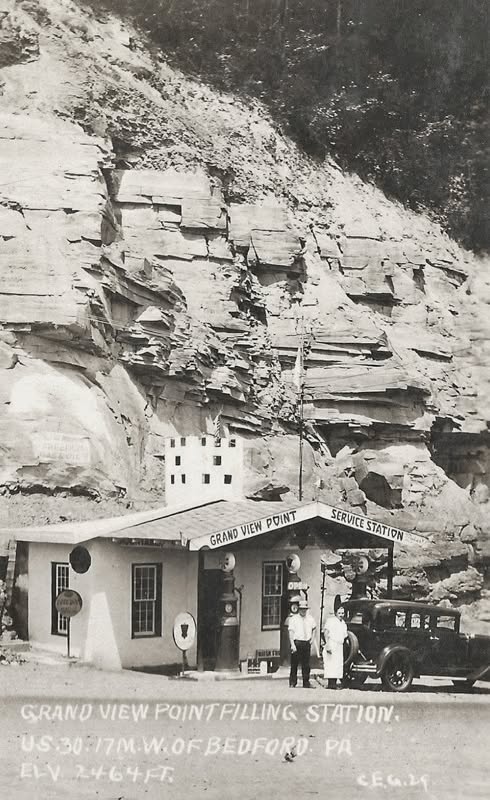
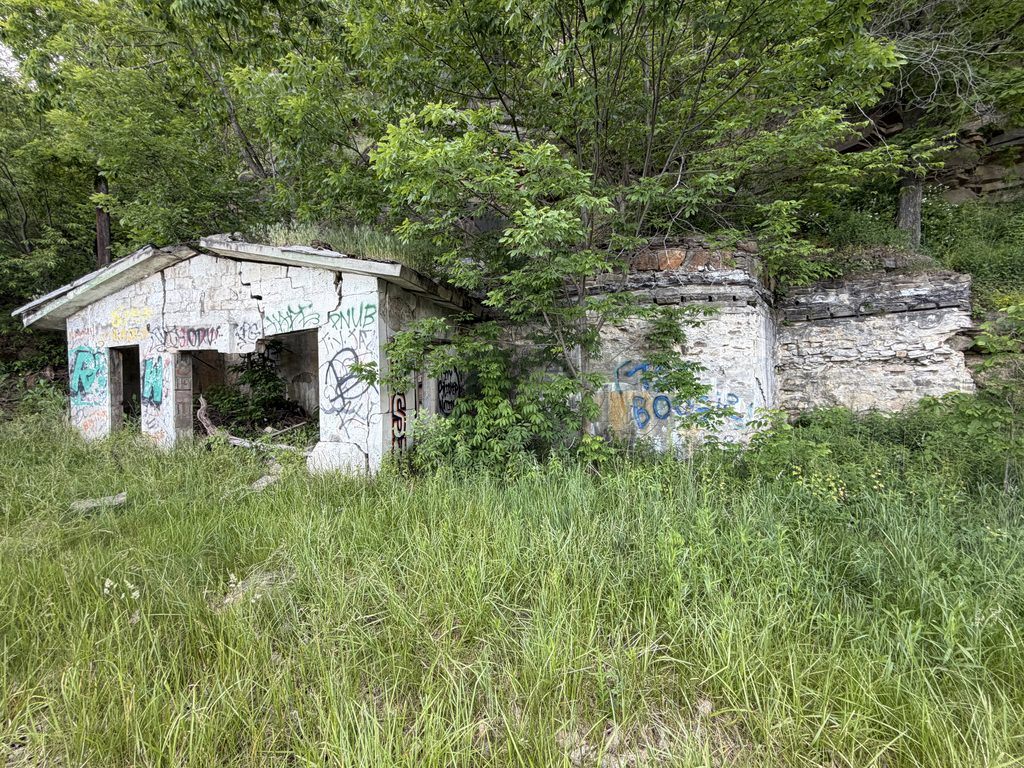
What we initially thought was an unidentified little roadside ruin turned out to be the original Grand View Point Filling Station. Comparing our photographs with historical images revealed the same distinctive building that once served motorists traveling the Lincoln Highway. The gasoline pumps, automobiles, and travelers are gone, but the surviving walls offer a remarkable connection to the days when the Ship of the Alleghenies welcomed visitors from across the country.
That tiny ruined building wasn’t just some forgotten shed. It was the old Grand View Point Filling Station.
In the historic photograph, the little service station stands proudly beside the Lincoln Highway, with its fuel pumps, a parked automobile, and people gathered outside.
In our photograph, the pumps are gone, the roof is collapsing, graffiti covers the walls, and vegetation is slowly reclaiming the building.
But the distinctive roofline and openings are still recognizable.
We hadn’t just found the location of the legendary Ship Hotel.
We had actually explored one of the surviving pieces of its roadside history.
And that little roadside mystery became an entire Forgotten Friday story.
What Stayed With Me
There’s something fascinating about discovering a place before you know its history.
If I’d known about the Ship Hotel beforehand, I would have arrived looking for evidence of the enormous building that once stood here.
I would have studied the mountainside, searched for surviving foundations, and tried to imagine the white ocean liner projecting above the valley.
But that’s not what happened.
We came around a curve.
Saw a beautiful overlook.
And stopped.
Just as thousands of travelers had done before us.

Nearly a century ago, people traveling the Lincoln Highway rounded this same mountain and discovered something extraordinary.
Some stopped because they wanted to see the ship.
Others stopped because the view was too beautiful to pass.
And decades after the hotel disappeared, we were still drawn to the same place.
There’s something wonderfully poetic about that.
Herbert Paulson built his remarkable hotel because he recognized the power of this landscape to capture a traveler’s imagination.
Almost a hundred years later, that landscape was still doing exactly that.
We just arrived too late to see his ship.
And as for those amazing rocks?
Well, let’s just say that a few of them may have been in desperate need of geological rehabilitation.
I can neither confirm nor deny whether a highly specialized rock recovery facility somewhere in Florida accepted them into its care.
Some mysteries are better left unsolved.

But the mystery of the Grand View Ship Hotel is one I’m glad we discovered.
Because sometimes history isn’t waiting behind museum doors or marked by an impressive monument.
Sometimes it’s hiding beside an ordinary stretch of highway, waiting for someone curious enough to pull over.
And sometimes the only thing left of an extraordinary place is the view that made someone dream of building it in the first place.
That’s why these forgotten places matter.
Not because every building can be saved.
But because their stories still deserve to be told.
Plan Your Visit: Mount Ararat / Grand View Point
Location: Historic Lincoln Highway (U.S. Route 30), Bedford County, Pennsylvania
Historic attraction: Grand View Point Hotel, also known as the S.S. Grand View Point Hotel, Ship Hotel of the Alleghenies, and Noah’s Ark
Original hotel: Established by 1927
Ship Hotel opening: May 29, 1932
Destroyed by fire: October 26, 2001
What you’ll find today: A scenic roadside overlook, sweeping views of the Allegheny Mountains, and remnants of the former roadside attraction.
Visitor tip: This is a roadside historical location, not a restored museum or maintained historical attraction. Use designated parking areas, watch for traffic along the mountain highway, and respect private property and unstable ruins.
Continue Exploring Forgotten History
If you enjoy discovering places where history has nearly disappeared, explore more Forgotten Friday stories from Travel Made Personal.
From forgotten military forts and abandoned landmarks to historic cemeteries and roadside discoveries, there’s always another story waiting beyond the next curve.
Watch the full Forgotten Friday episode:
Travel Made Personal — Exploring the places, people, and stories history left behind.
🚢 More Forgotten Places Are Waiting to Be Discovered!
We pulled over for a beautiful mountain view and accidentally discovered the remains of a legendary ship-shaped hotel—and its long-forgotten filling station!
That’s the magic of exploring. You never know what history is hiding around the next curve.
💌 Join the Travel Made Personal mailing list for more forgotten history, unexpected roadside discoveries, fascinating places, and the occasional adventure Murph never bothered to warn us about.
Because the best stories aren’t always on the itinerary!
If you see this after your page is loaded completely, leafletJS files are missing.