
Most ghost towns leave something behind.
Empty houses. Abandoned storefronts. Crumbling churches. Streets slowly disappearing beneath weeds and trees.
Brewster, Florida, is different.

When this former phosphate company town in Polk County reached the end of its life, people didn’t simply pack their belongings and leave their houses behind.
Some of them took the houses with them.
And that may be the best way to understand what happened to Brewster.
It wasn’t simply abandoned.
It was dismantled.
An Unexpected Ending to an Exploration Friday
Brewster was one of the stops on Dusty’s very first Exploration Friday with me, and by the time we reached it, we’d already had quite a day.
We had driven through one of those wicked Florida thunderstorms that makes you question every decision that brought you onto the highway in the first place.
Then we emerged from the storm and visited the Mulberry Phosphate Museum, where Dusty got to admire prehistoric bones and skeletons.
Basically, if you want to make Dusty happy, apparently you just surround her with dead things.
Good information to have.
We also stopped in Bradley Junction, where we walked alongside the modern railroad tracks photographing the remains of much older, deteriorating railroad beds nearby.
Eventually, a barking and growling dog behind a fence suggested that perhaps our exploration of Bradley Junction had reached its natural conclusion.
Message received, sir.
Then we headed toward Brewster.
And when we arrived, there wasn’t an abandoned town waiting for us to wander through.
There was a gate.
Beyond it, we could see an old smokestack rising above the landscape.
And directly in front of us was a warning making it abundantly clear that going any farther could result in a felony.
I love forgotten places.
I do not love them enough to explore the inside of a Polk County jail.
So we stayed exactly where we were allowed to be.
But standing at that gate raised a much more interesting question anyway:
What happened to the town that once stood beyond it?
Brewster wasn’t the only forgotten place we stumbled across that day, either. Later, another unplanned turn led us to Crum-Durrance Cemetery, a tiny historic cemetery we hadn’t expected to explore at all.
Brewster Was Born From Florida’s Phosphate Industry
To understand Brewster, you have to understand a little about the land surrounding it.
Central Florida contains an enormous phosphate deposit commonly known as Bone Valley, encompassing portions of Polk, Hillsborough, Hardee, and Manatee counties.
Phosphate became one of the industries that reshaped this part of Florida, bringing mines, processing facilities, railroads, and workers into areas that had previously been sparsely populated.
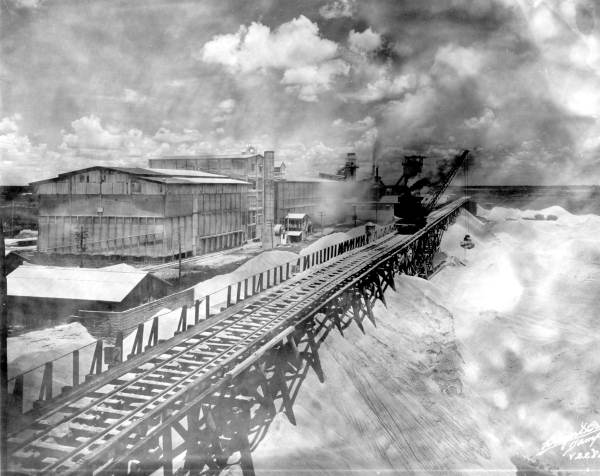
And workers needed somewhere to live.
In 1910, the Amalgamated Phosphate Company established Brewster near its mining operations in Polk County.
Eight years later, in 1918, American Cyanamid acquired the Brewster properties.
It would be under American Cyanamid that Brewster spent most of its life.
If you want to understand just how deeply phosphate shaped this part of Florida, our visit to the Mulberry Phosphate Museum offers a fascinating look at both the industry and the prehistoric world uncovered by mining in Bone Valley.
Building a Company Town
Brewster wasn’t merely a collection of houses beside a mine.
It became a community.
The town included company housing, schools, a movie theater, medical facilities, recreational opportunities, a swimming pool, and other amenities for the people who lived and worked there.
A post office opened in 1913.
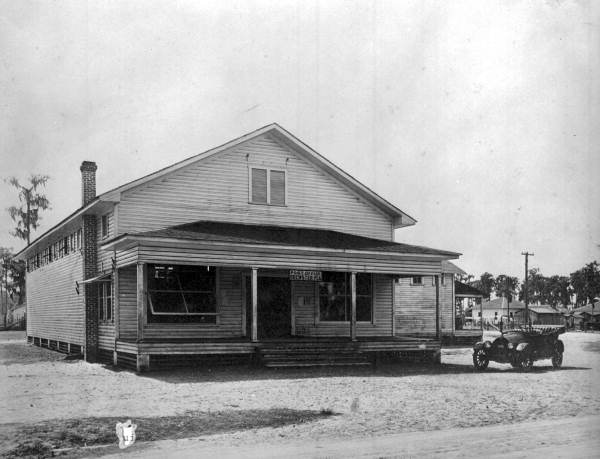
For families living in Brewster, the town wasn’t some future ghost town waiting to happen.
It was home.
Children went to school here.
Neighbors knew one another.
Families went to the movies.
People went to work, came home, raised children, fell in love, argued, celebrated birthdays, mourned deaths, and lived all of the ordinary moments that rarely make their way into history books.
But Brewster also reflected the society surrounding it.
Segregation in Brewster
Like much of Florida during the Jim Crow era, Brewster was segregated.
Like much of Florida during the Jim Crow era, Brewster was segregated—and that segregation was reflected in the town’s physical layout. A historic aerial map of Brewster explicitly identifies separate residential areas labeled the “White Section” and “Negro Section,” showing how racial segregation shaped the geography of the company town itself.

That’s an important part of the town’s history.
Company towns could provide housing, services, recreation, and a sense of community—but they existed within the same racial system governing the rest of the South.
The experiences of people living in Brewster were not all the same.
One Brewster Boy Helped Change Computing
One former Brewster resident would eventually become associated with something very different from phosphate mining.
John Vincent Atanasoff spent part of his childhood in Brewster after his family moved to Florida.

He later became a physicist whose work on the Atanasoff-Berry Computer helped pioneer electronic digital computing.
Before all of that, however, he was simply a kid growing up in a Florida phosphate town.
It’s one of those connections I love finding while researching forgotten places.
A community can disappear from the map while the lives shaped there continue outward in directions nobody could have predicted.
And in Brewster’s case, that idea would eventually become remarkably literal.
How Do You Move a Town?
Brewster’s post office closed in 1961.
Then, in 1962, American Cyanamid closed the residential company town.
But what happened next is what makes Brewster’s story so unusual.

Residents living in company-owned houses were given the opportunity to purchase them.
There was just one catch.
The houses had to leave too.
Not move out of the house.
Move.
The. House.
Historical accounts report that Brewster houses were physically relocated to surrounding communities, including Fort Meade, Mulberry, Bartow, and Bradley Junction.
Houses that remained behind were demolished.
Think about that for a moment.
Somewhere in Polk County, a house that looks like an ordinary old Florida home may have once stood on a street in Brewster.
The family left.
The house left.
Eventually, even the street disappeared.
The ghost town scattered.
Our Accidental Bradley Junction Connection
This was the point in my research when something from our Exploration Friday suddenly became much more interesting.
Before Dusty and I ever reached Brewster, we had stopped in Bradley Junction.
We hadn’t gone there because of Brewster.
We were simply doing what we tend to do—spotting something interesting and going to investigate.

We walked beside the railroad and photographed remnants of older railroad beds deteriorating beside the modern tracks.
Then we moved along.
It wasn’t until I researched Brewster later that I learned historical accounts list Bradley Junction among the communities where some Brewster houses were relocated.
Suddenly, two stops from the same day were connected.
We had started our day exploring remnants of the past in one community without realizing that pieces of another community’s past may have physically traveled there.
That’s one of my favorite things about exploring Florida.
These places don’t exist in isolation.
Their stories overlap.
Sometimes literally.
Brewster Didn’t Disappear in 1962
Calling 1962 the year Brewster disappeared also oversimplifies what happened.
The residential town closed that year.
Industrial operations remained.
Court records show that American Cyanamid continued operating a chemical plant at Brewster until June 1971.
In August 1972, American Cyanamid entered into an agreement with B.J. Thomas, Inc. involving demolition of the Brewster plant and salvage of equipment and materials.
The same court record discusses work connected with a new American Cyanamid plant site at Fort Lonesome, including transporting pipe, machinery, and equipment.

Historical accounts describe usable Brewster assets continuing to be relocated to Fort Lonesome into the mid-1970s.
So Brewster disappeared in stages.
First, the houses left.
Then the industry followed.
Brewster wasn’t a town where everyone simply walked away and left the buildings to decay around them.
The town itself was taken apart.
What Remains of Brewster Today?
When Dusty and I reached the former Brewster townsite, access was restricted.
We respected that.
From where we could legally stop, however, we could still see one unmistakable reminder of the industrial community that once existed there:
the old Brewster power plant smokestack.
It rises above the surrounding landscape like a marker for a place that has otherwise largely disappeared from view.
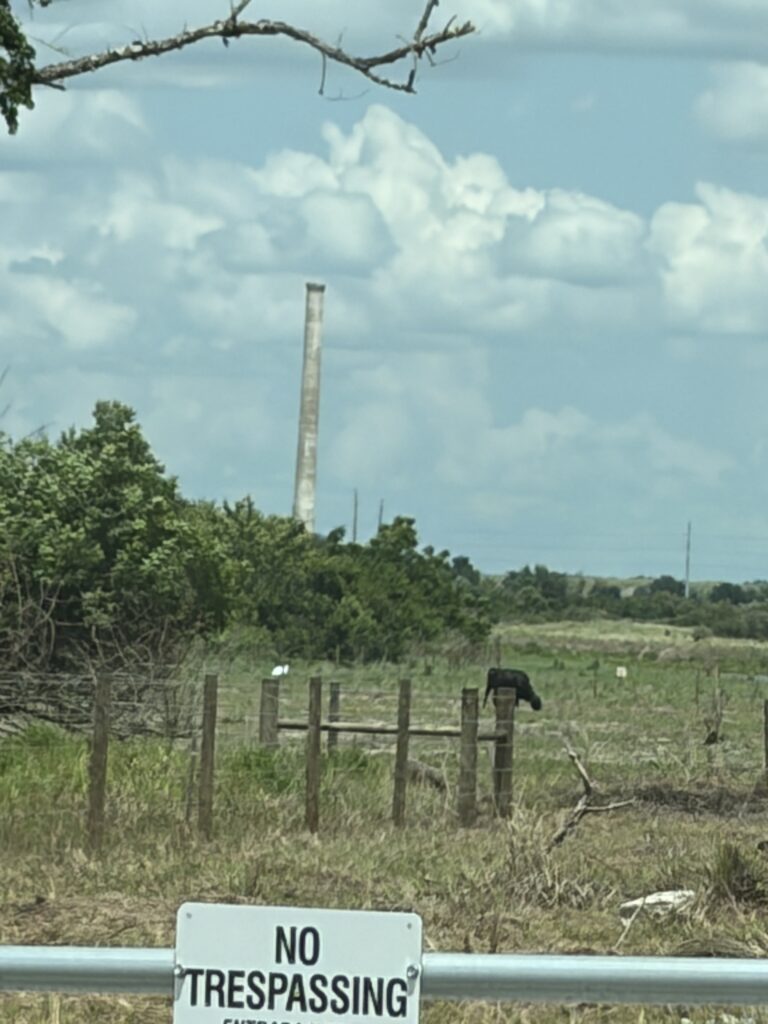
There is something almost appropriate about experiencing Brewster that way.
We could see where it had been.
We could see evidence that something substantial once existed beyond that gate.
But we couldn’t simply walk down an abandoned Main Street and photograph what remained.
Most ghost towns leave ruins.
Brewster mostly leaves absence.
Three People and Zero Houses
And then Brewster’s story gets even stranger.
According to the 2010 U.S. Census, the Brewster census-designated place recorded a population of just three people.
Its number of housing units?
Zero.

Three people.
Zero houses.
And no, I don’t know how that works either.
Census-designated boundaries and population reporting don’t necessarily correspond neatly with what we imagine when we picture a physical town, so this doesn’t mean three mysterious residents were secretly camping among Brewster’s ruins.
But as statistics go, it’s almost absurdly appropriate for this particular ghost town.
Even on paper, Brewster manages to be strange.
When Repetition Starts Looking Like History
Researching Brewster also gave me an important reminder about documenting forgotten places.
Several websites discussing Brewster repeat a claim that the property’s deed was eventually transferred to the State of Florida as partial payment of a judgment against American Cyanamid for environmental damages.
There’s a problem.
I couldn’t substantiate it.
American Cyanamid certainly has a documented environmental history. One of the company’s major environmental legacies involves the American Cyanamid Superfund site in Bridgewater Township, New Jersey.
Florida’s phosphate industry has its own extensive environmental history as well.
But after digging through the Brewster story, I could not find reliable documentation establishing the specific Florida environmental judgment described by those secondary accounts.
That doesn’t prove some related event never occurred.
It means I don’t have enough evidence to tell you that it did.
And that’s an important distinction.
Sometimes a story gets repeated.
Then repeated again.
Then somebody cites the person who repeated it.
Eventually, repetition begins to look like evidence.
Forgotten history can be especially vulnerable to that because the primary sources become harder to find while later writers naturally rely on what previous writers have said.
Part of preserving history responsibly is knowing when to say:
I don’t know.
I’d rather leave a question unanswered than turn an uncertain story into another “fact” for somebody else to repeat.
Why Brewster, Florida Still Matters
It’s easy to call Brewster another Florida ghost town.
But I think that description misses what makes it special.
Most ghost towns are defined by what people left behind.
Brewster is defined by what they took with them.
Its houses traveled down roads to other communities.
Its industrial equipment was removed.
Its residents scattered.

There’s an interesting contrast elsewhere in Polk County at Homeland Heritage Park, where historic buildings from the surrounding area were relocated specifically so pieces of local history could be preserved rather than lost.
The physical geography that once connected their homes, schools, workplaces, recreation, and neighbors gradually disappeared.
But that doesn’t mean Brewster vanished completely.
Pieces of the town may still be standing elsewhere.
Its former residents carried their memories with them.
Their descendants still carry pieces of those stories.
And one lonely smokestack still rises above the landscape where thousands of ordinary moments once happened.
The Best “Date” Ever
After realizing the felony sign represented the absolute limit of our Brewster exploration, Dusty and I continued on with our day.
There were more forgotten places.
More unexpected stops.
More history.
And eventually Dusty announced:
“KI! BEST. DATE. EVER!”
It wasn’t a date.
But I knew exactly what she meant.
Because this is why I keep exploring.
You start out looking for dots on a map.
Then you discover that railroad tracks you stopped to photograph are connected to houses carried away from a town you haven’t reached yet.

You stand at a locked gate looking toward a smokestack and realize that an entire community once existed beyond it.
And sometimes you discover that even the stories already written about forgotten places need to be rediscovered.
Brewster wasn’t simply abandoned.
It was dismantled.
Its pieces scattered.
Its people moved on.
But its story is still here.
And that’s reason enough to remember it.
Enjoy discovering places most people drive right past?
Join the Travel Made Personal mailing list for forgotten history, unexpected roadside finds, behind-the-scenes adventures, and stories from the road—delivered straight to your inbox.
Because there’s always another forgotten place waiting to be found.
Join the Adventure

If you see this after your page is loaded completely, leafletJS files are missing.
Have you heard stories about Brewster, Florida—or do you know of a house in Fort Meade, Mulberry, Bartow, Bradley Junction, or elsewhere in Polk County that was reportedly moved from Brewster? I’d especially love to hear from former residents and their descendants. Leave a comment and help preserve another piece of Brewster’s story.