
Hidden in Polk County, Florida, a collection of historic buildings preserves the stories of pioneer families, a nineteenth-century church, and a little schoolhouse that almost disappeared.
There are places in Florida where history has been carefully restored, polished, and presented behind museum doors. And then there are places where you pull through an open gate, discover absolutely nobody is around, and spend the afternoon wondering whether you’re actually supposed to be there.
Our visit to Homeland Heritage Park in Homeland, Florida, fell somewhere into that second category.

We had just finished exploring Crum-Durrance Cemetery when Dusty and I arrived at this little historic village. Unlike some of our more spontaneous roadside discoveries, Homeland Heritage Park was actually on our itinerary.
The gate was open, the grounds were maintained, and the historic buildings were waiting.
The people, however, were nowhere to be found.
Even the bathrooms were locked.
So, after a rather unsuccessful dash across the parking lot, we decided to do what we came to do: explore.
What we discovered was a collection of historic buildings preserving pieces of Florida’s pioneer past, including an 1887 Methodist church, an 1888 log cabin, historic family homes, and Polk County’s oldest surviving schoolhouse.
And while most of those buildings remained locked during our visit, one very important door was open.
As it turned out, that was the door that mattered most.
What Is Homeland Heritage Park?
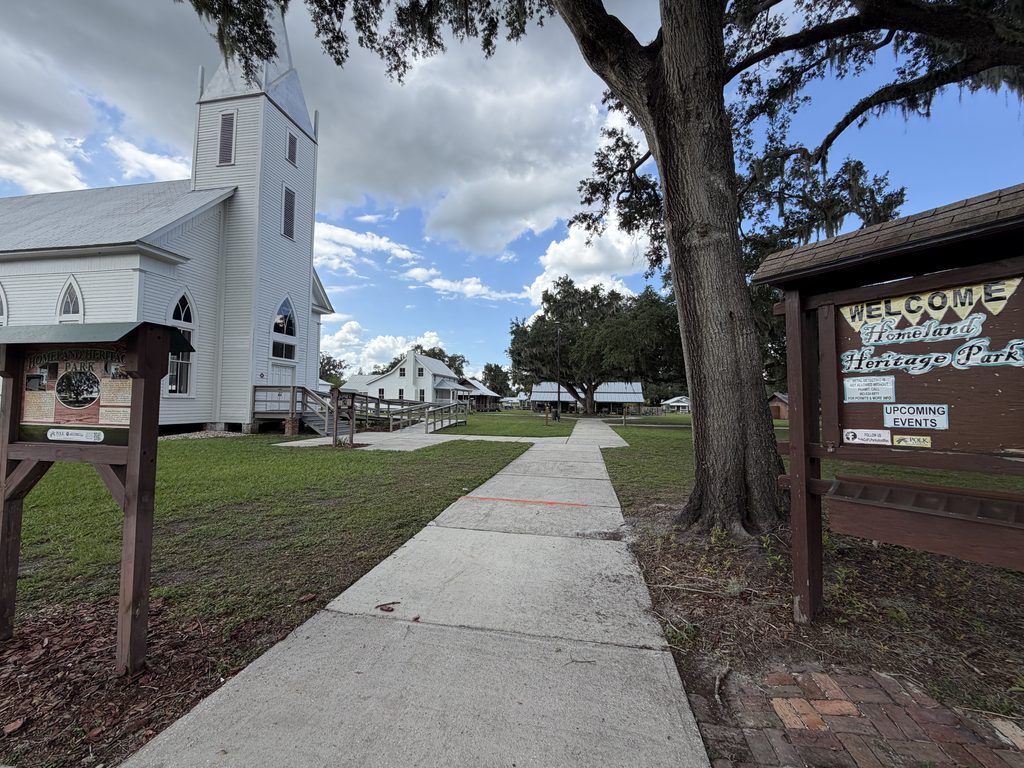
Located in the small community of Homeland, just south of Bartow, Homeland Heritage Park is a five-acre historical park dedicated to preserving Polk County’s pioneer heritage.
The park features original buildings dating to the nineteenth and early twentieth centuries, many of which were relocated from other parts of Polk County to protect them from deterioration or demolition.

These aren’t modern replicas designed to look like old Florida.
They’re actual historic structures that witnessed the development of rural Central Florida.
Homeland Heritage Park reminds me of another wonderful place we’ve explored: Barberville Pioneer Settlement, where historic buildings, traditional crafts, and everyday artifacts help bring Florida’s pioneer history to life. Both places preserve the kinds of ordinary stories that might otherwise disappear as Florida continues to grow.
The community of Homeland traces its roots to the nineteenth century, when farming, family life, churches, and schools helped establish permanent settlements throughout the region.
Life here looked very different from the Florida we know today.
There were no interstate highways connecting communities, no sprawling subdivisions, and certainly no theme parks drawing millions of visitors.
Families built homes from available materials, worked the land, and depended on their neighbors for support.
And many of the buildings that once defined those communities eventually disappeared as Florida developed.
Homeland Heritage Park exists because a group of people decided that at least some of those buildings deserved another chance.
The Old Homeland Methodist Church: Faith on the Florida Frontier
One of the most recognizable buildings at Homeland Heritage Park is the Old Homeland Methodist Church, constructed in 1887.
With its white wooden siding, tall steeple, and pointed-arch windows, the church looks like something lifted directly from a nineteenth-century Florida community.
And in a way, that’s exactly what it is.

The 1887 building replaced an earlier church dating to 1878, which was reportedly a much simpler structure without windows or lights.
For pioneer families, churches were much more than places to attend Sunday services.
They were gathering places where neighbors shared news, celebrated marriages, mourned loved ones, and supported one another through the challenges of frontier life.
In isolated rural communities, those connections mattered.
The construction of a more substantial church in 1887 reflected the growing permanence of Homeland.
This was no longer simply a collection of settlers trying to establish themselves.
It was becoming a community.
A Church That Survived Florida’s Weather
Like so many historic Florida buildings, the church has endured its share of storms.
Its original steeple was destroyed by a hurricane in 1946 and was eventually replaced with an aluminum structure.
But one of the church’s most interesting stories involves something hidden inside.

During restoration work, stained-glass features that had been concealed by a dropped ceiling were rediscovered.
It’s a fitting story for a park devoted to recovering pieces of the past.
Sometimes history doesn’t disappear completely.
Sometimes it’s simply hidden until someone cares enough to look.
The park also preserves buildings associated with the church, including a former Methodist parsonage and annex.
Together, they offer a glimpse into the role religion played in the everyday lives of Homeland’s early residents.
Unfortunately, the church was locked when we visited, so we admired its architecture from outside and continued exploring.
The English Family Log Cabin: Life in Pioneer Florida
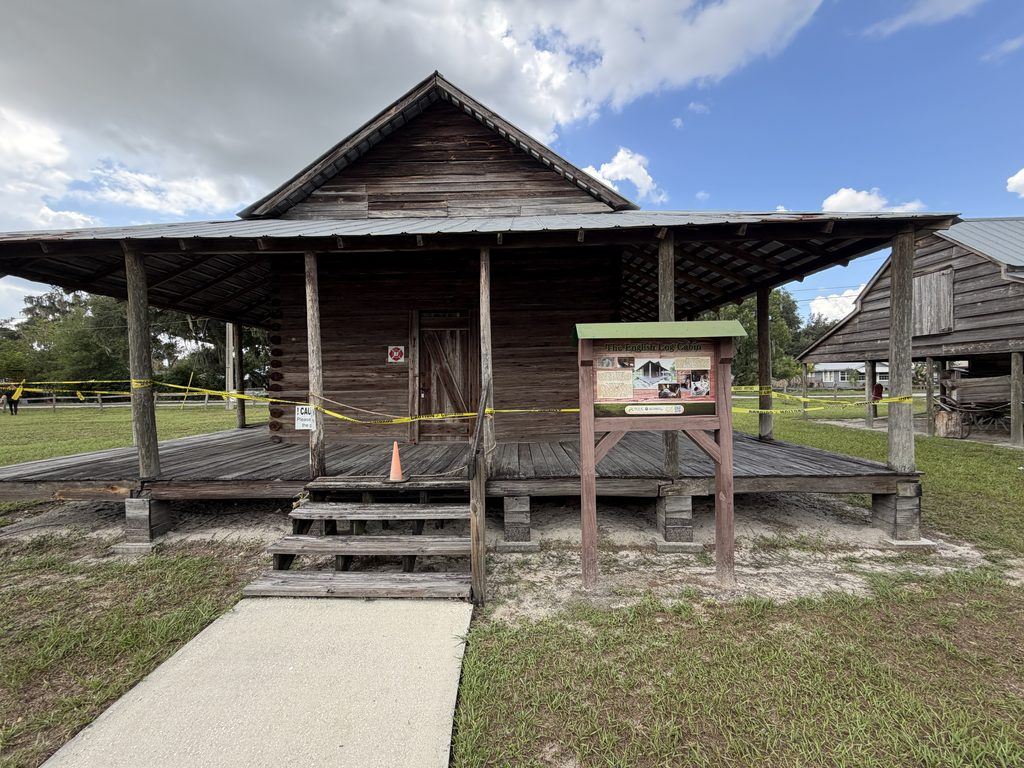
If you’ve ever wondered what everyday life looked like for Florida’s earliest rural settlers, the English family log cabin provides a fascinating example.
Built around 1888 by brothers Cornelius and James English, the cabin represents a simple style of frontier construction known as a single-pen cabin.
Essentially, it consisted of one primary room, with a loft providing additional sleeping space.
Imagine an entire family living in that small space.
No air conditioning.
No running water.
No modern kitchen.
And, perhaps most importantly, no escape from Florida’s summer humidity.
The cabin was designed to make the most of natural ventilation. Multiple doors and windows allowed breezes to pass through, while the porch offered an alternative sleeping area during particularly hot weather.
Nearby, a pole barn reflects the agricultural lifestyle that sustained families in rural Florida.
Farm equipment, tools, feed, and livestock were essential parts of everyday survival.
Growing food, maintaining equipment, caring for animals, and keeping a household functioning required constant work.
For another glimpse into the agricultural lives of Florida’s early settlers, Dudley Farm Historic State Park preserves a historic farmstead where visitors can explore the buildings, tools, and traditions that shaped generations of rural families. It’s another reminder that pioneer life wasn’t simply about surviving the wilderness—it was about building a home and a future through years of hard work.
Standing outside that cabin, it’s difficult not to appreciate how much physical labor went into simply getting through an ordinary day.
And while we couldn’t go inside during our visit, even the exterior offers a reminder of how different life once was.
The Raulerson House: Another Side of Pioneer Life
Not every family in pioneer Florida lived in a one-room log cabin.
The Raulerson House, built in the late 1880s, represents a more prosperous side of rural life.
Daniel Raulerson purchased the home in 1901, and the house later accommodated both his family and the family of his grove foreman.
The Raulerson family occupied the ground floor, while the grove foreman’s family lived upstairs.

Architecturally, the home reflects traditional Florida Cracker-style design, developed to accommodate the region’s climate.
But despite being a larger and more comfortable residence than the English cabin, it still lacked conveniences we consider essential today.
There was no indoor plumbing or running water.
The Raulerson family lived in the house until 1912, although the property remained in the family for many years afterward.
In 1987, the house was donated and relocated to Homeland Heritage Park.
Seeing the Raulerson House and English cabin within the same park provides an interesting contrast.
Both represent families living in roughly the same period, but their homes reveal different economic circumstances and living arrangements.
Together, they remind us that pioneer Florida wasn’t one single experience.
Every family had its own story.
The Homeland School: The Building That Started Everything
Of all the buildings at Homeland Heritage Park, one holds a particularly important place in the park’s history.
And wonderfully enough, it was the only historic building we were able to enter.
The Homeland School, originally known as Bethel Academy, was constructed in 1878.

It is recognized as the oldest surviving schoolhouse in Polk County.
Unlike many of the other buildings at the park, which were relocated for preservation, the schoolhouse remains on its original site.
That means the ground beneath this building is the same ground where generations of Homeland children once arrived for lessons.
From Five Students to a Growing Community
When the school first opened, it reportedly served just five students and one teacher.
Lessons focused on the fundamentals of reading, writing, and arithmetic.
But as Homeland grew, so did its school.
An additional classroom was constructed in 1888, and enrollment eventually climbed to more than 75 students.
For a period, the school was reportedly the largest in Polk County.
It’s remarkable to think about that while standing inside such a modest wooden building.
Today, it’s quiet.
But once, these rooms were filled with children learning their lessons, teachers managing classrooms, and generations of young people preparing for lives in a changing Florida.
The school continued operating until 1956.
Think about everything that happened during those decades.
Florida transformed from a largely rural frontier state into a rapidly developing destination.
Automobiles replaced horse-drawn transportation.
Electricity and modern conveniences changed daily life.
Two world wars came and went.
And through all those changes, children continued attending school in this little wooden building.
The One Door That Was Open
During our visit, Dusty and I had spent most of our time walking around locked buildings and peering through windows.
Then we reached the schoolhouse.
One door was unlocked.
Finally!

We were able to step inside, explore the classroom, and capture footage of the historic interior.
After spending so much time admiring buildings from the outside, it was wonderful to actually walk through one.
And the fact that it happened to be the building responsible for the park’s existence made the experience even more meaningful.
Because this little schoolhouse almost didn’t survive.
How One Schoolhouse Saved a Historic Village
By the 1980s, the old Homeland School had long since stopped operating.
Its future was uncertain.
According to accounts of the park’s founding, a local newspaper reporter noticed an item on a school board agenda indicating that the historic school property was being considered for disposal.
That discovery helped draw attention to the building’s significance.
Rather than allowing it to disappear, community members rallied to preserve it.

In 1985, the school property was donated for preservation, becoming the foundation of what would eventually grow into Homeland Heritage Park.
From there, the effort expanded.
Other historic buildings from around Polk County were donated, relocated, and restored.
A church.
Family homes.
A log cabin.
Agricultural structures.
Each building represented another piece of local history that might otherwise have been lost.
In 2007, the Homeland School was listed on the National Register of Historic Places, recognizing its historical significance.
What began as an effort to save one old schoolhouse had become something much larger.
A place where visitors could explore the buildings and stories of Florida’s pioneer past.
And it all happened because someone noticed what was about to disappear.
Exploring Homeland Heritage Park: Nobody Was Home
Now, I should probably mention that our visit wasn’t exactly the immersive historical experience we had imagined.
The gate was open when we arrived, but there wasn’t another person in sight.
No staff.
No guides.
No other visitors.
Almost every historic building was locked.
Even the bathrooms were locked, which was especially unfortunate considering we’d just come from exploring a cemetery.
So we spent most of our time wandering between buildings, looking through windows, examining the architecture, and reading the interpretive displays.
I would’ve loved to explore the interiors of the church, cabin, and historic homes.
There are details you simply can’t appreciate from outside.
But the park was still a lovely place to wander.
And we weren’t entirely alone.
Dusty Attempts to Befriend the Local Residents
A handful of feral cats appeared to have taken up residence around the historic village.
Naturally, Dusty immediately decided they needed affection.
The cats disagreed.
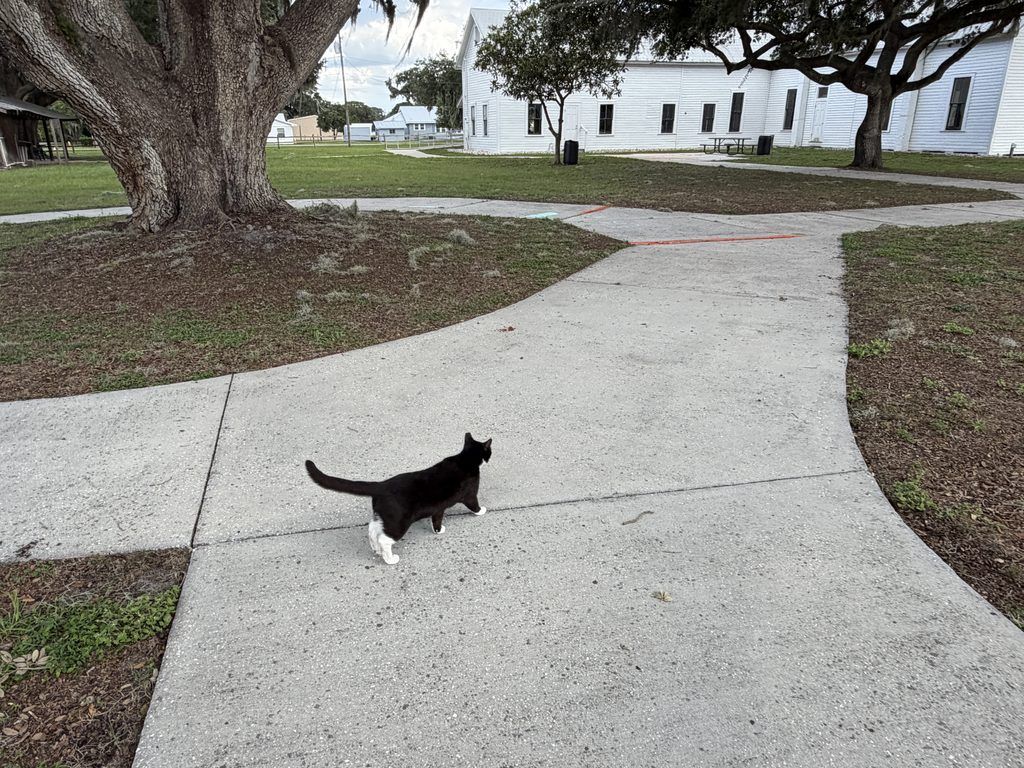
Apparently, the local feline population had established a strict no-contact policy.
So while Dusty attempted to negotiate diplomatic relations, the cats maintained a respectful distance and continued supervising our exploration.
Honestly, they seemed perfectly comfortable being the only residents of the village that day.
And I suppose every historic community needs somebody keeping an eye on things.
Planning Your Visit to Homeland Heritage Park
If you enjoy historic buildings, pioneer history, or discovering lesser-known Florida destinations, Homeland Heritage Park is worth considering.
Location: Homeland Heritage Park, Homeland, Polk County, Florida
What You’ll Find: Historic pioneer homes, a nineteenth-century Methodist church, a log cabin, agricultural buildings, and the 1878 Homeland School.
Historical Highlight: The Homeland School is Polk County’s oldest surviving schoolhouse and is listed on the National Register of Historic Places.
Time to Allow: Approximately 45–90 minutes for a casual walk around the grounds, with additional time if historic building interiors are accessible.
Visitor Tip: Check with Polk County Parks and Recreation before your visit to confirm current operating hours, restroom availability, and whether the historic buildings will be open.
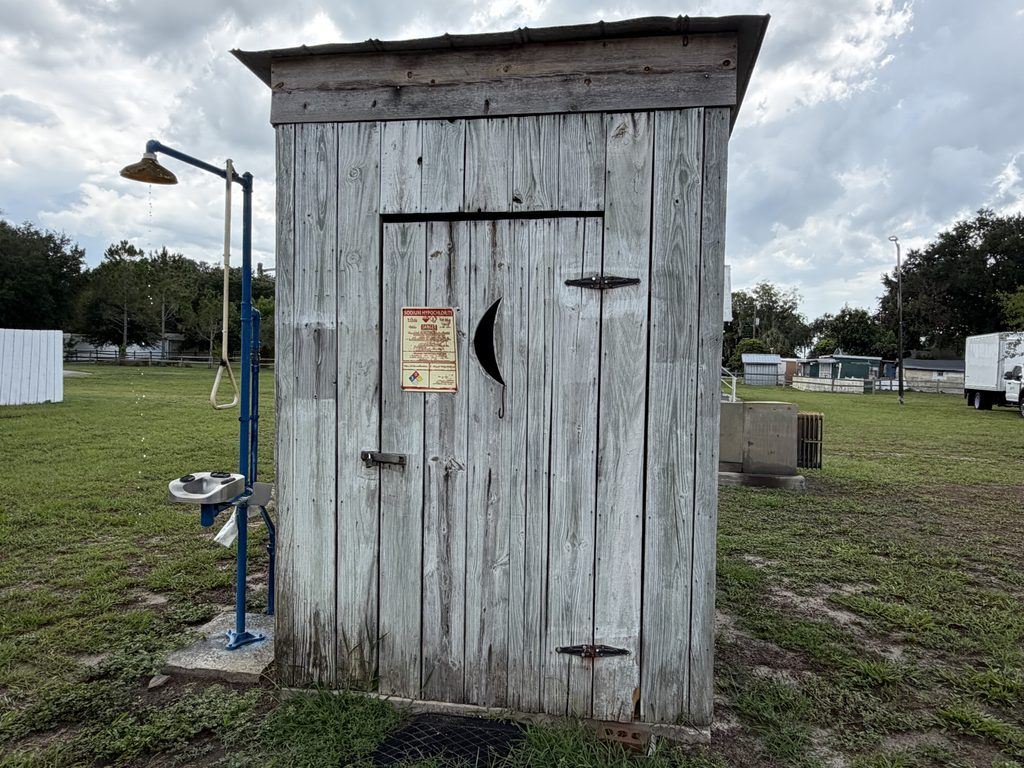
Our experience proved that an open gate doesn’t necessarily mean every building—or bathroom—will be accessible.
If touring the interiors is important to you, confirming access in advance would be a very good idea.
And perhaps make a bathroom stop before arriving.
Just saying.
What Stayed With Me
I’ve visited plenty of historic places where the buildings are little more than foundations, ruins, or photographs on interpretive signs.
Sometimes all that’s left of a community is a cemetery.
Sometimes it’s an old road disappearing into the woods.
And sometimes there’s nothing visible at all.
That’s part of what makes Homeland Heritage Park special.

These buildings are still standing.
Not because time was particularly kind to them.
Not because Florida’s weather spared them.
And not because development somehow passed them by.
They’re standing because people made the effort to save them.
Someone recognized that the English family cabin mattered.
That the Raulerson House mattered.
That the Old Homeland Methodist Church mattered.
And that a little schoolhouse built in 1878 deserved something better than demolition.
I wish we’d been able to explore more of the interiors.
I wish there had been someone around to tell us more about the buildings.
And yes, I definitely wish the bathrooms had been unlocked.
But none of those things changes what this park represents.
Homeland Heritage Park isn’t an entire pioneer town preserved exactly where it originally stood.
It’s something different.
It’s a collection of pieces rescued from a disappearing Florida and brought together so their stories could survive.
That same dedication to preserving everyday history extends beyond Florida. At Landmark Park in Dothan, Alabama, historic buildings and exhibits help tell the story of rural life in the Wiregrass region. Like Homeland Heritage Park, it’s a place where the buildings themselves help connect today’s visitors with the people and communities who came before us.
And in some ways, that makes it even more meaningful.
Because every building represents a choice.
Someone could have let it disappear.
Instead, someone decided to save it.
Final Thoughts: Preserving the Florida We Almost Lost
Our afternoon at Homeland Heritage Park was quieter than expected.
There were no crowds, no guided tours, and very few open doors.
Just two curious travelers wandering through historic buildings while a handful of feral cats watched from a distance.
But sometimes a quiet place has an important story to tell.
The little schoolhouse that opened in 1878 became the foundation of an entire preservation effort more than a century later.
Around it now stand homes, a church, and other structures representing generations of families who helped build rural Central Florida.

These buildings don’t tell the complete story of pioneer life.
No collection of buildings ever could.
But they preserve something tangible.
The wood.
The windows.
The doorways.
The spaces where ordinary people lived, worked, worshipped, and learned.
And sometimes those ordinary stories are the ones most easily forgotten.
That’s why places like Homeland Heritage Park matter.
Because history doesn’t always disappear in one dramatic moment.
Sometimes it vanishes quietly, one building at a time.
And sometimes saving it begins when somebody notices what’s about to be lost and decides…
Not this one.
Come Explore More Forgotten Florida History
If you enjoy discovering overlooked historic sites, forgotten communities, old cemeteries, and the stories hiding along Florida’s back roads, join us for more adventures on Travel Made Personal.
Watch our Forgotten Friday exploration of Homeland Heritage Park on YouTube, and follow along as we continue uncovering the places and people that helped shape the world around us.
Have you visited Homeland Heritage Park, or do you know of another historic Florida landmark that deserves to be preserved? I’d love to hear about it in the comments.
Because sometimes the next great adventure begins with a place somebody else almost forgot.
📬 Love discovering Florida’s forgotten history?
From pioneer villages and historic schoolhouses to forgotten cemeteries and roadside treasures, there’s always another story waiting down a back road. Join the Travel Made Personal newsletter for new adventures, fascinating history, and the occasional mischief that happens along the way. 💜
Subscribe and let’s keep exploring the stories worth remembering!
If you see this after your page is loaded completely, leafletJS files are missing.