

Mount Vernon, Virginia | TMP Haunts
What happens when one of America’s most famous historic homes has more than two centuries of ghost stories hiding behind its doors?
George Washington’s Mount Vernon Estate is one of those places that hardly needs an introduction. Overlooking the Potomac River in Virginia, the sprawling property was once home to America’s first president, his family, and hundreds of enslaved people whose labor sustained the plantation.
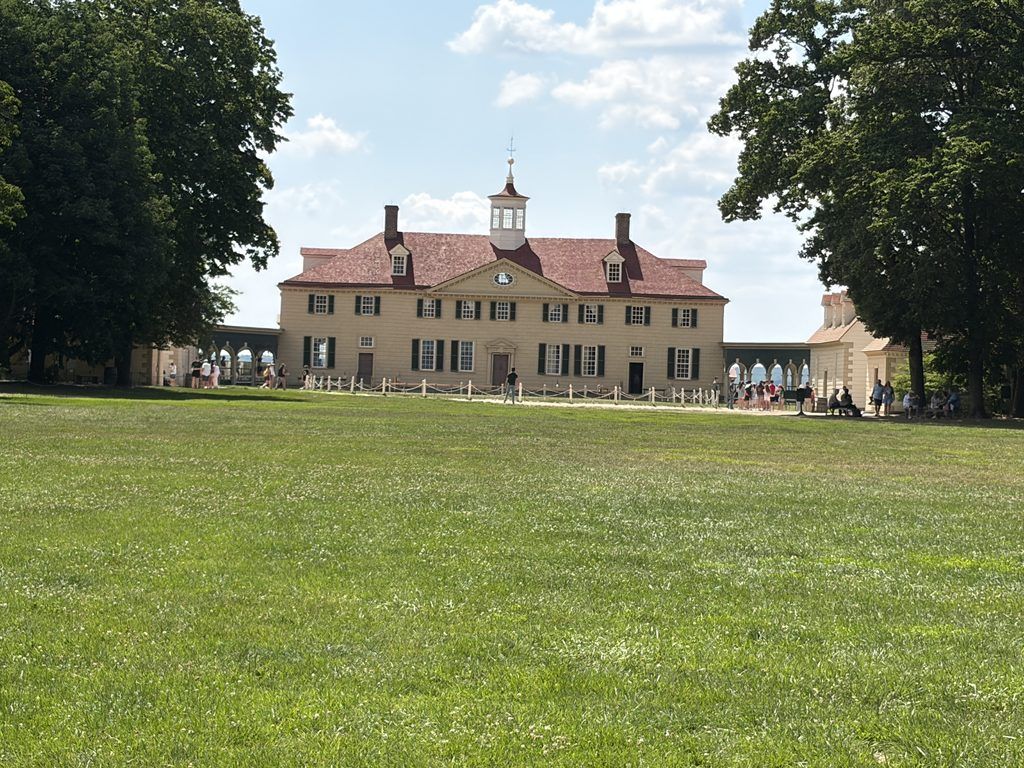
Today, visitors come to explore the mansion, walk the grounds, and learn about the people who shaped its history.
But there’s another side to Mount Vernon.
For generations, visitors and employees have reported strange experiences inside the mansion. Disappearing figures, unexplained footsteps, unseen hands, and even the sound of heavy keys moving across the floor of the bedroom where George Washington died.
And here’s what makes these stories particularly fascinating: Mount Vernon itself has preserved many of the accounts.
So naturally, when I learned about the estate’s haunted reputation, I had to take a closer look.
Although, as it turned out, the greatest threat to my survival wasn’t a ghost.
It was a metal grate.
But we’ll get to that.
A Visit to George Washington’s Mount Vernon
Our next adventure took us to Mount Vernon, about thirty minutes from our previous stop.
After purchasing our tickets, we watched an introductory film before heading out to explore the grounds.
Mount Vernon has a long and complicated history. The Washington family’s connection to the property dates to the seventeenth century, and George Washington eventually transformed an earlier family residence into the 21-room mansion visitors recognize today.

Washington considered Mount Vernon his home throughout much of his adult life. Even while serving as commander of the Continental Army and later as the nation’s first president, he longed to return to the estate.
He died here on December 14, 1799, at the age of 67.
But Mount Vernon was much more than the home of one famous American.
It was also a working plantation built upon enslaved labor.
And that became one of the most meaningful parts of our visit.
Remembering the People Behind the Mansion
Before touring the house, we visited the tomb of George and Martha Washington.
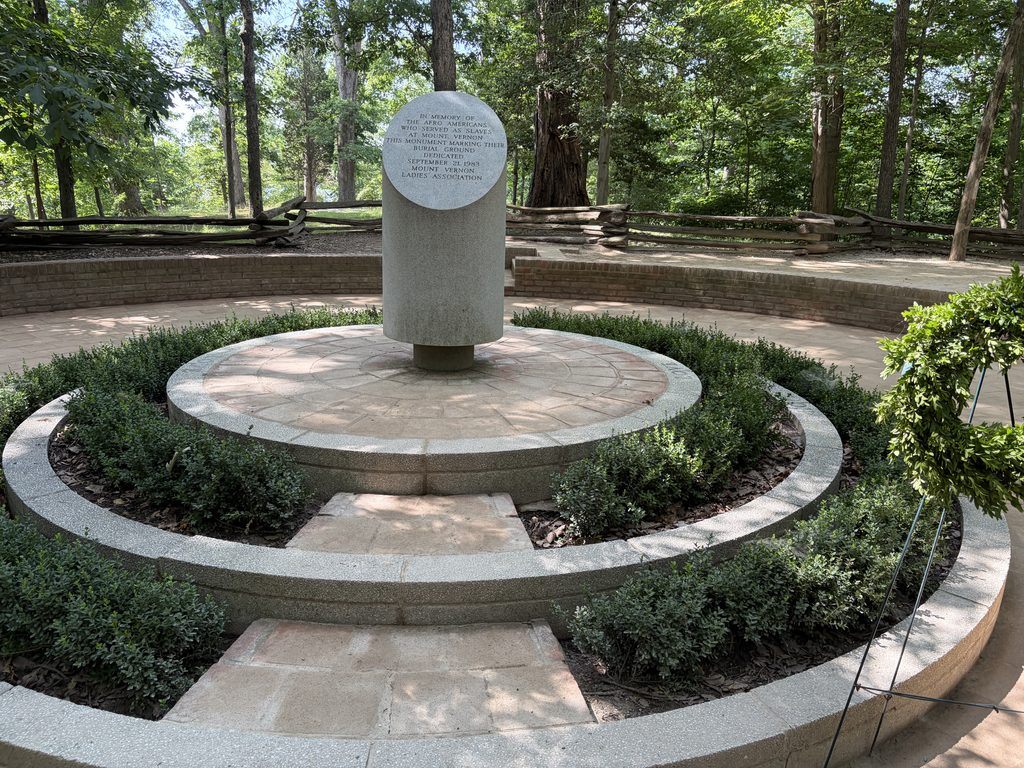
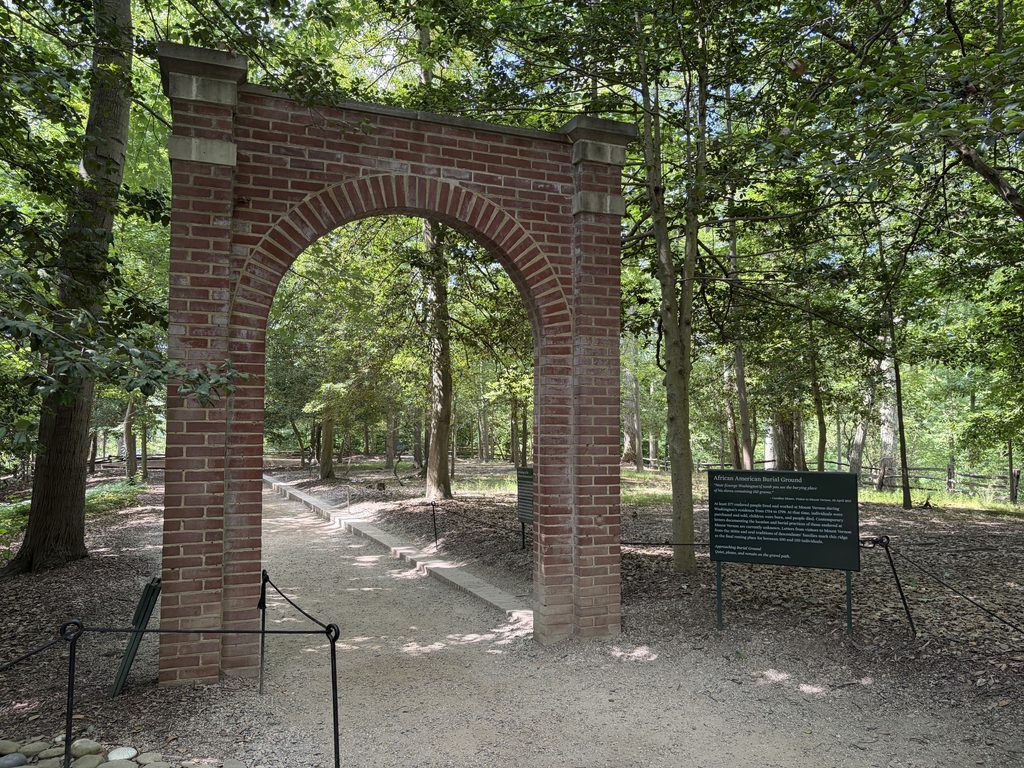
Then we made our way to the burial ground associated with the enslaved people who lived and worked at Mount Vernon.
Of everything we saw that day, this was probably the most important stop for us.
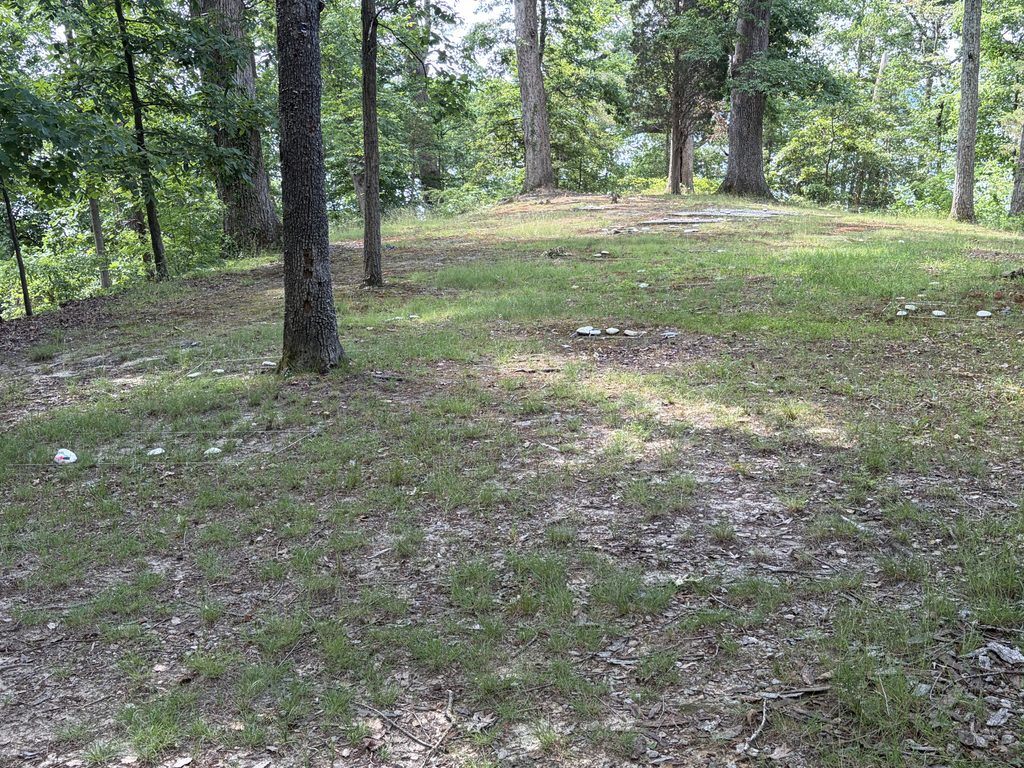
When people think of Mount Vernon, they naturally think of George Washington. His accomplishments, his presidency, his military leadership, and his role in the founding of the United States.
But the estate’s story is much larger than one man.
In 1799, 317 enslaved people lived at Mount Vernon. They included people Washington personally enslaved, people belonging to the Custis estate, and individuals rented from another enslaver.
They worked in the fields, maintained buildings, prepared meals, cared for livestock, raised families, and performed the countless tasks necessary to sustain the plantation.
Many never had the opportunity to leave.
Standing at the burial ground, I found myself thinking about the lives that unfolded here beyond the mansion’s grand rooms.
The people whose names are less familiar.
The families who lived and died on this land.
The generations whose stories deserve to be remembered.
It’s easy for the history of an important place to become the history of its most famous resident.
But Mount Vernon reminds us that there are always more stories beneath the surface.
Inside the Mansion
After visiting the burial ground, we had approximately 45 minutes before our scheduled mansion tour.
So we started making our way back toward the house.
As we approached, one of the staff members asked whether we’d like to take an earlier tour.
Ummm… YES!
We jumped at the opportunity.
Somehow, we managed to finish everything we’d planned to see about fifteen minutes before our original tour was even supposed to begin.
For two travelers who had already spent a considerable amount of time walking, that was a beautiful thing.
Future sitting time!
The mansion tour itself was an interesting experience.

Rather than following a single guide through the entire building, staff members were stationed in different rooms. As we entered each section, they shared a brief explanation of the room’s history and significance.
It almost felt like a self-guided tour, and we actually preferred that arrangement.
We could take our time looking around without feeling quite so rushed.
Walking through the mansion, I kept returning to the sheer number of people required to operate the estate.
It’s difficult to imagine a household supported by hundreds of enslaved laborers, particularly when looking at the beautifully furnished rooms and carefully maintained architecture.
The contrast between the lives lived inside those rooms and the lives of the people responsible for maintaining them is impossible to ignore.
And one room in particular carries a story that extends beyond documented history.
The Washingtons’ Bedchamber.
The Bedroom Where George Washington Died
On December 14, 1799, George Washington died in his second-floor bedchamber following a rapidly worsening illness.
His wife Martha, physician Dr. James Craik, secretary Tobias Lear, and members of the enslaved household were among those present during his final hours.
Following his death, Martha reportedly stopped using the room.

And only a few years later, an unusual story emerged.
In 1806, Massachusetts politician Josiah Quincy III visited Mount Vernon and stayed overnight as a guest of Bushrod Washington, George Washington’s nephew.
According to a story later published by Quincy’s son, the elder Quincy believed he had seen George Washington during the night.
The account offers relatively little detail about the experience.
But Quincy’s son described his father’s conviction as absolute.
Interestingly, the family account also entertained the possibility that the experience had a natural psychological explanation.
Was it a dream?
An illusion?
Or something Quincy genuinely couldn’t explain?
We may never know.
But the story became part of Mount Vernon’s enduring folklore.
And it was far from the last strange experience reported inside the mansion.
The Woman Who Disappeared on the Staircase
One of Mount Vernon’s most intriguing accounts comes from an interpreter working inside the mansion during the 1980s.
While standing in the Central Passage, the employee reportedly noticed a woman descending the staircase.
She was wearing eighteenth-century clothing and carrying what appeared to be a large punch bowl filled with flowers.
At a historic estate where interpreters sometimes wear period clothing, that might not seem particularly unusual.

Except that when the woman reached the bottom of the staircase…
She disappeared.
The interpreter’s account became part of Mount Vernon’s collection of ghost stories.
Of course, an eyewitness report isn’t proof of a supernatural encounter.
But it’s an interesting story, particularly because it comes from someone familiar with the building and its daily operations.
And apparently, disappearing visitors weren’t the only unusual occurrences reported by the staff.
The Superintendent Who Never Clocked Out
Another interpreter reported an encounter in the Little Parlor during a particularly busy day.
The employee noticed a man standing beyond a visitor barrier and approached to ask him to return to the designated area.
But something about this gentleman was unusual.

He wore clothing resembling styles from the late nineteenth or early twentieth century and had a prominent mustache.
And he was apparently not pleased with the noise.
According to the account, he demanded:
“What the hell is going on here?”
The interpreter responded.
And the man vanished.
Later, after seeing a photograph of Colonel Harrison Howell Dodge, the interpreter reportedly identified him as the gentleman she’d encountered.
Dodge had served as Mount Vernon’s superintendent for more than fifty years before his death in 1937.
Now, I’m not saying the former superintendent was still wandering around Mount Vernon trying to maintain order.
But if someone dedicated half a century to managing a historic estate, I suppose it’s fitting that the ghost stories would involve him complaining about unruly visitors.
Some people really do take their jobs seriously.
Even after retirement.
Permanent retirement.
Unseen Hands in the Yellow Room
Not every unexplained experience at Mount Vernon involves an apparition.
In 2006, a supervisor reportedly encountered something unusual while helping close the mansion.
After the visitors and interpreters had left, she walked upstairs alone and entered the Yellow Room.
That’s when she felt pressure against her shoulders.
As though someone had placed their hands on her back and was pushing her forward.
But nobody was there.

According to her account, the experience happened three times.
When she returned with another employee, nothing happened.
When she went upstairs alone, the sensation returned.
Eventually, she decided she would no longer close that portion of the mansion by herself.
And I can’t say I blame her.
Old houses make strange noises.
Floorboards creak.
Shadows shift.
But the sensation of unseen hands pushing you through an empty room?
That would certainly get my attention.
Stories of unexplained encounters aren’t limited to grand historic mansions. At the Old Franklin County Jail, better known in our adventures as the Cross Key Hotel, we explored another historic building with a reputation for experiences that aren’t easily explained.
The Sound of Washington’s Keys
Of all the unexplained stories associated with Mount Vernon, this might be my favorite.
A security officer recalled an unusual experience during the estate’s early Candlelight Tours.
It was December 14, the anniversary of George Washington’s death.
Around 10:30 that evening, approximately the time Washington had died, the officer was alone inside the mansion inspecting its alarm system.
While standing in Washington’s Study, he heard something directly overhead.

The sound of heavy keys moving across the floor of the Washingtons’ Bedchamber.
The officer began moving toward the stairs.
And the sound stopped.
Here’s what makes the story particularly interesting.
Washington was known to carry a heavy set of keys.
And according to accounts of his final hours, those keys were removed from his pocket after his death.
Was the security officer hearing the ordinary sounds of an old building?
Could something else have produced the noise?
Or was there another explanation entirely?
There’s no way to establish what caused the sound from the account alone.
But I have to admit…
If I were alone in that mansion on the anniversary of Washington’s death, at approximately the hour he died, and heard keys moving across the floor of his bedroom…
I would probably discover a sudden and urgent need to inspect the alarm system from outside.
Preferably from the parking lot.
Our Own Mount Vernon Experience
After touring the mansion, we spent some time exploring the surrounding outbuildings.
And although we didn’t encounter any apparitions, unexplained footsteps, or mysterious keys…
I did have an unexpected encounter.
With a metal grate.
While walking uphill toward the museum and gift shops, I stepped on the grate awkwardly, rolled my ankle, and nearly fell.
Fortunately, I managed to catch myself.
Unfortunately, my ankle was not particularly impressed with my recovery.
I spent the next several hours limping.
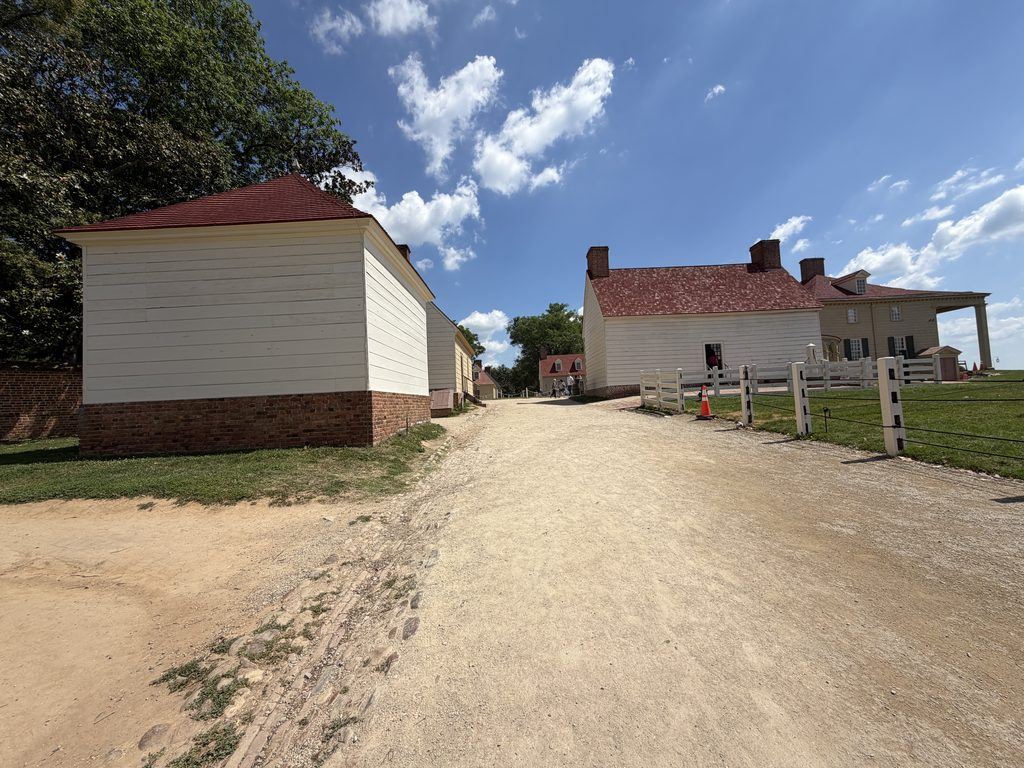
So while some Mount Vernon employees have reported being pushed by unseen hands, my personal experience involved nearly being taken down by historic infrastructure.
Thanks, Murph.
Very subtle.
By the time we reached the museum, we were both pretty exhausted.
We walked through the main corridor but didn’t have the energy to explore all the exhibits.
Instead, we headed toward the gift shops.
Which were…
Very peopley.
I found a couple of books and other things I wanted, but the checkout line was moving painfully slowly.
And my feet were already staging a rebellion.
So I abandoned my selections and went to the shop across the hall.
There, we found the trinkets we wanted, I discovered an even better book, and the checkout process was considerably faster.
Small victories.
Then we dragged our tired selves all the way back to the truck.
We was hurtin’.
But we’d seen everything we’d really wanted to see.
And sometimes, that’s enough.
Is Mount Vernon Really Haunted?
Mount Vernon isn’t the only historic place we’ve explored where documented history and unexplained stories intersect. During our visit to the Trans-Allegheny Lunatic Asylum, we discovered how a building’s complicated past can become inseparable from the ghost stories told about it.
Mount Vernon has accumulated an impressive collection of ghost stories over the years.

Some involve famous historical figures.
Others describe ordinary people seemingly continuing their routines long after death.
A woman carrying flowers.
A superintendent complaining about visitors.
Someone walking through a bedroom.
The sound of keys moving across a wooden floor.
What fascinates me most isn’t necessarily the possibility that George Washington’s ghost still wanders through his former home.
It’s the way these stories reflect the ordinary activities of people who once occupied the estate.
And perhaps that’s part of why historic buildings inspire so many ghost stories.
Every room once had a purpose.
Every hallway carried footsteps.
Every staircase connected the daily lives of people whose world looked very different from ours.
When we walk through these places today, we’re surrounded by reminders that countless people came before us.
Some were powerful.
Some were famous.
And many lived lives that history didn’t record nearly as carefully.
Mount Vernon is a place of extraordinary historical significance, but it’s also a place where generations experienced ordinary human emotions.
Love.
Grief.
Fear.
Joy.
Loss.
And for the enslaved people who lived here, the profound injustice of being denied freedom.
Whether any of those experiences left something supernatural behind is impossible to establish.
But the stories themselves have become part of the estate’s history.
And that makes them worth exploring.
What Stayed With Me
When I think back on Mount Vernon, I don’t immediately think about ghosts.
I think about the burial ground.
I think about standing inside the mansion and trying to comprehend the number of enslaved people whose labor sustained it.
I think about the beautiful architecture and the complicated history behind it.
That intersection of history, loss, and enduring folklore reminded me of our visit to Gettysburg National Military Park, where the events of the past continue to shape both the landscape and the stories people tell about it.
And yes…
I think about my ankle.
Because apparently Murph wanted to make sure I remembered him, too.
But learning about Mount Vernon’s ghost stories afterward added another dimension to the experience.
The estate isn’t just a collection of preserved rooms and historic artifacts.
It’s a place where stories have been told, retold, questioned, and preserved for generations.
Some are supported by extensive historical documentation.
Others survive through eyewitness accounts and folklore.
And the distinction matters.
History is what can be documented. Folklore is what has been told. Experience is what happened when we walked there.
At Mount Vernon, our experience didn’t include anything paranormal.
But that doesn’t make the stories any less fascinating.
Because sometimes the most interesting thing about a haunted place isn’t whether the ghosts are real.
It’s what those ghost stories reveal about the people who lived there, the people who visited afterward, and the memories that refuse to disappear.
And Mount Vernon certainly has plenty of those.
Plan Your Visit to Mount Vernon
Location: 3200 Mount Vernon Memorial Highway, Mount Vernon, Virginia
Official Website: https://www.mountvernon.org/
Mount Vernon offers visitors the opportunity to explore George Washington’s historic estate, including the mansion, gardens, outbuildings, burial sites, museum exhibits, and grounds overlooking the Potomac River.
I particularly recommend allowing time for the enslaved burial ground and memorial, rather than focusing exclusively on the mansion.
Mansion admission and tour arrangements may vary, so check the official website for current ticketing information, hours, and available experiences before visiting.
And wear comfortable shoes.
Seriously.
Trust me on this one.
Explore the Ghost Stories
Mount Vernon maintains its own collection of reported unexplained experiences, including accounts from employees and visitors.
You can explore those stories through the estate’s official website:
These accounts are part of the property’s folklore, not verified evidence of paranormal activity.
Watch Our TMP Haunts Adventure
Want to hear more about the unexplained sights and sounds reported at Mount Vernon?
Join us for our TMP Haunts episode, where we explore the history, ghost stories, and our own experiences at George Washington’s famous estate.
🎥 The Unexplained Sights and Sounds of Mount Vernon | TMP Haunts
And now I’m curious…
If you were alone inside Mount Vernon after dark and heard footsteps moving through Washington’s bedroom, would you investigate?
Or would you suddenly remember something very important waiting for you in your vehicle?
I already know which one I’d choose.
👻 Love history with a haunted twist? Join the Travel Made Personal newsletter for fascinating historic places, forgotten stories, eerie legends, and real adventures from the road. No ghostly spam—just a little history, mystery, and occasional mischief from Murph delivered to your inbox! 🧭
If you see this after your page is loaded completely, leafletJS files are missing.