
Exploring Columbus Cemetery, Civil War Earthworks, and the Forgotten History of Live Oak, Florida
There is a ghost town hiding inside Suwannee River State Park.
Not the kind with abandoned storefronts or houses slowly collapsing beneath the weight of time. This one is quieter. Its streets have become forest trails, its buildings have largely disappeared, and most of the people who once called it home are remembered only through historical records and weathered gravestones.
But if you know where to look, pieces of Columbus, Florida, are still waiting among the trees.
And the funny thing is, we hadn’t originally planned to visit.

What began as an unexpected addition to our itinerary turned into a morning of exploring an old cemetery, walking through Civil War defenses, and discovering just how much history can hide inside one Florida state park.
Of course, we also encountered an owl who refused to cooperate, a mysterious smell that absolutely did not require further investigation, and a hiking trail that eventually convinced us we’d had enough exercise.
Just another day on the road with Travel Made Personal.
An Unexpected Addition to Our Florida Adventure
Sometimes the best stops are the ones that weren’t on the itinerary.
We’d left much earlier than expected the previous day and somehow managed to complete most of what we’d originally scheduled for Saturday. Suddenly, we had some breathing room.
Dusty had mentioned Suwannee River State Park several times before. She’d visited previously but hadn’t been able to finish exploring because a storm interrupted her hike.
I’d never been.
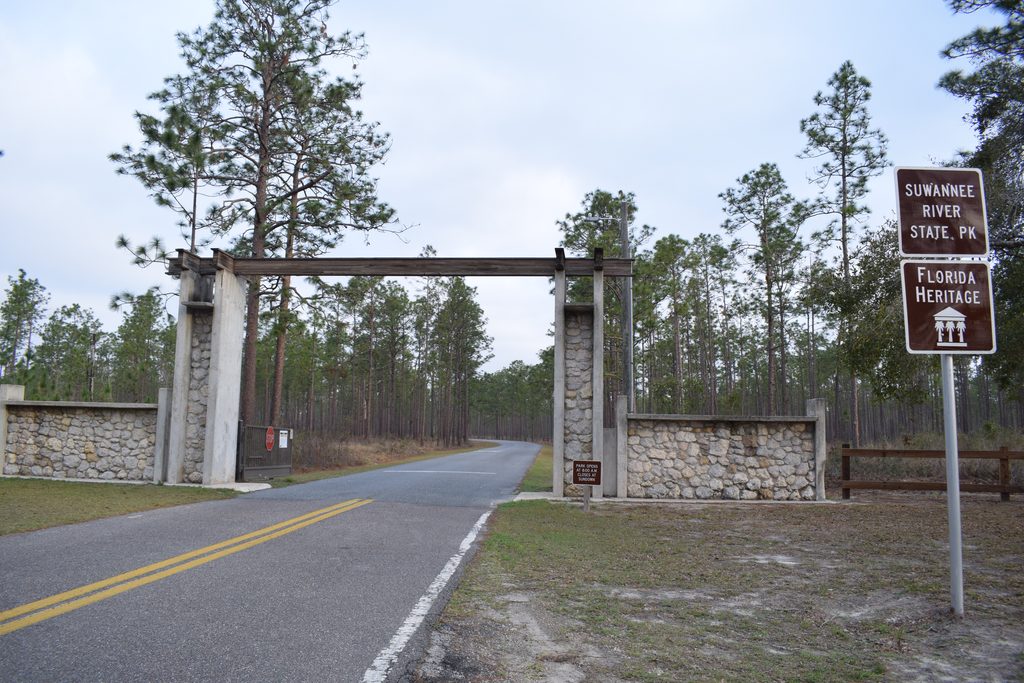
Since we were already in the area, it seemed like the perfect opportunity to change that.
There was just one small problem.
My feet were not particularly enthusiastic about another day of walking.
After the previous day’s adventures, I was sore enough that our first stop of the morning was Walmart, where I bought orthotic inserts for my boots and some Aleve.
I also bought pretty napkins to make candles with.
Because apparently, even when I’m limping through a store looking for pain relief, I can still find crafting supplies I absolutely need.
After a substantial breakfast at Waffle House, we headed toward the park.
And that’s where our unexpected adventure really began.
Exploring Suwannee River State Park
Located near Live Oak in North Florida, Suwannee River State Park protects a beautiful landscape surrounding the meeting of the Suwannee and Withlacoochee Rivers.
The park is known for its forested hiking trails, limestone formations, scenic river views, and opportunities for camping and paddling.
But beneath that natural beauty is a remarkable collection of Florida history.
Long before the park existed, people traveled, traded, settled, and fought over this region. The rivers served as transportation routes, connecting inland communities with other parts of Florida.
And during the 19th century, a town called Columbus developed near this important river junction.
When we arrived, there wasn’t a ranger on duty, so we found somewhere to park and studied the trail map.
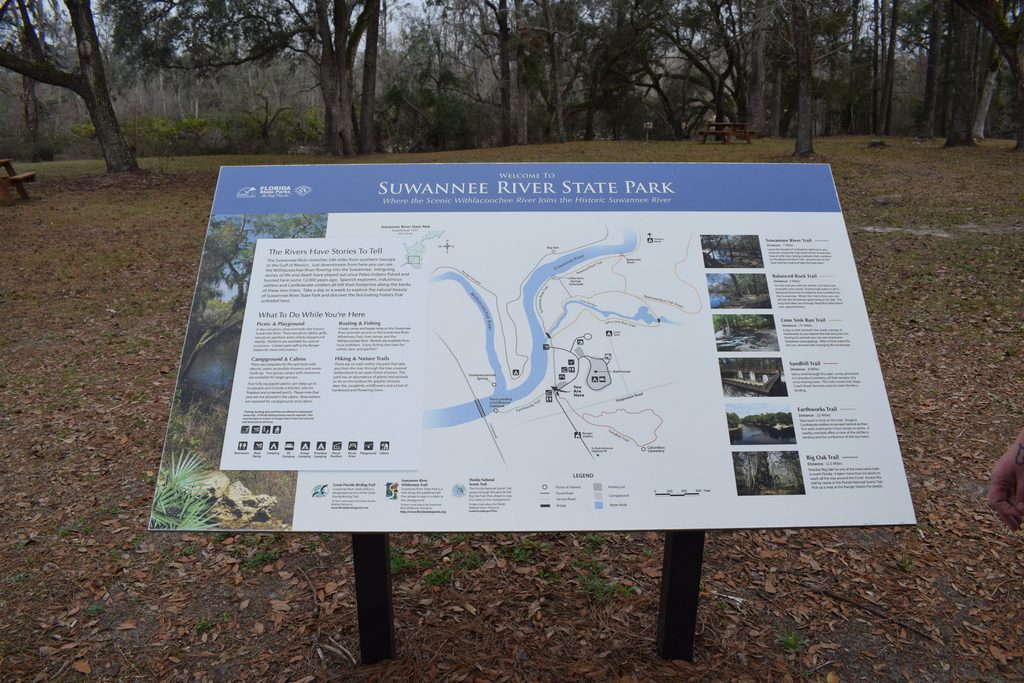
It quickly became obvious that we weren’t going to explore everything in one visit.
Too old. Too tired. Too owie.
We settled on two priorities: the Sandhill Trail and the Earthworks Trail.
Our first destination was the old Columbus Cemetery.
And that meant we were about to walk into the remains of a forgotten town.
The Lost Town of Columbus, Florida
Before highways carried travelers across Florida, rivers were among the state’s most important transportation corridors.
Communities developed along waterways because boats could move passengers, supplies, and agricultural products far more efficiently than many of the primitive overland routes.
Columbus grew near the confluence of the Suwannee and Withlacoochee Rivers during the 19th century.
By the 1840s, it had become an active river community.

Steamboats traveled the Suwannee carrying passengers and commercial cargo, including cotton. Stores, a post office, and other businesses served the people who lived and worked here.
The town’s population reportedly reached several hundred residents during its more prosperous years.
Imagine standing here nearly two centuries ago.
Instead of birdsong and rustling leaves, you might have heard steamboat whistles, wagon wheels, conversations outside local businesses, and the sounds of cargo being loaded along the river.
Columbus wasn’t just a collection of buildings.
It was a community.
People worked here, raised families here, celebrated milestones, and buried their loved ones here.
Today, much of that community has disappeared beneath the forest.
But one particularly meaningful piece remains.
Hiking the Sandhill Trail to Columbus Cemetery
Our first hike took us along the Sandhill Trail, a roughly eight-tenths-of-a-mile route leading toward the old Columbus Cemetery.
Parts of the park’s trail system follow historic travel routes associated with the former town, offering a tangible connection to the people who once moved through this landscape.
I love places like this.
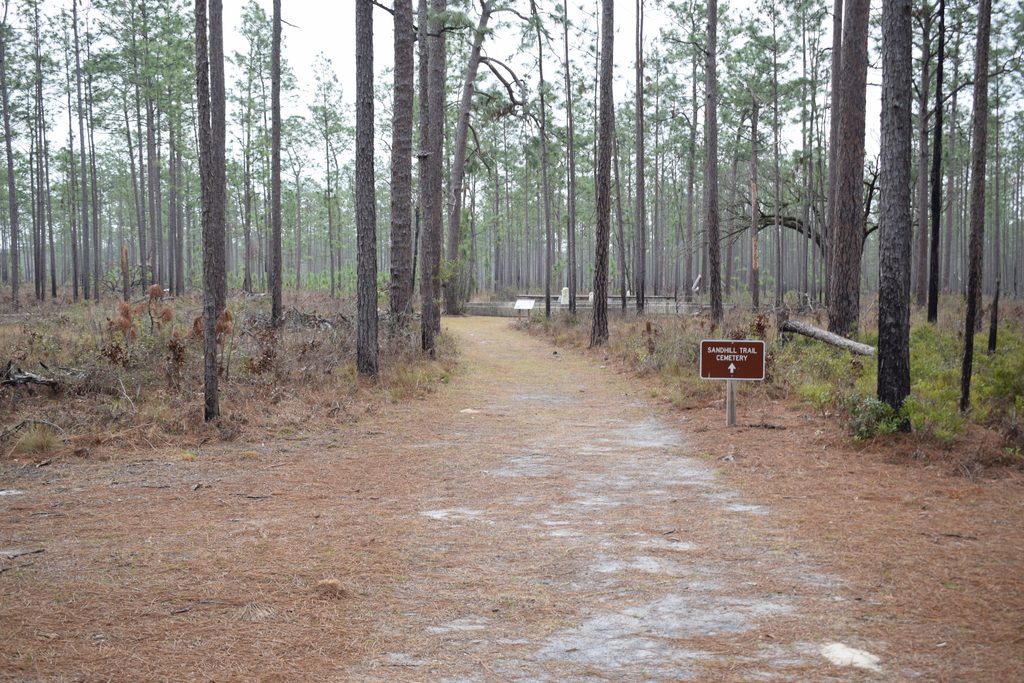
Sometimes history isn’t displayed behind museum glass or explained on a monument.
Sometimes you’re walking directly through it.
The trail wound through a quiet stretch of forest, surrounded by the kind of natural beauty that makes North Florida so special.
Unfortunately, there was something else in the woods.
Something dead.
Very dead.
We couldn’t see it, but we could certainly smell it.
And whatever it was had reached an advanced stage of decomposition.
The odor was absolutely putrid.
I have explored enough cemeteries and forgotten places to appreciate a good mystery.
This was not one of them.
I had no interest whatsoever in finding the source.
We continued toward the cemetery, preferably while breathing as little as possible.
Columbus Cemetery: Where the Ghost Town Still Has Names
Eventually, we reached the old Columbus Cemetery.
And I immediately loved it.
It was small, quiet, and tucked away among the trees.
Exactly the kind of historic cemetery I enjoy discovering.
Old brick enclosures surrounded some of the family burial plots, and weathered markers stood as reminders of the people who once called Columbus home.
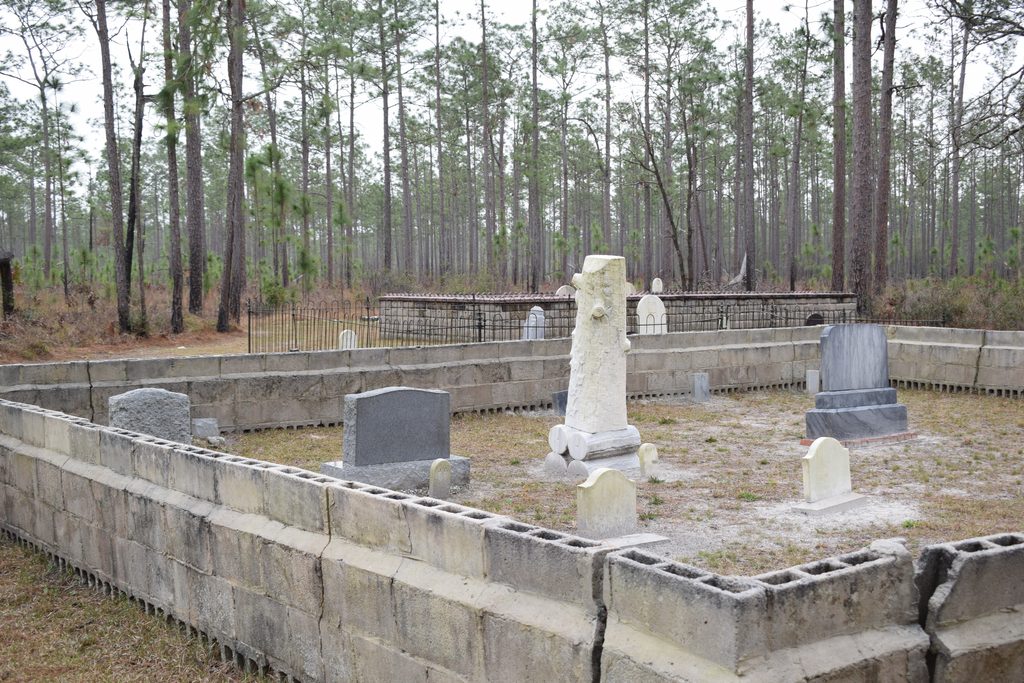
The surviving graves date back to the 19th century, preserving a personal connection to the vanished community.
For me, cemeteries often tell the most meaningful part of a place’s history.
It’s one thing to read that Columbus once had stores, steamboats, and hundreds of residents.
It’s something else entirely to stand among the graves of the people who lived here.
These weren’t simply names in a history book.
They were parents, children, neighbors, merchants, and members of a community that no longer exists.
They experienced ordinary days and extraordinary ones, just as we do.
And while their homes and businesses have largely disappeared, some of their names remain carved into stone.
That’s what makes old cemeteries so fascinating to me.
They turn a forgotten place back into a human story.
We spent time exploring the small cemetery and photographing what remained before returning toward the parking area.
And then it was time for our next trail.
An Owl With Terrible Customer Service
Before we got very far along the Earthworks Trail, I spotted something moving overhead.
An owl!
It flew across the trail and landed on a nearby branch.
Naturally, I started taking pictures.

Unfortunately, I didn’t have the lens I really wanted.
So I went back to the truck to retrieve my larger lens, thinking I’d finally get some beautiful close-up photographs.
You can probably guess what happened next.
The moment I started walking back toward the owl, it flew away.
Of course it did.
Apparently, the owl had agreed to a brief appearance but had not authorized a professional photo session.
I wasn’t particularly surprised.
But I was annoyed with myself.
I’d brought the equipment I needed. I just hadn’t brought it with me onto the trail.
Lesson learned.
Make a camera gear bag.
And then actually use it.
Unfortunately, the owl wasn’t finished causing problems for me.
Because my next photographic subject was going to be a little difficult to capture with that enormous lens.
Civil War History Along the Earthworks Trail
Suwannee River State Park preserves more than the remains of Columbus.
It also contains surviving Civil War earthworks built to help defend a strategically important railroad crossing.
During the Civil War, Florida supplied the Confederacy with food, livestock, and other materials.

Railroads were essential for moving those supplies, particularly as Union military operations disrupted other transportation routes.
The railroad bridge over the Suwannee River near Columbus became an important part of that network.
In February 1864, Union forces advanced westward from Jacksonville during a campaign that threatened Confederate transportation and supply lines.
The railroad crossing at the Suwannee River was among the strategically important objectives farther west.
Confederate troops prepared defenses near Columbus in anticipation of a possible attack.
Those defenses included earthen embankments and ditches designed to provide protection and strengthen the position around the crossing.
More than 160 years later, portions of those earthworks are still visible.
And we were walking right through them.
Walking Through Defenses Built for a Battle That Never Came
Unlike a stone fort or an old brick building, Civil War earthworks can be surprisingly difficult to recognize.
They’re part of the landscape.
Raised banks of soil, shallow depressions, and defensive ditches don’t necessarily look dramatic until you understand why they’re there.

But once you know what you’re looking at, the terrain begins to tell its own story.
Men worked to construct these defenses because they believed an attack might be coming.
They were preparing to protect a railroad crossing that had become valuable to the Confederate war effort.
Yet the anticipated Union advance never reached Columbus.
On February 20, 1864, Confederate forces defeated the Union advance at the Battle of Olustee, the largest Civil War battle fought in Florida.
The Confederate victory stopped that particular Union campaign before it reached the Suwannee River crossing.
The earthworks at Columbus were never tested in the battle they had been built to withstand.
And today, they remain quietly beneath the trees.
I found that fascinating.
So much work went into preparing these defenses, yet the battle that gave them purpose was fought elsewhere.
History doesn’t always leave behind evidence of what happened.
Sometimes it leaves behind evidence of what people feared might happen.
As for photographing the earthworks?
Well, remember that giant lens I’d retrieved for the owl?
It wasn’t particularly useful for photographing large sections of ground.
I really should have kept both lenses with me.
The owl had now managed to sabotage my photography efforts twice without even being present.
Impressive, really.
Why Did Columbus, Florida, Disappear?
Standing among the surviving traces of Columbus raises an obvious question.
If this community was once such an important river port, what happened to it?
The answer wasn’t a single catastrophic event.
It was a gradual shift in how people traveled, worked, and conducted business.
As transportation networks changed during the 19th century, river communities that had once depended on steamboat commerce faced growing competition from railroads and developing industrial centers.

And Columbus had a particularly significant neighbor.
Across the river, businessman George Franklin Drew, who would later serve as governor of Florida, established a major sawmill operation at Ellaville.
The mill helped transform Ellaville into an important industrial community, drawing economic activity toward the growing settlement.
Meanwhile, Columbus gradually lost the commercial importance that had once sustained it.
Businesses disappeared.
Families moved away.
Buildings were abandoned or removed.
And over time, the forest reclaimed much of the former town.
There wasn’t necessarily one dramatic final day when Columbus ceased to exist.
Its decline unfolded over years.
That’s something I find especially interesting about ghost towns.
We often imagine abandoned communities disappearing because of a disaster, a violent event, or some mysterious tragedy.
But sometimes the explanation is much simpler.
The world changes.
The economy moves elsewhere.
And a place that once seemed essential slowly becomes unnecessary.
Eventually, all that’s left are fragments of the community that used to be there.
One More Trail… Because Apparently We Hadn’t Walked Enough
After exploring the Sandhill and Earthworks Trails, we still had some time before our next scheduled stop.
And despite our earlier agreement that we were too old, too tired, and too owie to explore the entire park, we decided to attempt another trail.
The Limestone Trail.
That was optimistic.

We started walking, but the terrain eventually became more strenuous than we wanted to tackle that morning.
So we turned around.
Sometimes knowing when to stop is just as important as knowing where to go.
Especially when your feet have already submitted several formal complaints.
Fortunately, the walk back provided one final surprise.
Two Cardinals and a Little Photographic Redemption
On our way back, we spotted a male and female cardinal.
And this time, I had exactly the lens I needed.
Finally!

After losing the owl and struggling to photograph the earthworks, I managed to get some wonderful close-up pictures of the cardinals.
I was ridiculously happy.
It’s funny how a small moment like that can turn an ordinary walk into something memorable.
We’d spent the morning exploring a ghost town, an old cemetery, and Civil War defenses.
But two little birds ended up providing one of my favorite photographic moments of the day.
Sometimes nature gives you something better than what you were originally looking for.
And sometimes it just makes you work for it.
Planning Your Visit to Suwannee River State Park
If you enjoy Florida history, hiking, old cemeteries, or exploring places that don’t immediately reveal all their secrets, Suwannee River State Park deserves a place on your itinerary.
Location: Suwannee River State Park, near Live Oak, Florida
What to explore: The park offers hiking trails, scenic river landscapes, historic sites, and opportunities for camping and paddling.
Historic highlights: Columbus Cemetery, surviving Civil War earthworks, and historic transportation routes associated with the former town of Columbus.
Trails we explored: Sandhill Trail, Earthworks Trail, and part of the Limestone Trail.
A Few Tips From Our Visit
- Check the trail map before heading out. There’s more to explore than you may be able to comfortably cover in one visit.
- Wear supportive walking shoes. Some trails may have uneven terrain, exposed roots, or more challenging sections.
- Bring water and insect protection. This is Florida, after all.
- Carry the camera equipment you’ll actually need. Trust me on this one.
- Respect the historic sites. Leave gravestones, brickwork, earthworks, and other surviving features undisturbed.
- Check current park conditions. Trail access, hours, fees, and facilities can change.
For current visitor information, check the official Suwannee River State Park website.
And if you enjoy historic cemeteries, give yourself enough time to explore Columbus Cemetery without rushing.
For me, it was one of the most memorable parts of the park.
What Stayed With Me
When I think back on our visit, I remember the cemetery first.
Not because it was particularly large or elaborate.
It wasn’t.
I remember it because of what it represented.
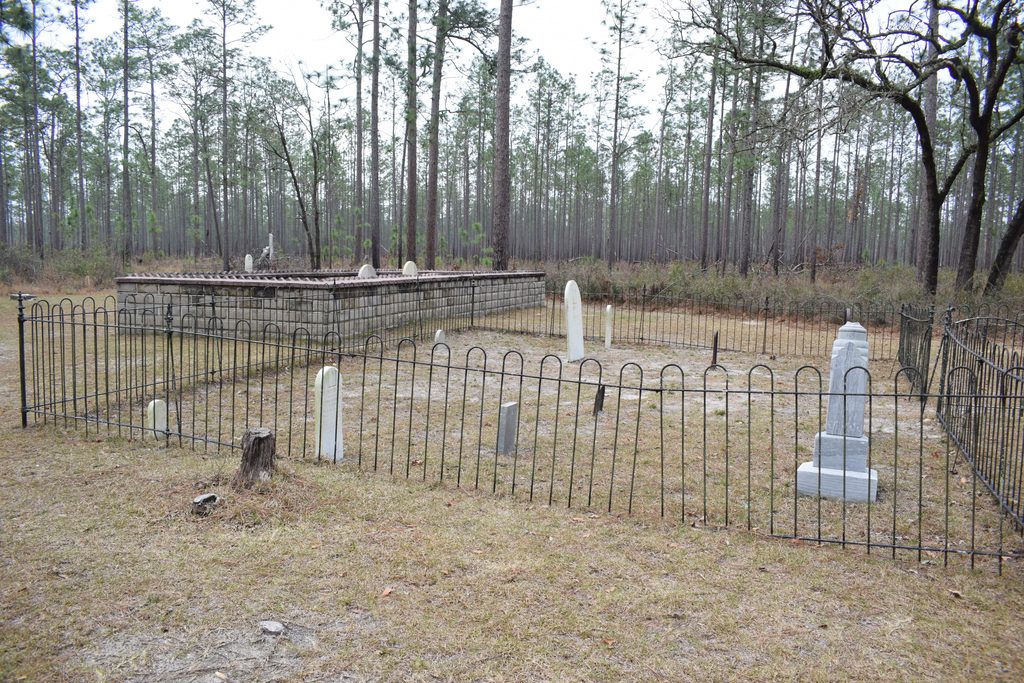
Columbus was once a real community filled with people going about their everyday lives.
They had businesses to run, families to care for, and plans for their futures.
They couldn’t have known that someday their town would largely disappear beneath the trees.
And yet, that’s exactly what happened.
Today, people come to Suwannee River State Park to hike, camp, paddle, and enjoy the natural beauty of the rivers.
Some may never realize they’re exploring land that once supported a thriving community.
Others might notice the cemetery or the earthworks and wonder what happened here.
And that’s where the story begins again.
Because a forgotten place isn’t necessarily a place without history.
Sometimes it’s simply a place whose history is waiting for someone to notice.
And Columbus isn’t the only place along the Suwannee River where the past is still waiting to be discovered. Farther upstream, the historic White Sulphur Springs Bathhouse tells another fascinating story of a Florida destination that once drew visitors from far and wide, only to see its glory days fade into history.
Final Thoughts: More Than Just a Florida State Park
Suwannee River State Park turned out to be much more than an unexpected stop on our itinerary.
We came because Dusty had been talking about the park for a while and we suddenly had some extra time.
We left having explored the remains of a forgotten river town, visited its cemetery, and walked through Civil War defenses that had survived for more than a century and a half.
We also encountered an uncooperative owl, two much more accommodating cardinals, and something in the woods that smelled like it had been dead since the Civil War.
I’m kidding.
Probably.

But that’s what I love about exploring Florida’s back roads and historic places.
You never know what you’re going to find.
Sometimes it’s a beautiful river.
Sometimes it’s an old cemetery.
And sometimes, hidden beneath the trees of an ordinary-looking state park, it’s an entire town that the world has nearly forgotten.
Columbus may have disappeared from the map, but its story is still here.
You just have to follow the trail.
Come Explore With Us!
Want to see the old Columbus Cemetery, walk the Civil War earthworks, and experience our visit to Suwannee River State Park?
🎥 Watch our Suwannee River State Park adventure on YouTube
And if you enjoy discovering forgotten Florida towns, historic cemeteries, and the stories hiding along America’s back roads, subscribe to Travel Made Personal for more adventures.
Real Places. True Stories. Travel Made Personal.
🌲 Love discovering the history hiding in unexpected places?
From forgotten ghost towns and historic cemeteries to scenic back roads and places most travelers overlook, there’s always another story waiting to be uncovered.
Join the Travel Made Personal mailing list for new adventures, fascinating history, and a little mischief along the way—delivered straight to your inbox.
Because every place has a story. Let’s go find it! ❤️

If you see this after your page is loaded completely, leafletJS files are missing.