
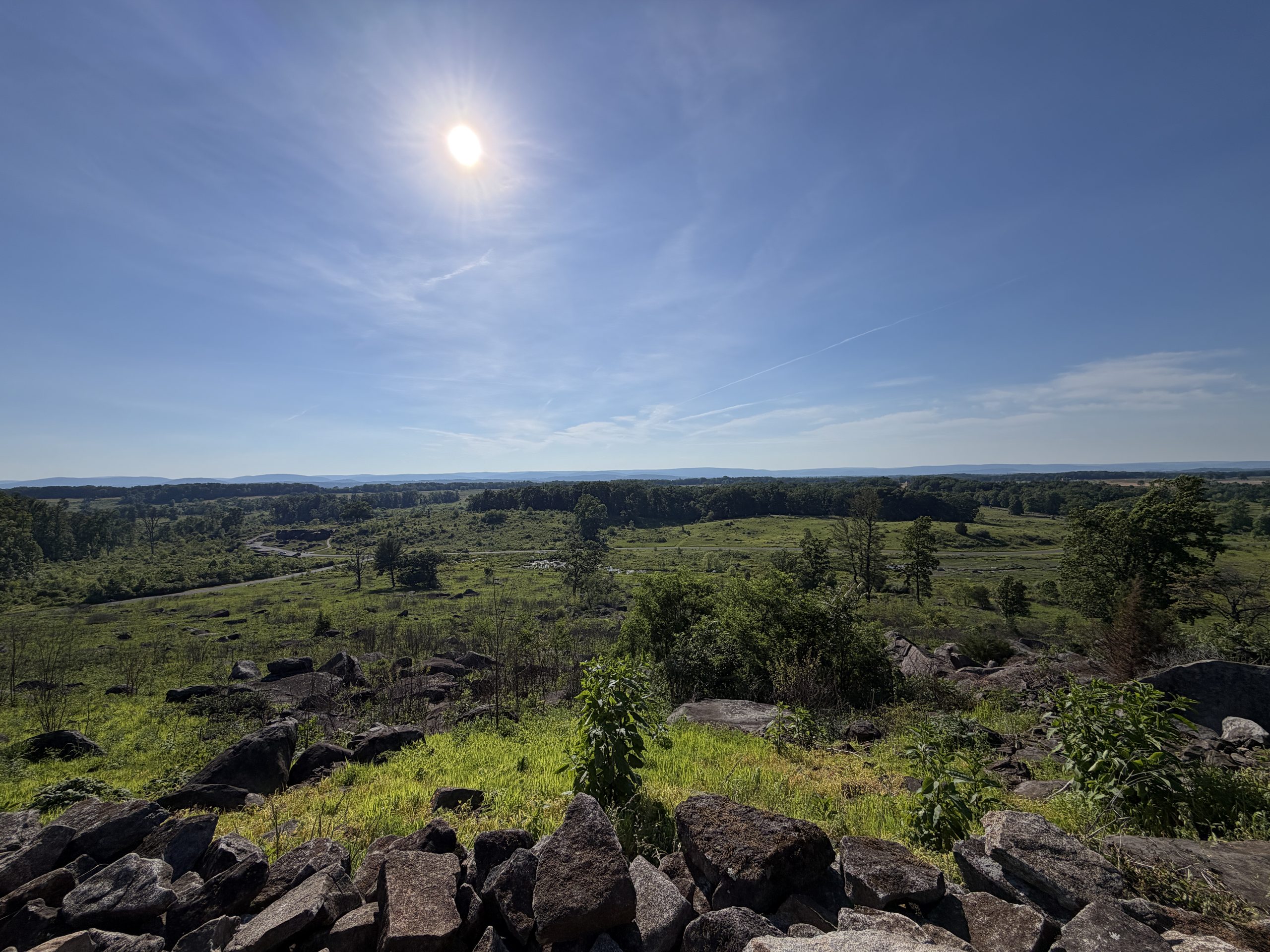
Gettysburg National Military Park | Gettysburg, Pennsylvania
There are places where ghost stories seem to have been added to the history later. And then there are places like Gettysburg, where the history itself is haunting enough.
For three days in July 1863, the rolling fields and rocky hills surrounding this small Pennsylvania town became the setting for one of the bloodiest battles of the American Civil War. When the fighting ended, approximately 51,000 soldiers had been killed, wounded, captured, or reported missing.
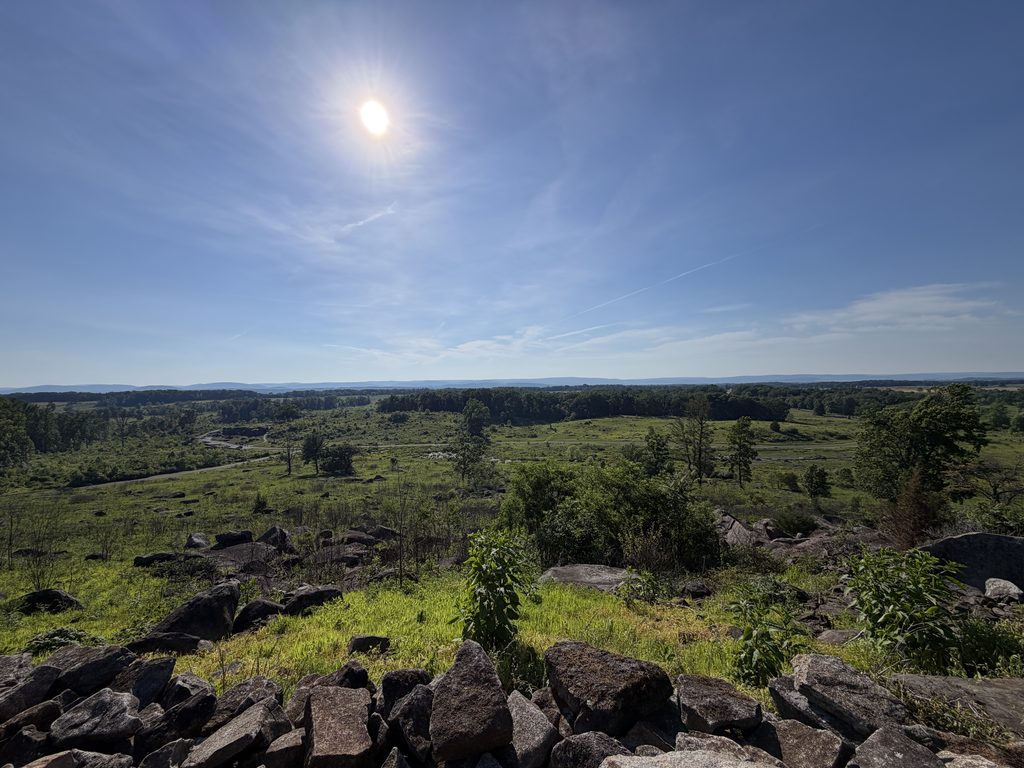
More than 160 years later, Gettysburg National Military Park preserves the landscape where those events unfolded. Monuments stand where regiments fought, cannons overlook quiet fields, and visitors follow roads that wind through places forever associated with courage, suffering, and loss.
But Gettysburg has another reputation.
For generations, people have reported unexplained footsteps, phantom gunfire, mysterious figures, and soldiers who supposedly never left the battlefield.
Is Gettysburg really haunted? Or have the events of July 1863 inspired legends that continue to grow with every passing generation?
We weren’t there to investigate the paranormal. We came to explore the battlefield, revisit its history, and discover what makes Gettysburg such an unforgettable place.
And, apparently, to take a nap.
But we’ll get to that.
The Battle That Changed Gettysburg Forever
On July 1, 1863, Confederate forces under General Robert E. Lee encountered Union troops near Gettysburg, Pennsylvania. What began as a confrontation between portions of two armies quickly escalated into a massive three-day battle.
Union forces commanded by Major General George G. Meade ultimately held the high ground south of town, forming defensive positions along Cemetery Ridge, Cemetery Hill, and Culp’s Hill.
On July 2, Confederate attacks swept across locations that would become some of the most recognizable names in Civil War history: Devil’s Den, the Wheatfield, the Peach Orchard, and Little Round Top.
The following day, Confederate troops launched a massive assault against the Union center. Remembered as Pickett’s Charge, the attack failed to break the Federal line.
Lee’s army began its retreat toward Virginia on July 4.
The Union victory at Gettysburg became a turning point in the war, but the cost was devastating.
Approximately 51,000 soldiers were casualties over the three days of fighting. The surrounding community, home to only a few thousand residents, was left to care for the wounded, bury the dead, and somehow recover from the destruction.
Homes, churches, barns, and public buildings became temporary hospitals. Farms and fields became burial grounds.
Long after the armies departed, Gettysburg’s residents continued living with the consequences.
Perhaps it isn’t surprising that a place associated with so much suffering eventually became known for its ghost stories.
Our Visit: An Unexpected Nap at Gettysburg
Gettysburg National Military Park was our final stop of the day.
When I originally planned our itinerary, I wasn’t entirely sure we’d make it to the Visitor Center before closing. Rather than risk missing anything, I scheduled Gettysburg as both our last stop that afternoon and our first stop the following morning.
Just in case.
As it turned out, we arrived around three o’clock.
Perfect!
Except we discovered that the gift shops closed at four.
Now we had a situation.
We purchased tickets for the museum and Cyclorama and headed into the orientation film.
Normally, we skip those films. But this time, we decided to be responsible historical tourists and watch the presentation.
And when I say we watched it, what I really mean is that the lights went down, the movie started, and Dusty and I promptly fell asleep.
Both of us.
I think the film lasted fifteen or twenty minutes, which apparently was exactly the power nap our bodies needed.
When the lights came back on, we woke up and started giggling.
So, unfortunately, I can’t offer a detailed review of the film.
But the seating was excellent.
The Gettysburg Cyclorama: Standing in the Middle of History
After our unexpected nap, we moved into the Gettysburg Cyclorama.
Fortunately, this experience required standing, which dramatically improved our chances of remaining conscious.
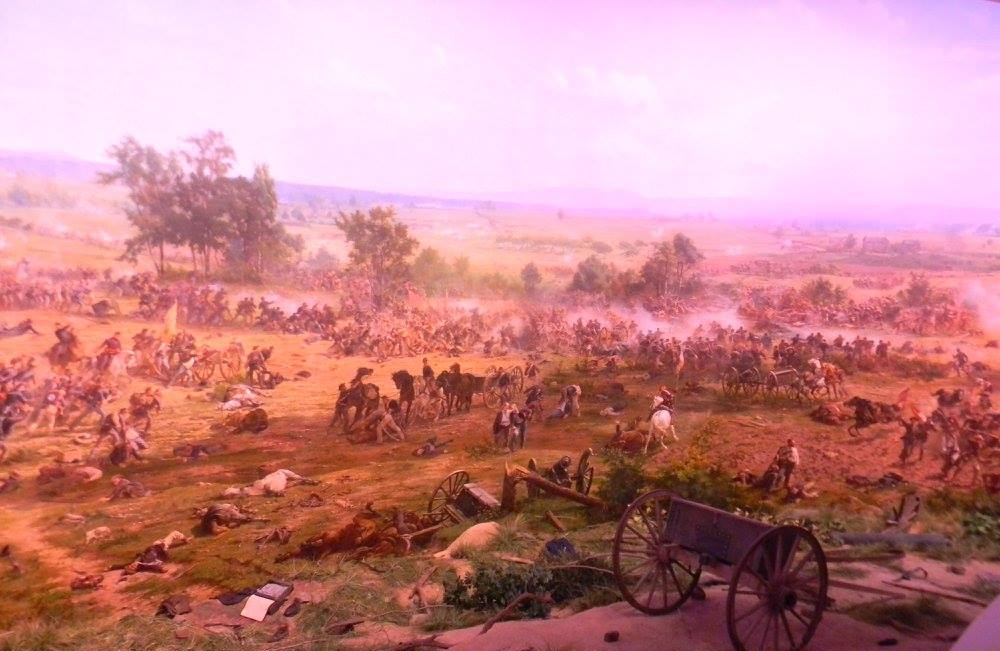
The enormous circular painting, The Battle of Gettysburg, depicts Pickett’s Charge on July 3, 1863.
Created by French artist Paul Philippoteaux in the 1880s, the painting surrounds visitors with a panoramic depiction of the battlefield. Its combination of perspective, lighting, and carefully arranged foreground elements creates the illusion of standing amid the fighting.
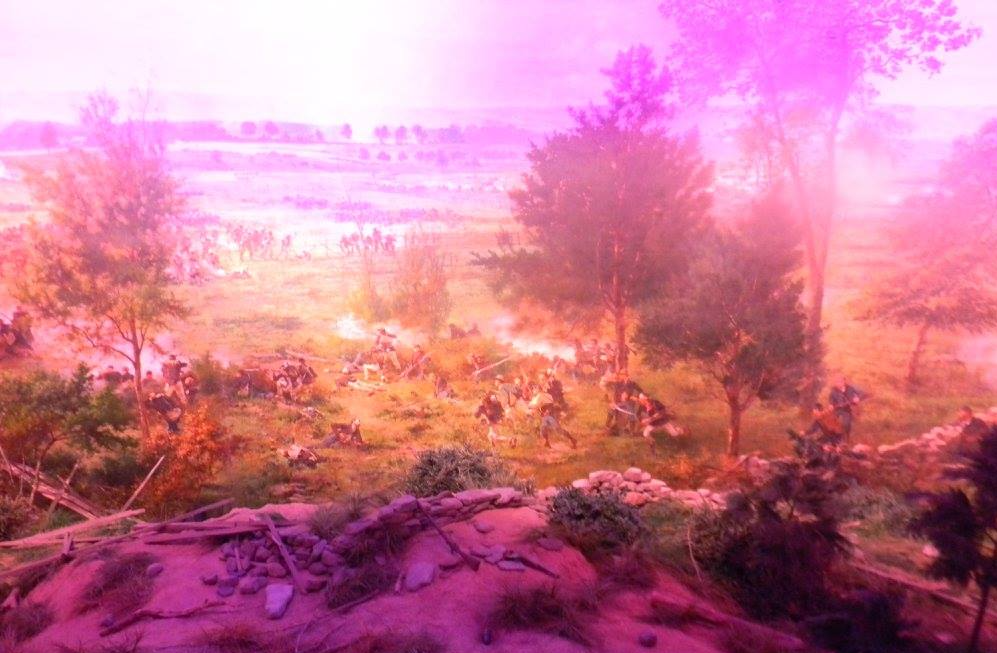
Dusty was particularly impressed by how realistic the painting looked.
And I have to agree. Even knowing you’re looking at a painting, the scale and detail are remarkable.
From there, we continued into the museum.
I’d visited Gettysburg before, and as anyone who travels with me eventually discovers, I tend to photograph absolutely everything.
Fortunately, I already had an extensive collection of museum photographs from my previous visit.
I told Dusty not to worry about me and to take her time looking at whatever interested her.
She did exactly that.
Unlike me, Dusty doesn’t photograph every exhibit, artifact, sign, and informational panel as though she’s conducting a museum inventory.
She photographs the things that catch her attention.
Consequently, we made it through the museum fairly quickly.
Which was fortunate.
Because we had approximately fifteen minutes left to shop.
Passport Stamps, Trinkets, and More Books
Every traveler has priorities.
Ours apparently include National Park passport stamps, souvenirs, and an ever-expanding collection of books.
With the gift shops preparing to close, we hurried inside to collect our stamps and find a few treasures.
Naturally, more books came home with us.
Because the books already waiting at home clearly needed company.
With the important business completed, we headed outside to begin exploring the battlefield.
This time, we were following the National Park Service auto tour.
And that’s where Gettysburg becomes an entirely different experience.
Inside the museum, you learn about the battle.
Outside, you begin to understand the landscape where it happened.
Exploring Gettysburg by Auto Tour
Gettysburg National Military Park covers thousands of acres, preserving many of the fields, hills, roads, and historic locations associated with the battle.
Following the auto tour allowed us to move through the battlefield at our own pace while listening to the history of each stop.
Dusty compared Gettysburg with Antietam National Battlefield, which we’d also explored.
She immediately noticed the difference in scale and the sheer number of monuments.
And she wasn’t wrong about the monuments.
They’re everywhere.
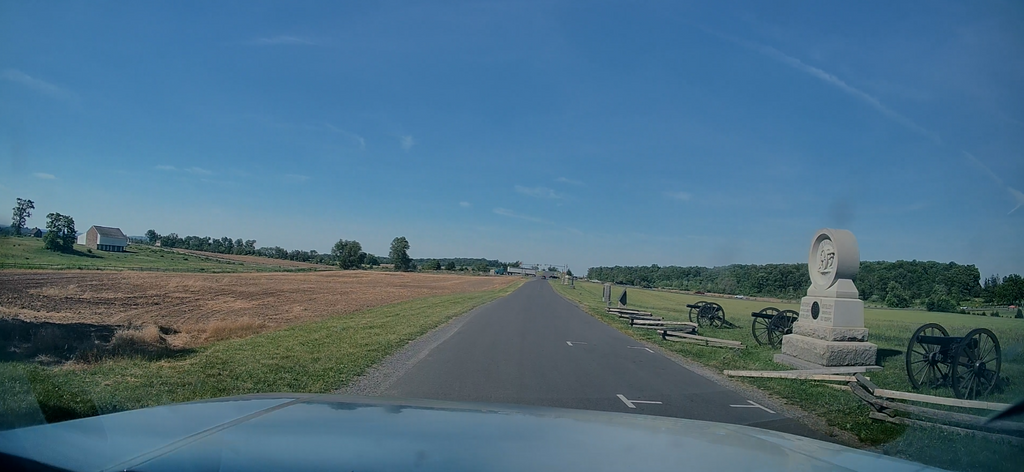
Stone memorials rise beside roads, along tree lines, and across open fields. Cannons stand near preserved artillery positions. Regimental markers identify places where soldiers fought, advanced, retreated, and sometimes died.
Each monument represents another piece of the battle’s enormous human story.
We drove from stop to stop, occasionally pulling over so Dusty could photograph something that interested her.
After all the walking we’d already done that day, the auto tour was also a welcome opportunity to give our feet a break.
Our feetsies were grateful.
Eventually, we reached one of the battlefield’s most famous locations.
Little Round Top.
Little Round Top: A Historic Rock and a Familiar View
Little Round Top played a crucial role in the fighting on July 2, 1863.
The rocky hill overlooked the Union left flank, making it strategically important to both armies.
Union Chief Engineer Brigadier General Gouverneur K. Warren recognized the danger posed by Confederate troops approaching the position and helped secure reinforcements.
Union defenders, including the 20th Maine Infantry and other regiments, fought desperately to hold the hill against Confederate attacks.
Their successful defense helped protect the Union flank.
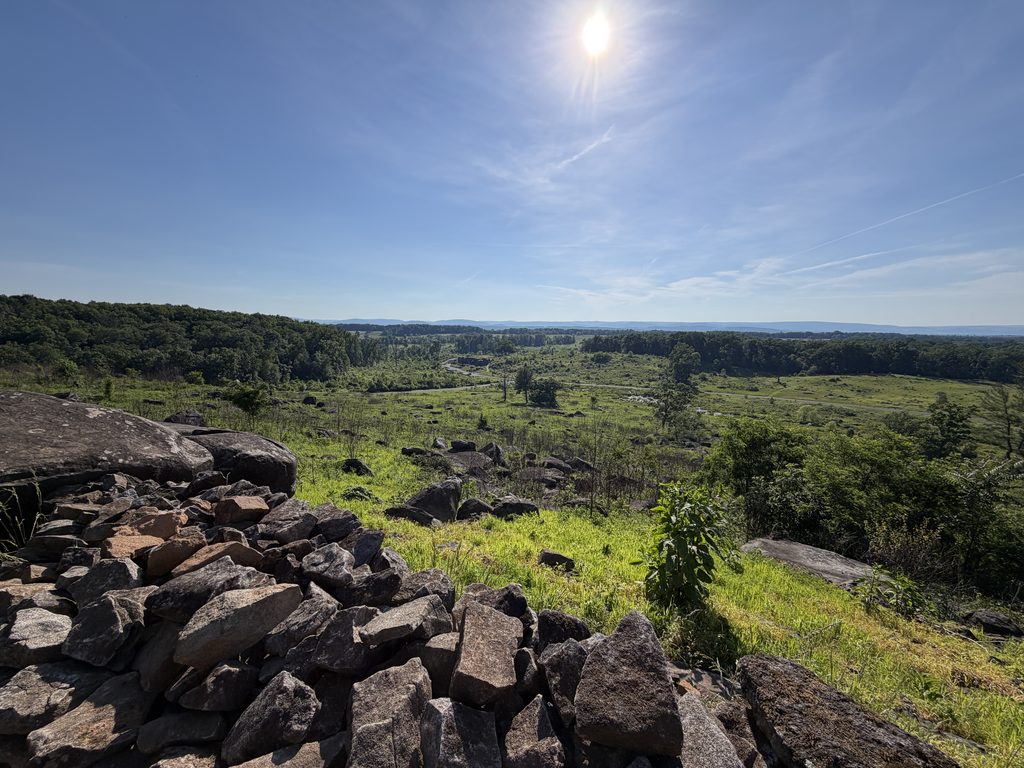
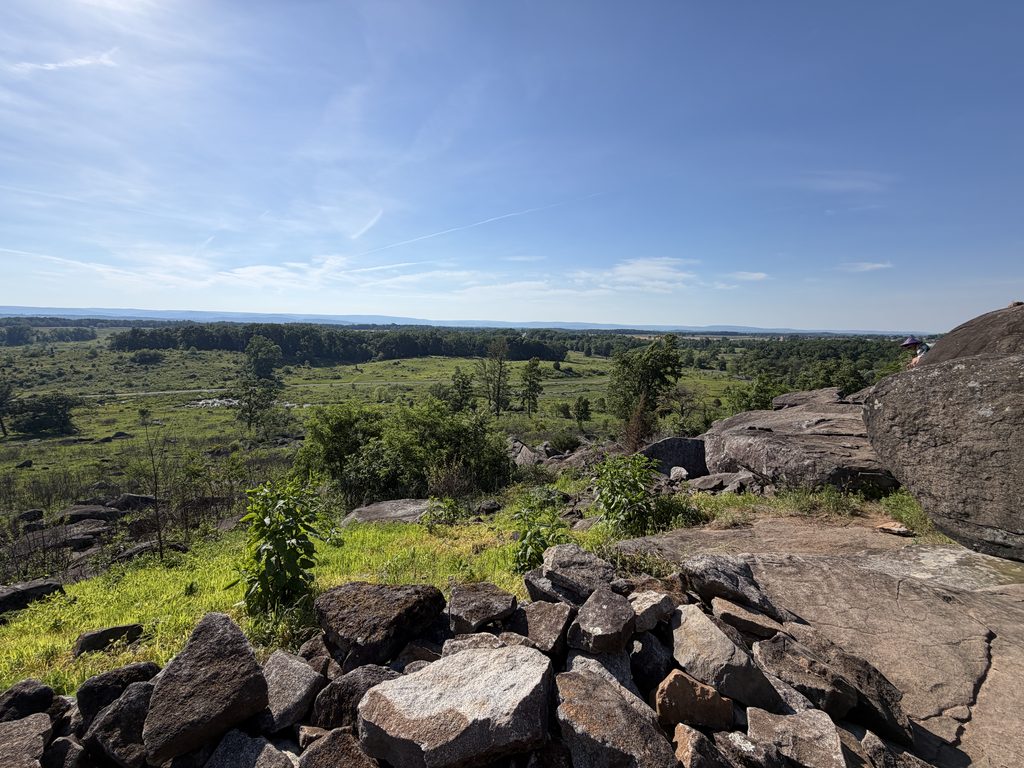
Today, Little Round Top offers sweeping views across the surrounding battlefield.
It’s a remarkable place to stand, particularly when you consider what happened on the slopes below.
But Little Round Top also holds a rather different memory for me.
During a previous visit with my son, he sat down on one of the boulders and proudly announced that he was sitting on a historic rock.
Naturally, I told Dusty that story.
And naturally, Dusty decided we needed to continue the tradition.
She sat down on another boulder, grinned at me, and invited me to join her for a selfie on a historic rock.
So we did.
Two grown women, happily sitting on a historic rock, giggling like children.
Sometimes those are the memories that stay with you just as much as the history.
But from the heights of Little Round Top, you can also look toward another location with a much darker reputation.
Devil’s Den.
Devil’s Den: Gettysburg’s Most Famous Ghost Stories
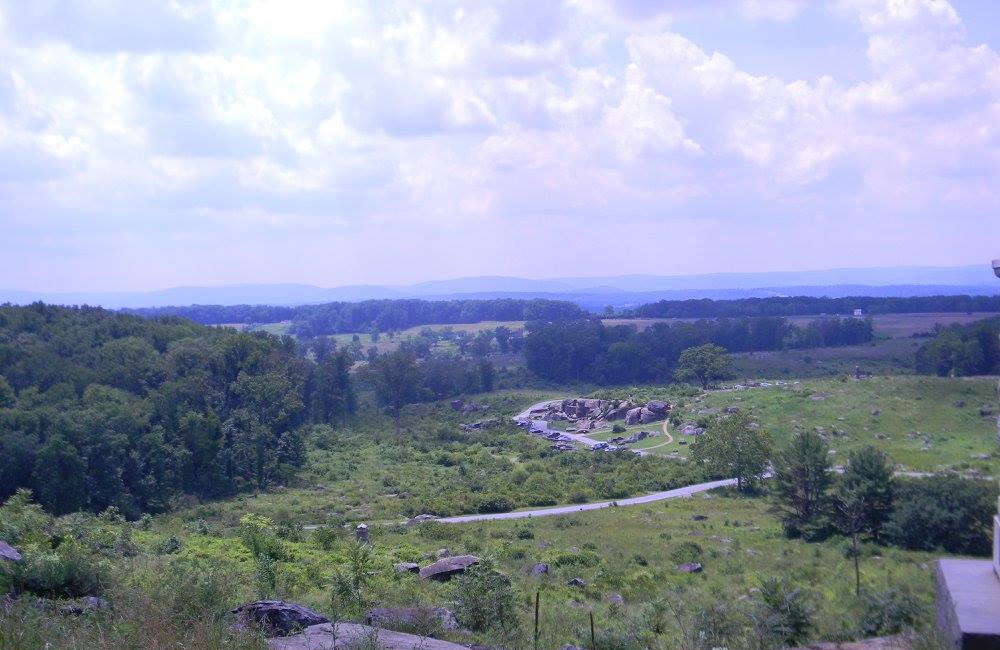
Below Little Round Top lies Devil’s Den, a dramatic formation of enormous granite boulders.
On July 2, 1863, this rocky landscape became the scene of fierce fighting between Union and Confederate troops.
The boulders provided cover, but the irregular terrain also created dangerous conditions for soldiers attempting to maneuver through the area.
After the battle, photographer Alexander Gardner and his assistants photographed the dead among the rocks, producing some of the Civil War’s most recognizable images.
One famous photograph, often called Home of a Rebel Sharpshooter, has also become part of the historical discussion surrounding Gettysburg photography because the body appears to have been repositioned for the image.
Even without the ghost stories, Devil’s Den is an unsettling place when you know its history.
But its paranormal reputation has grown considerably over the years.
Gettysburg isn’t the first place we’ve explored where documented tragedy and paranormal folklore have become intertwined. During our visit to Trans-Allegheny Lunatic Asylum, we encountered another historic location whose complicated past continues to inspire ghost stories.
The Barefoot Soldier of Devil’s Den
One of Gettysburg’s best-known ghost legends involves a barefoot soldier reportedly seen wandering among the rocks.
According to versions of the story, visitors encounter a man dressed in clothing resembling a Confederate uniform.
Sometimes he appears to offer directions.
One frequently repeated line attributed to the mysterious figure is:
“What you’re looking for is over there.”
Then, according to the legend, the soldier disappears.
Some versions associate the apparition with a Texas soldier, although no reliable historical evidence establishes the identity of a ghost.
Other visitors have reported unexplained figures, unusual sounds, and electronic equipment behaving strangely around Devil’s Den.
These accounts belong to Gettysburg’s paranormal folklore rather than its documented military history.
We didn’t encounter the barefoot soldier during our visit.
But it’s easy to understand why a place with such a dramatic landscape and tragic past has inspired stories that continue to circulate generations later.
The Wheatfield and the Valley of Death
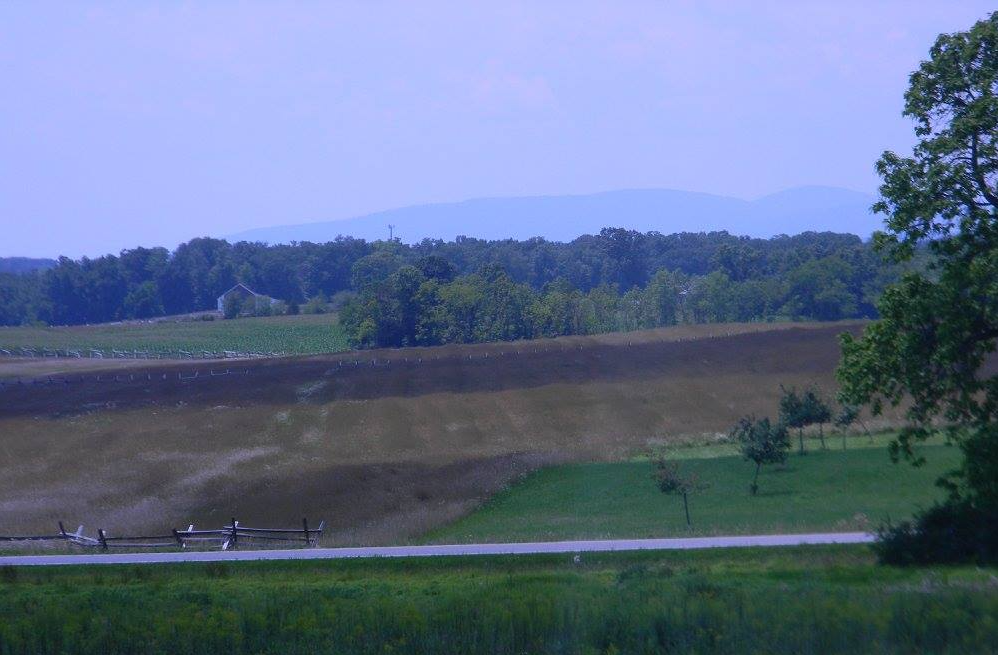
Another location associated with Gettysburg’s haunted reputation is the Wheatfield.
On July 2, 1863, Union and Confederate forces fought repeatedly for control of this relatively small area.
The fighting was chaotic and extraordinarily destructive, with control of the field changing hands multiple times.
Nearby, the low ground between Devil’s Den and Little Round Top became known as the Valley of Death.
Today, these locations can appear almost peaceful.
Trees sway in the breeze. Grass covers the fields. Visitors stop to read monuments and admire the landscape.
But the quiet scenery conceals a violent history.
And according to Gettysburg’s ghost lore, the battlefield isn’t always as quiet as it appears.
Phantom Gunfire and Soldiers Who Never Left
Visitors have described hearing what they believe to be distant gunfire, cannon blasts, marching footsteps, and drums across portions of the battlefield.
Others have claimed to see figures dressed in Civil War-era uniforms appearing briefly before vanishing.
Some paranormal enthusiasts interpret these stories as residual hauntings—the idea that traumatic events somehow leave an impression that can be experienced later.
There is no established scientific evidence demonstrating that such hauntings occur.
Still, the stories remain an enduring part of Gettysburg’s cultural landscape.
Perhaps the most interesting question isn’t whether every unexplained sound has a supernatural explanation.
It’s why these particular stories continue to resonate.
When you know thousands of soldiers fought and suffered on the ground beneath your feet, even an ordinary sound can take on a different meaning.
It’s a distinction we encountered while exploring the Old Franklin County Jail, better known in local ghost lore as the Cross Key Hotel. The documented history tells one story, while the legends that developed afterward tell another.
The Aftermath: Gettysburg’s Most Haunting History
For me, the most haunting part of Gettysburg isn’t a ghost story.
It’s what happened after the fighting stopped.
The battle left an enormous number of wounded soldiers scattered across the surrounding countryside.
Local residents and volunteers struggled to provide food, shelter, and medical care.
Camp Letterman, a large general hospital established east of Gettysburg, eventually treated thousands of wounded Union and Confederate soldiers.
Meanwhile, the work of burying the dead continued.
Temporary graves dotted farms and fields.
Families searched for loved ones.
Residents faced the enormous task of rebuilding their community while living among reminders of the battle.
Later that year, the Soldiers’ National Cemetery was dedicated to provide a more permanent resting place for Union dead.
On November 19, 1863, President Abraham Lincoln delivered the Gettysburg Address during the cemetery’s dedication ceremonies.
His brief remarks transformed the battlefield into something larger than a military victory.
Gettysburg became a place where Americans were asked to consider the meaning of sacrifice, national unity, and the unfinished work of the nation.
Those are the stories that give this landscape its weight.
Whether or not anyone believes the battlefield is haunted, its history deserves to be remembered.
Visiting places like Gettysburg reminds me why preserving historic landscapes matters. Whether we’re exploring a battlefield or walking the grounds of George Washington’s Mount Vernon, these places help connect the historical record to the people who lived it.
Is Gettysburg Really Haunted?
Gettysburg is frequently described as one of America’s most haunted battlefields.
The stories range from mysterious soldiers wandering among the boulders of Devil’s Den to phantom sounds echoing across the Wheatfield.
But folklore and documented history aren’t the same thing.
The Battle of Gettysburg happened.
The casualties, military movements, hospitals, burials, and aftermath are supported by historical records.
The ghost stories are accounts and legends passed down over time.
That doesn’t mean they aren’t interesting.
Quite the opposite.
I find the relationship between history and folklore fascinating.
We encountered that same fascinating relationship between history and folklore at Tybee Island Lighthouse, where generations of maritime history have inspired stories about those who may never have left.
Sometimes a ghost story encourages someone to visit a place they might otherwise overlook.
Then they begin reading about what happened there.
They discover the people involved.
And suddenly, the history becomes personal.
We didn’t experience anything paranormal at Gettysburg.
We experienced something different.
We explored a battlefield, revisited stories we’d learned before, discovered new details, laughed together, and took a selfie on a historic rock.
And for me, that’s more than enough.
Planning Your Visit to Gettysburg National Military Park
Gettysburg National Military Park is located in Gettysburg, Pennsylvania, and offers numerous opportunities to explore Civil War history.
Start at the Museum and Visitor Center
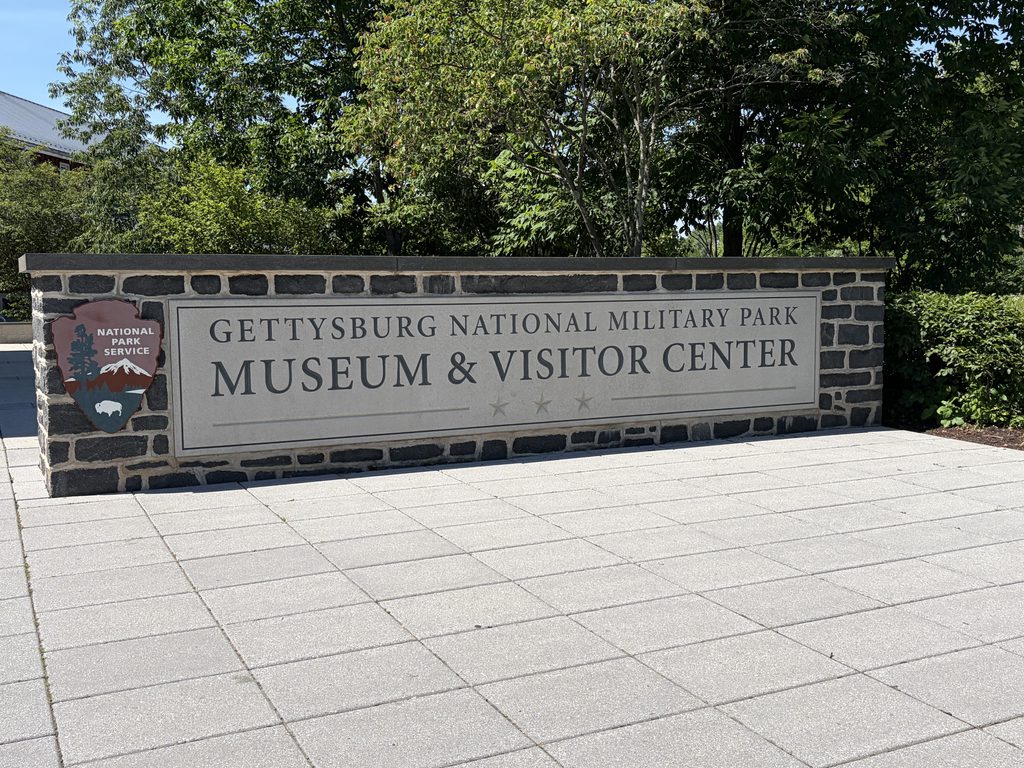
The Gettysburg National Military Park Museum and Visitor Center is an excellent starting point.
Here, visitors can explore museum exhibits, watch the orientation film, and experience the Gettysburg Cyclorama.
The film, museum, and Cyclorama are ticketed experiences, while access to many battlefield areas is free.
Allow sufficient time to explore the exhibits without feeling rushed.
And perhaps avoid scheduling the film at the end of an exhausting travel day.
Unless you need a nap.
Explore the Battlefield
The battlefield auto tour provides an accessible way to explore major locations throughout the park.
Visitors can also take advantage of ranger programs and licensed battlefield guide services.
If you enjoy photography, history, or simply exploring historic landscapes, plan extra time for stops along the route.
Little Round Top, Devil’s Den, Cemetery Ridge, and other battlefield locations each offer different perspectives on the events of July 1863.
Allow More Time Than You Think
Gettysburg is not a place I’d recommend rushing.
Between the museum, Cyclorama, monuments, scenic overlooks, and battlefield stops, there’s easily enough to fill an entire day.
For visitors who enjoy detailed historical exploration, multiple days would be even better.
Our afternoon worked because I’d already visited before, and we were able to focus on the places and experiences that interested us most.
Check Current Park Information
Before visiting, check the National Park Service website for current operating hours, road closures, tour information, and visitor center details.
Some roads and historic areas may have seasonal restrictions or temporary closures.
Official website: https://www.nps.gov/gett/
Museum and Visitor Center: https://www.gettysburgfoundation.org/
And one final recommendation?
Leave room in your luggage for books.
Trust me.
What Stayed With Me
Gettysburg is one of those places where the landscape tells a story even when nobody is speaking.
The monuments, rocky hills, open fields, and preserved roads make it possible to imagine the enormous scale of what happened here.
But the memories I brought home weren’t exclusively solemn.
I remember Dusty being impressed by the Cyclorama.
I remember us waking up after accidentally sleeping through the film.
I remember rushing into the gift shop with fifteen minutes to spare.
And I remember sitting on a historic rock, laughing about something my son had said during an earlier visit.
Those moments don’t diminish the history.
They remind me that visiting historic places is also about the memories we make while learning about the people who came before us.
Final Thoughts: When History Becomes the Haunting
Gettysburg has earned its place in American history through the events of July 1863.
Its ghost stories have added another layer to the landscape, drawing curious visitors who want to know whether soldiers still wander the fields where they once fought.
I can’t tell you whether the barefoot soldier of Devil’s Den exists.
I can’t tell you whether phantom gunfire truly echoes across the Wheatfield.
And I certainly can’t tell you whether Gettysburg is America’s most haunted battlefield.
But I can tell you that the people who fought here were real.
Their suffering was real.
Their stories deserve to be remembered.
And perhaps that’s what I appreciate most about exploring places associated with paranormal legends.
The ghost story makes us curious. Curiosity makes us look backward. And somewhere along the way, we find the people.
Gettysburg was the perfect place to close our 2026 TMP Haunts season.
Because sometimes the most powerful haunting isn’t something we see or hear.
It’s the history that stays with us long after we’ve gone home.
Until next October, keep exploring.
Because every place has a story.
And some stories refuse to fade.
Gettysburg brings our inaugural season of TMP Haunts to a close, but the stories don’t end here. From historic hotels and forgotten jails to lighthouses and battlefields, we’ve spent this season exploring the history behind some extraordinary legends.
Travel Made Personal explores historic places through documented history, local folklore, and firsthand travel experiences. Paranormal legends are presented as folklore, not verified supernatural events.
👻 Some stories refuse to fade…
From haunted battlefields and forgotten cemeteries to historic places hiding extraordinary stories, there’s always another mystery waiting down the road.
Join the Travel Made Personal mailing list for monthly travel adventures, fascinating history, behind-the-scenes stories, and a few unexpected detours along the way.
📬 Because every place has a story—and you never know where the next one will lead!

If you see this after your page is loaded completely, leafletJS files are missing.