

Introduction: Where the River Still Waits
There are places that vanish quietly, and then there are places like Ellaville—towns that don’t disappear so much as sink.
Tucked along a bend of the Suwannee River, Ellaville was once one of Florida’s most prosperous lumber towns. In the late 1800s, steam whistles echoed through the trees, steamboats lined the docks, and one of the largest sawmills in the state chewed through yellow pine day and night. Money flowed. Confidence soared. A governor’s mansion rose from the wilderness.
Then the trees ran out.
Then the fires came.
Then the river decided it was done waiting.

Today, Ellaville exists as a ghost town—its streets reclaimed by forest, its ruins softened by moss, its story written in waterlines and rust. We visited Ellaville during a brief calm between hurricanes, when fallen trees blocked old paths and caution outweighed curiosity. We stayed close to the ruins this time, listening more than wandering. Ellaville has learned patience. It isn’t in a hurry to be explored.
A Town Built on Timber and Ambition
Ellaville was founded in the early 1860s by George Franklin Drew, a businessman from New Hampshire who came to Florida chasing a second fortune after losing his first. He named the settlement Ellaville in honor of Ella, a long-serving African American member of his household—a detail that still lingers quietly in the town’s legacy.
After the Civil War, Drew partnered with Prussian immigrant Louis Bucki and went all in on lumber. A massive steam-powered sawmill rose along the riverbank, perfectly positioned beside dense forests and a natural transportation route. Logs floated in. Lumber floated out. Ellaville found its purpose.
For a time, the bet paid off.
The Boom Years: When Ellaville Ruled the River
By the late 1860s, Ellaville had found its rhythm—and it was loud.
The steam-powered sawmill along the Suwannee River grew into the largest in Florida, employing hundreds of workers and supporting a population that swelled to nearly a thousand people. Yellow pine logs floated downriver in seemingly endless supply, feeding an operation that ran day and night. Steam whistles marked the hours. Work dictated life.

Ellaville wasn’t just productive—it was connected. The Florida Railroad ran directly through town, with a spur line dedicated to hauling lumber from the mill. Steamboats docked regularly, bringing supplies in and shipping finished lumber out. For this stretch of North Florida, Ellaville wasn’t a backwater—it was an industrial hub.
The town built what it needed to survive and thrive: churches, schools, a company store, and a Masonic lodge. Families settled in. Children grew up to the sound of saws and river traffic. And presiding over it all was George Franklin Drew, whose growing wealth earned him the nickname “Millionaire Drew.”
Ellaville had everything a boomtown could want—except a backup plan.
A Mansion, a Governor, and Peak Confidence
In 1868, at the height of Ellaville’s success, George Franklin Drew built a home that made a statement.
The Drew Mansion was a ten-room, two-story structure designed by his brothers and surrounded by formal gardens. Inside were imported mahogany staircases, oak parquet floors, and marble fireplace mantels—luxuries that felt almost surreal in a frontier lumber town. It wasn’t just a house. It was a declaration.
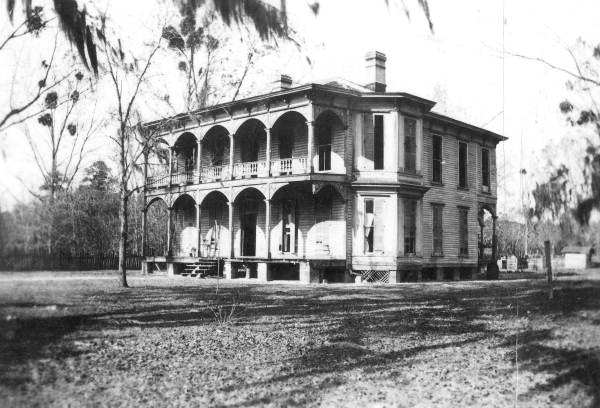
Drew’s influence extended far beyond Ellaville. In 1876, he was elected Governor of Florida, guiding the state through the turbulent final years of Reconstruction. For a time, it seemed that both the man and the town he built were untouchable.
But prosperity has a way of masking risk. Ellaville’s success depended on a single resource, extracted as fast as possible, with little thought for what came after. The river gave generously—but it was keeping score.
Fire, Forests, and the First Cracks
Ellaville’s downfall didn’t begin with a flood. It began with depletion.
For decades, the sawmill consumed yellow pine at an unsustainable pace. What once seemed infinite slowly disappeared. By the late 1800s, the surrounding forests were thinning, and the quality of available timber declined. Profits followed suit.
Then, in 1898, disaster struck. The sawmill—the economic heart of Ellaville—burned to the ground.
It was rebuilt, but the damage went deeper than charred beams. The new mill struggled to compete without quality timber. By 1900, operations ceased permanently. Drew had already sold his interests and moved on, dying later that same year in Jacksonville.
Ellaville remained—but its purpose was gone.
When the River Took Control
With the mill silent, Ellaville was vulnerable.
The Suwannee River, once the town’s lifeline, became increasingly hostile. Floods in the early 1900s crept higher each time, pushing residents out and damaging what infrastructure remained. One flood sent six feet of water into the Drew Mansion itself, forcing its final occupants to abandon the home.
The breaking point came in August 1928.
After weeks of heavy storms, the Suwannee River and the nearby Withlacoochee River swelled beyond their banks and converged at Ellaville. The town was overwhelmed. Train platforms disappeared beneath the water. Cars were propped on blocks. Boats replaced streets as residents checked on one another.
The disaster occurred just weeks before the catastrophic Okeechobee Hurricane struck South Florida, overshadowing Ellaville’s destruction in the news. But for those who lived there, the outcome was final. The floods didn’t just damage Ellaville—they erased any remaining reason to stay.
Ellaville’s fate is not unique—across North Florida, rivers have a long memory, slowly reclaiming bridges, towns, and crossings like Bellamy Bridge, where history still clings to steel and water in uneasy balance.
The Long Goodbye
After 1928, Ellaville entered a slow, quiet decline.
Without industry, dry land, or economic hope, families began to leave. The Great Depression sealed any chance of recovery, and World War II pulled away those who remained. Homes were abandoned. Structures rotted. Nature pressed in.

In 1942, the Ellaville post office closed its doors for good. With that single administrative act, the town officially ceased to exist.
The Drew Mansion lingered for decades as a hollowed shell, stripped by vandals and left to decay, until it finally burned in the 1970s—arson suspected. In 1986, Highway 90 was rerouted across a new bridge, bypassing Ellaville entirely and abandoning the old Hillman Bridge.
Ellaville wasn’t just forgotten. It was cut off.
Ellaville Today: What the River Left Behind
What remains of Ellaville today isn’t dramatic in the way ruins often are. There are no towering walls or preserved streets. Instead, Ellaville lingers in fragments—quiet, partial, and patient.
Hiking trails now follow paths where streets and homes once stood. In cooler months, when the undergrowth thins, the stone foundation of the Drew Mansion can still be found near a picnic area, its outline barely rising above the ground like a memory refusing to fully sink. The forest has softened its edges, but it hasn’t erased it.
The most visible landmark is the old Hillman Bridge, its rusting steel frame arching over the dark water of the Suwannee River. Once a vital crossing, it now stands silent—a skeletal reminder of connection, commerce, and eventual abandonment. Nearby, the ruins of the old Suwannee River Store slowly surrender to vines and time, while a small cemetery tucked into the woods holds a handful of former residents who never left.
At Suwannee River State Park, a massive flywheel from Ellaville’s sawmill rests on display. Solid. Heavy. Impossibly real. It’s the last intact piece of the machine that once powered an empire—and a reminder that this wasn’t folklore or exaggeration. Ellaville was built, lived in, and worked hard.
It just didn’t last.

Reflections from the Road
We visited Ellaville during an uneasy calm—after one hurricane, before another. Fallen trees blocked the old paths into the woods, and after a brief conversation, we decided not to push further. Dusty was right. The land didn’t feel closed, exactly… just cautious.
Ellaville has learned patience.
Standing among the ruins, it’s hard not to think about how quickly confidence can outrun foresight. Ellaville wasn’t destroyed by one mistake, but by a series of choices that made sense in the moment—cut the trees, rebuild the mill, trust the river. The same things that made the town powerful eventually made it vulnerable.
Some places ask to be explored aggressively. Ellaville doesn’t. It asks you to slow down, to notice what’s missing, and to accept that not every story ends with preservation. Some end with absorption.
And that’s okay.
Visiting Ellaville Today
Ellaville is located within Suwannee River State Park and is accessible via marked trails and picnic areas. Conditions can change quickly after storms, and fallen trees or flooded sections are common—especially after heavy rain or hurricanes.
If you visit:
- Stay on established paths
- Respect posted closures and warning signs
- Leave ruins undisturbed
- Remember this is both a historic site and a natural one
Ellaville doesn’t need souvenirs taken. It just needs to be remembered.

Closing Thoughts
Ellaville rose fast, burned bright, and faded slowly. It wasn’t undone by a single disaster, but by the long, quiet math of overuse, exposure, and time. The river that once carried its wealth eventually carried its ending.
Today, Ellaville stands as a reminder that prosperity without balance rarely lasts—and that nature is always patient enough to wait us out.
Some ghost towns shout their stories.
Ellaville whispers.
🌲 Want more forgotten places like Ellaville? 🌲
Ellaville didn’t disappear in a single moment.
It faded. Flooded. Waited.
If stories like this one—quiet ghost towns, abandoned places, and the history most maps leave behind—speak to you, I’d love to keep walking these roads together.
When you opt in, you’ll get:
- New Travel Made Personal stories delivered straight to you
- Early looks at upcoming trips and forgotten places
- Behind-the-scenes notes from the road (and the occasional Murph sighting)
- A growing archive of history that deserves to be remembered
No spam. No noise. Just stories, places, and the slow unraveling of time.
📩 Join the list and travel the backroads with us.Some places whisper.
You just have to be listening.

If you see this after your page is loaded completely, leafletJS files are missing.