There are some places you visit because they’re famous.
There are others you visit because you feel like you should.
The United States Holocaust Memorial Museum fell into that second category for me.

It was our final full day in Washington, D.C. The next morning, my son and I would leave the nation’s capital behind and head toward Colonial Williamsburg, where a different chapter of American history awaited us. But before we left, there was one thing we absolutely wanted to do: visit the museums.
We parked near the Washington Monument and began the familiar walk across the National Mall. The National Mall isn’t just home to famous monuments—it’s also where some of Washington’s most meaningful museums invite visitors to explore the triumphs, struggles, and defining moments of American history.
By that point in the trip, our feet were tired, our energy was fading, and we’d already spent days exploring memorials, cemeteries, monuments, and historic sites. Yet something about this museum felt different before we ever walked through the doors.
Some places tell history.
Others ask you to carry it.
A Promise to Remember
The story of the United States Holocaust Memorial Museum begins with a question that felt almost impossible to answer.
How do you memorialize an event that defies comprehension?
In 1978, President Jimmy Carter established the President’s Commission on the Holocaust and asked a group of survivors, scholars, and civic leaders to determine how the United States should remember the victims of the Holocaust. Leading that effort was Elie Wiesel, a Holocaust survivor whose life had become dedicated to ensuring the world never forgot what had happened.
Rather than recommending a traditional monument, the commission proposed something far more ambitious: a living memorial.
The vision included a museum, educational programs, archives, and ongoing efforts to confront genocide wherever it might emerge in the future. It would not simply preserve the past. It would challenge future generations to learn from it.
Years later, that vision became reality in a striking building just off the National Mall.
From the outside, it blends into Washington’s landscape of grand civic architecture. Inside, however, the mood shifts almost immediately.

Architect James Ingo Freed, himself a refugee who escaped Nazi Germany as a child, designed the building to make visitors feel slightly unsettled. Exposed steel, stark brick walls, narrow bridges, and unusual spaces create an atmosphere where something feels off balance.
It is architecture designed not for comfort, but for reflection.
And it works.
Walking Through the Story
The museum’s exhibits guide visitors through the rise of Nazi Germany, the gradual erosion of human rights, the horrors of the Holocaust itself, and the aftermath that followed.
What struck me most was how ordinary everything seemed at the beginning.
Photographs of families.
Wedding pictures.
Schoolchildren.
Shopkeepers.
Birthday celebrations.
The exhibits begin with people living everyday lives much like our own.
That choice is intentional.
It reminds visitors that history’s victims were not statistics. They were parents, children, neighbors, coworkers, and friends.
As the exhibits progress, visitors witness the gradual dismantling of those lives. Rights disappear. Communities are isolated. Propaganda spreads. Hatred becomes normalized.
The museum carefully shows that these events did not happen all at once.
They happened one step at a time.
One law.
One policy.
One act of dehumanization after another.
Walking through those galleries, I found myself thinking less about history as something distant and more about how fragile human dignity can be.
The Experience
For all the exhibits, artifacts, and historical information, there is one moment that remains clearer than anything else.
The shoes.
I’d seen photographs of them before.
I’d read about them.
I’d watched documentaries.
None of that prepared me for standing in front of them.
Thousands of shoes stretch across the exhibit space in a silent pile that seems almost impossible to comprehend. Children’s shoes. Women’s shoes. Work boots. Dress shoes.
Every pair belonged to someone.
Someone who had plans for next week.
Someone who loved their family.
Someone who expected tomorrow to arrive.

Standing there, I stopped seeing numbers.
I started seeing people.
The Holocaust is often discussed through statistics because the scale is so enormous. Yet standing in that room, surrounded by thousands of shoes, the numbers disappeared. What remained was humanity.
A worn heel.
A child’s tiny shoe.
A scuffed work boot.
Tiny details that somehow carried more emotional weight than any statistic ever could.
My son and I moved quietly through the exhibit after that. Neither of us felt much like talking. Some experiences don’t demand conversation. They simply ask you to sit with them.
After several hours inside the museum, we eventually made our way to the café to rest.
Outside, a summer storm had rolled into Washington.
Rain hammered the windows. Thunder echoed across the city.
And honestly, we were exhausted.
The plan had been to visit more museums that afternoon, but between the weather and our tired feet, we decided to head back to the hotel instead.
For the rest of the day, we simply rested.
The museum had given us enough to think about.
What Stayed With Me
I’ve visited battlefields, cemeteries, memorials, and historic sites across the country. Earlier in this same trip, Ford’s Theatre offered another powerful reminder that history often turns on deeply personal moments. Standing where President Abraham Lincoln spent his final evening carried a different kind of weight, but one that also transformed familiar history into something profoundly human.
Just across the street, the Peterson House preserved the quiet room where Lincoln died the following morning. Like the Holocaust Memorial Museum, it reminds visitors that history isn’t only shaped by dates and events, but by the people who lived through them.
Many have been emotional.
Few have stayed with me the way the Holocaust Memorial Museum did.
Part of that is the subject matter itself. The Holocaust represents one of humanity’s darkest chapters.
But what lingered wasn’t simply the horror.
It was the reminder that every historical tragedy begins with people.
Ordinary people.
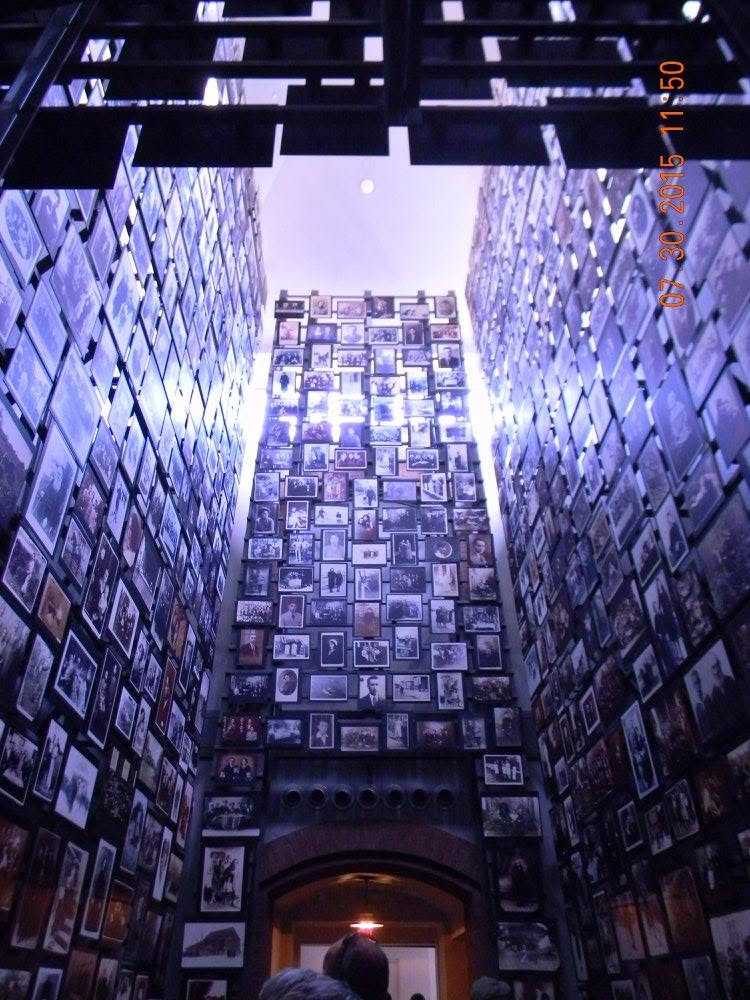
People who believed tomorrow would arrive much like today.
The museum never lets visitors forget that.
Long after I forgot specific exhibit panels or dates, I remembered those shoes.
I remembered the silence in the gallery.
I remembered the feeling of standing beside my son and realizing that history isn’t just something we study.
It’s something we inherit.
And with that inheritance comes responsibility.
To remember.
To learn.
And to remain vigilant whenever human dignity is threatened.
Echo’s Corner
?️ The museum was envisioned not as a traditional memorial, but as a “living memorial” dedicated to education, remembrance, and genocide prevention.
?️ Architect James Ingo Freed escaped Nazi Germany as a child in 1939, giving the building’s design a deeply personal connection to the history it preserves.
?️ The museum’s Hall of Remembrance contains an eternal flame and serves as a quiet space where visitors can reflect after completing the main exhibition.
Stay in the Loop
Love uncovering the stories behind the places we visit? Join the Travel Made Personal newsletter and get hidden history, forgotten places, Echo’s Corner curiosities, and new adventures delivered straight to your inbox.

The next morning, my son and I left Washington and headed toward Colonial Williamsburg.
The D.C. portion of our trip was officially over.
We hadn’t managed to see everything on our list. There were museums we missed, exhibits we never reached, and stories we’d have to save for another visit.
Oddly enough, that felt perfectly fine.
Some journeys aren’t measured by how much you see.
They’re measured by what you carry home.
For me, the Holocaust Memorial Museum wasn’t simply another stop in Washington, D.C.
It was a reminder that memory matters.
That history matters.
And that behind every statistic is a human story waiting to be remembered.
Sometimes the most important places we visit don’t leave us with answers.
They leave us with responsibility.
If you see this after your page is loaded completely, leafletJS files are missing.