
In 1905, the people of Dothan, Alabama gathered beneath a brand-new bell tower to celebrate what they proudly called a Temple of Justice. The original Houston County Courthouse stood as a symbol of progress—brick, mortar, and law rising together in Alabama’s newest county.

But while the bell rang and the courthouse doors swung open, another story quietly took shape inside. One not carved into stone or etched onto plaques, but another one that represents the resilience of Black communities in Dothan. A story of power, exclusion, and a justice system that did not treat all citizens equally.
This is that story.
A County Is Born, and So Is a Courthouse
Houston County was officially created in 1903, the last of Alabama’s 67 counties. With a new county came a familiar civic ritual: building a courthouse to anchor law, order, and local government.
Dothan was selected as the county seat, and architect Andrew J. Bryan was hired to design a structure worthy of the occasion. Construction began in February 1905 and wrapped up just 210 days later. On October 28th, the courthouse officially opened.
The building was imposing—designed to project permanence and authority. Its bell tower dominated the skyline, and for more than fifty years, the courthouse bell rang across the city, calling court to order and marking the passage of civic life.
To many, it was more than a building.
It was a promise.
When Justice Doesn’t Echo Evenly
Behind the courthouse’s dignified façade, that promise was already fraying.
A courtroom is meant to be one of the most democratic spaces in society. A jury of peers. A cross-section of the community. But in Houston County, that principle was quietly undermined for decades.
Defense attorneys began noticing a disturbing pattern—particularly in capital cases. Qualified African American citizens were being struck from jury pools at alarming rates. Not once. Not twice. Repeatedly.
Individually, these removals were easy to dismiss. Peremptory strikes are, by design, difficult to challenge. But over time, the pattern became unmistakable. Juries were overwhelmingly white in a county with a significant Black population.
The bell still rang.
But justice was not evenly heard.
The Case That Exposed the Pattern
In 2011, the silence finally broke.
The Equal Justice Initiative, led by civil rights attorney Bryan Stevenson, filed a federal civil rights lawsuit against District Attorney Douglas Valeska. The case, Hall et al. v. Valeska et al., was not about a single trial—it was about an entire system.
The plaintiffs were African American citizens who alleged they had been systematically excluded from jury service solely because of their race.
The data was staggering.
Between 2006 and 2010, in death penalty cases alone, the District Attorney’s office used its strikes to remove approximately 80 to 82 percent of qualified Black jurors. During the same period, Houston County ranked among the highest in Alabama for per-capita death sentencing.
The implication was unavoidable: jury manipulation and sentencing outcomes were deeply intertwined.
A Practice Rooted in the Past
What made the lawsuit especially damning was that this behavior was not new.
Appellate courts had previously overturned convictions from Houston County due to unconstitutional jury selection practices. One of the plaintiffs, Vicky Allen Brown, had been involved in such a ruling as far back as 1998.
Despite decades of precedent—including the Supreme Court’s Batson v. Kentucky decision and constitutional protections under the Fourteenth Amendment—the pattern persisted.
According to the lawsuit, this was not oversight.
It was policy… and a reminder that authority and accountability don’t always align.

The Courthouse Falls, but the System Remains
While the legal battle unfolded, the courthouse itself had already met a quieter end.
By the late 1950s, the once-grand building had fallen into disrepair. Rather than preserve it, Houston County chose demolition. In the early 1960s, the wrecking ball swung, and the 1905 courthouse was erased from the landscape.
A new courthouse rose in 1962—modern, efficient, and unburdened by architectural memory.
In hindsight, the demolition feels almost symbolic. A physical attempt to erase a troubled past. As if replacing the building might cleanse the system housed inside it.
It didn’t.
The Bell That Still Speaks
Almost nothing remains of the original courthouse.
Almost.
The bell was saved.
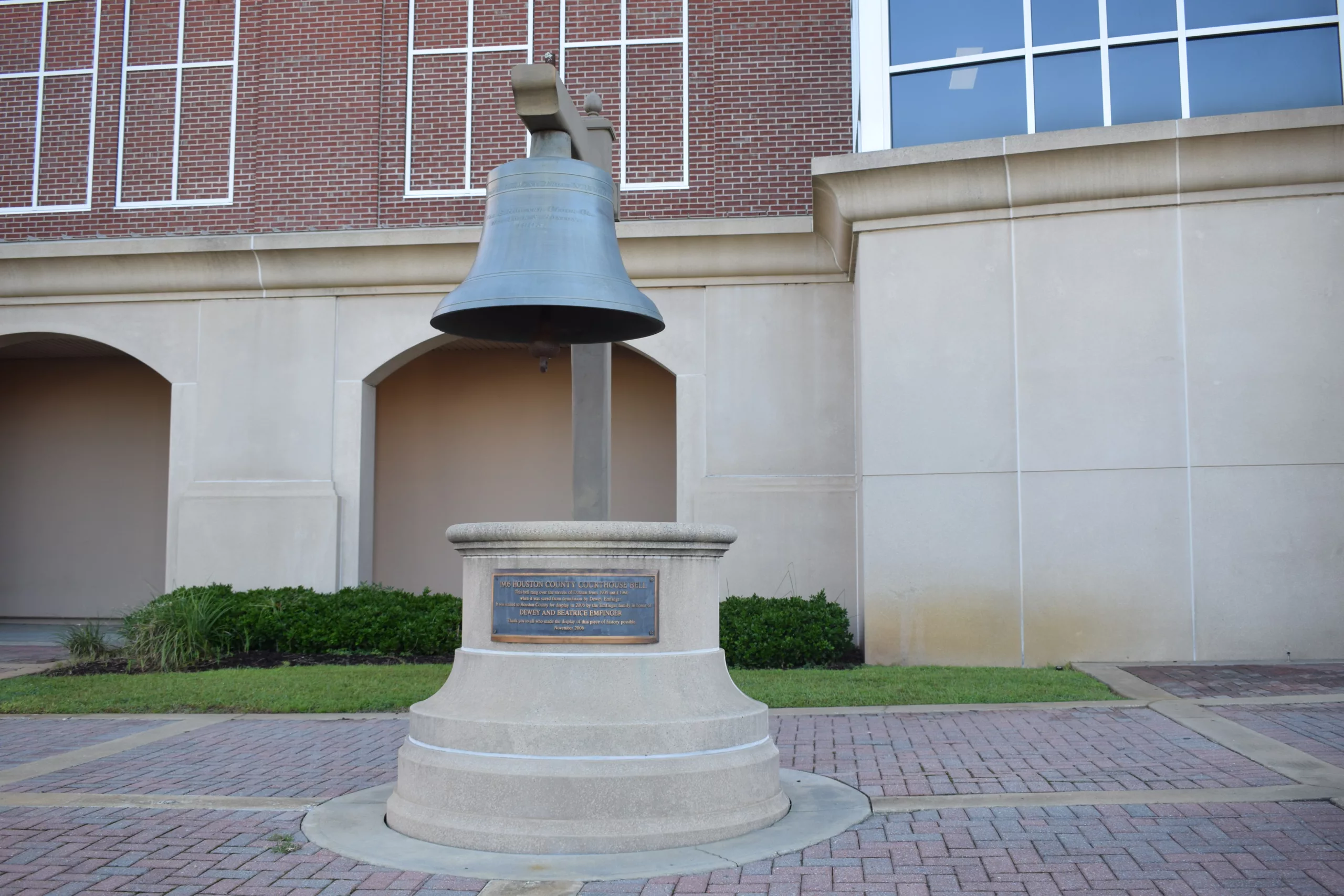
After years in private ownership, it was eventually returned to the county and now rests on a stone pedestal downtown, accompanied by a plaque recounting the courthouse’s official history.
But the bell remembers more than the plaque admits.
It once called court to order.
Now, in silence, it stands as a witness—to jurors denied their civic duty, to defendants judged by anything but true peers, and to a justice system that failed to live up to its own ideals.

What This Courthouse Teaches Us
The story of the Houston County Courthouse is really two stories.
One is about a building—a hopeful monument that rose, crumbled, and was demolished.
The other is about an idea—the promise of equal justice—that was betrayed for decades before being challenged in the light of federal court.
Justice is not built from brick and mortar.
It is built from vigilance, accountability, and the refusal to accept silence as neutrality.
And sometimes, the loudest truths come not from ringing bells—but from the quiet they leave behind.
This courthouse was built to represent fairness.
History says otherwise.
Join me as we dig into the hidden story of the Houston County Courthouse—its rise, its fall, and the injustice it tried to bury.
And check out the Howell School nearby, for another historic Dothan building with a complicated past.
? Sign up to explore history beyond the marker.

If you see this after your page is loaded completely, leafletJS files are missing.