How a military outpost became the birthplace of Tampa—and why it took me two visits, a parking garage, and a very stubborn GPS to find its history.
I Went Looking for a Fort. My GPS Found a Parking Garage.
“Your destination is on the left.”
That’s what my GPS announced as I drove through downtown Tampa looking for the historic site of Fort Brooke.
I looked to my left.
A parking garage.
Well, then.
Apparently, Fort Brooke had been promoted to covered parking.
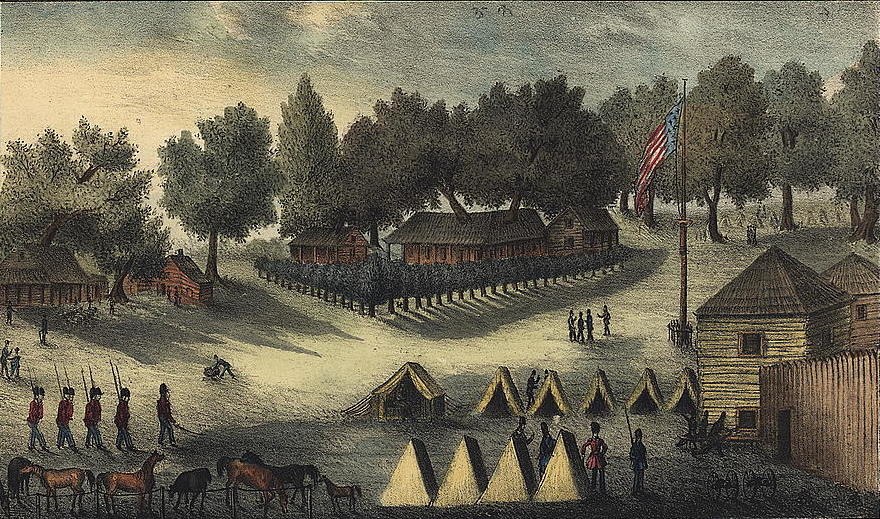
Now, I knew I wasn’t going to find an actual fort. Fort Brooke had disappeared from Tampa’s landscape a very long time ago. But I was hoping to find at least a historical marker acknowledging the military installation that helped give rise to the city.
So I circled the block.
Twice.
Because surely I was missing something.
Nope. Nothing.
At least, nothing I could find.
I eventually gave up and left Tampa convinced that the historical marker I was looking for was gone.
But as it turns out, Fort Brooke’s history hadn’t disappeared quite as completely as I thought.
I just needed to come back and look a little harder.
And when I did, what should have been a relatively straightforward historical exploration turned into an adventure involving a parking garage, a drawbridge, a tunnel, an emergency Publix stop, and $129 worth of souvenirs.
But before we get into all that, let’s talk about why Fort Brooke mattered in the first place.
Before Tampa, There Was Fort Brooke
Long before downtown Tampa was filled with skyscrapers, hotels, convention centers, and waterfront development, the mouth of the Hillsborough River was home to a very different landscape.
And it wasn’t empty.
Indigenous peoples had lived around Tampa Bay for thousands of years. The region had a long human history before Florida became a United States territory in 1821.
Following the First Seminole War, the United States government negotiated the Treaty of Moultrie Creek in 1823, which confined Seminoles to a reservation in central Florida and strengthened federal control over the territory.
To enforce its policies and maintain a military presence, the Army needed strategic outposts.
One of those outposts would be established near the mouth of the Hillsborough River.
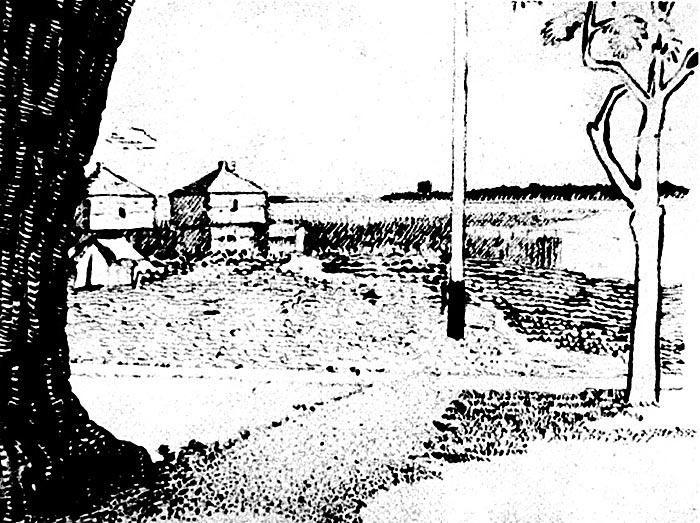
In January 1824, Colonel George Mercer Brooke arrived with four companies of infantry and established the military post that would become Fort Brooke.
Its location provided access to Tampa Bay and the Gulf of Mexico, making it valuable for transportation, supplies, and military operations.
But life at Fort Brooke was hardly comfortable.
The soldiers faced isolation, difficult terrain, oppressive heat, mosquitoes, and disease.
Nobody was planning a thriving city.
They were establishing a military post on Florida’s frontier.
And yet, that decision would help shape the future of Tampa.
Fort Brooke and the Seminole Wars
Fort Brooke became one of the most important military installations in Florida during the Second Seminole War, which lasted from 1835 to 1842.
The fort served as a headquarters, supply depot, and staging area for military expeditions into the peninsula.
And one of the most consequential events of the war began here.
In December 1835, Major Francis Dade departed Fort Brooke with more than 100 soldiers bound for Fort King, near present-day Ocala.
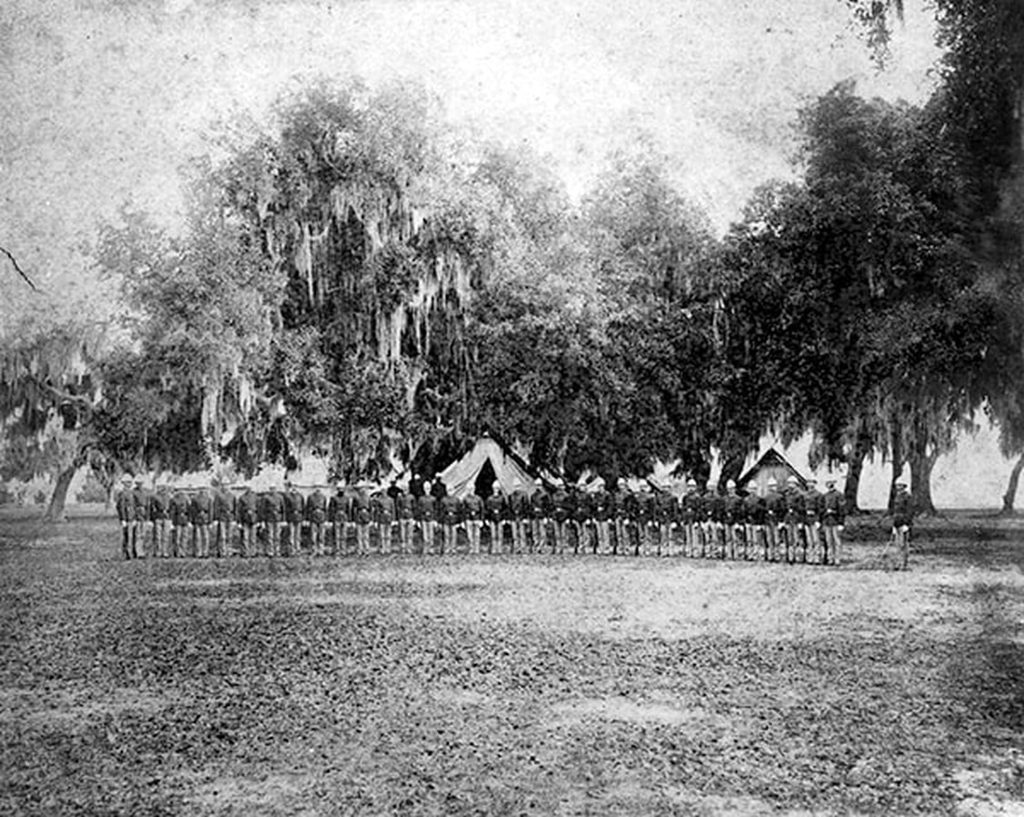
They traveled along the military road connecting the two forts.
But on December 28, Seminole warriors attacked Dade’s command near present-day Bushnell.
Nearly the entire column was killed.
Today, the site of that devastating encounter is preserved at Dade Battlefield Historic State Park near Bushnell, Florida. I visited Dade Battlefield to explore the place where Dade’s march came to its tragic end and where one of the defining battles of the Second Seminole War unfolded.
The battle became one of the defining events at the beginning of the Second Seminole War.
And it’s one of the reasons Fort Brooke matters so much to the larger Seminole War story.
Fort King, near present-day Ocala, was another important military installation during the Seminole Wars. Like Fort Brooke, it played a significant role in the United States military campaign in Florida. I’ve explored Fort King in another Forgotten Friday episode, where we uncover the history of this frontier outpost and its connection to the larger conflict.
Fort Brooke, Fort King, the military road, and Dade Battlefield weren’t isolated places.
They were connected parts of the same conflict.
But Fort Brooke’s history wasn’t limited to military campaigns.
The fort also became part of the federal government’s efforts to forcibly remove Seminoles from Florida.
Another chapter of this conflict unfolded at Fort Cooper, near present-day Inverness. Established during the Second Seminole War, Fort Cooper became the site of a prolonged confrontation in 1836. Its story offers another glimpse into the challenges and conflicts that shaped Florida’s frontier.
Captured and surrendered Seminoles passed through the Tampa Bay area before being transported west. Black Seminoles and enslaved Black people were also affected by the conflict, facing displacement, family separation, and the threat of enslavement.
That history is essential to understanding Fort Brooke.
The military post helped create the conditions for an American settlement to grow.
But it also played a role in policies that displaced people who had already made Florida their home.
Both stories belong to this place.
How Fort Brooke Accidentally Built Tampa
While the Army focused on military operations, civilian life gradually developed outside Fort Brooke.
Soldiers needed supplies.
Merchants recognized opportunities.
Workers, traders, and families began settling nearby.
Businesses followed.
And before long, a small community had formed along the northern boundary of the military reservation.
The settlement received its first post office in 1831.
In 1849, residents organized the Village of Tampa.
And in December 1855, Tampa received its city charter.
Think about that.
The Army established Fort Brooke for military purposes.
But forts need food, equipment, transportation, and services.
Those needs attract businesses.
Businesses attract residents.
And eventually, the people living outside the fort become a community of their own.
Fort Brooke wasn’t built to create Tampa.
But the city grew from the settlement that developed beside it.
Which makes what happened next rather ironic.
Fort Brooke During the Civil War
When Florida seceded from the Union in 1861, Fort Brooke entered another chapter of military history.
Confederate forces occupied the installation, and Tampa Bay became important to blockade-running operations during the Civil War.
Union forces targeted the area more than once.
During June 30 and July 1, 1862, the USS Sagamore bombarded Tampa.
One eight-inch shell reportedly landed in Oaklawn Cemetery.
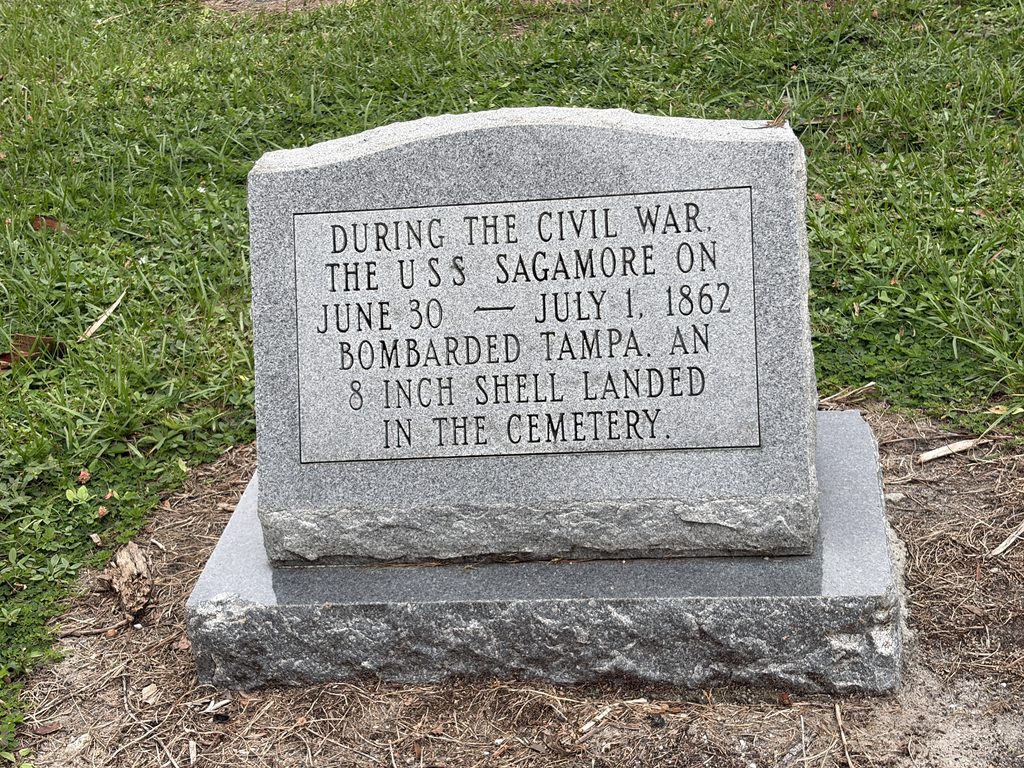
I actually photographed the small stone marker commemorating that event during my own visit to Oaklawn, but that’s another Forgotten Friday story waiting to be told.
Then, in October 1863, Union gunboats again bombarded Fort Brooke as part of an operation against Confederate blockade runners.
While the bombardment drew attention toward the fort, Union troops landed farther south and moved inland to attack vessels along the Hillsborough River.
The blockade runners Scottish Chief and Kate Dale were destroyed during the operation.
Fort Brooke had now served through the Seminole Wars and the Civil War.
But its military importance was fading.
And the civilian community beside it was becoming increasingly important.
The City That Grew Over Its Own Beginning
By 1883, Fort Brooke had been closed as a military installation, and its reservation lands were opened for civilian settlement and development.
Among the people who settled portions of the former reservation were African American families whose presence helped shape the community later known as the Garrison.
That history deserves its own exploration.
Meanwhile, Tampa was entering a period of rapid growth.
In 1884, Henry Plant’s railroad connected Tampa to the broader transportation network.
The phosphate industry expanded.
The port became increasingly important.
And in 1886, Vicente Martinez Ybor established the cigar-making community that would become Ybor City.
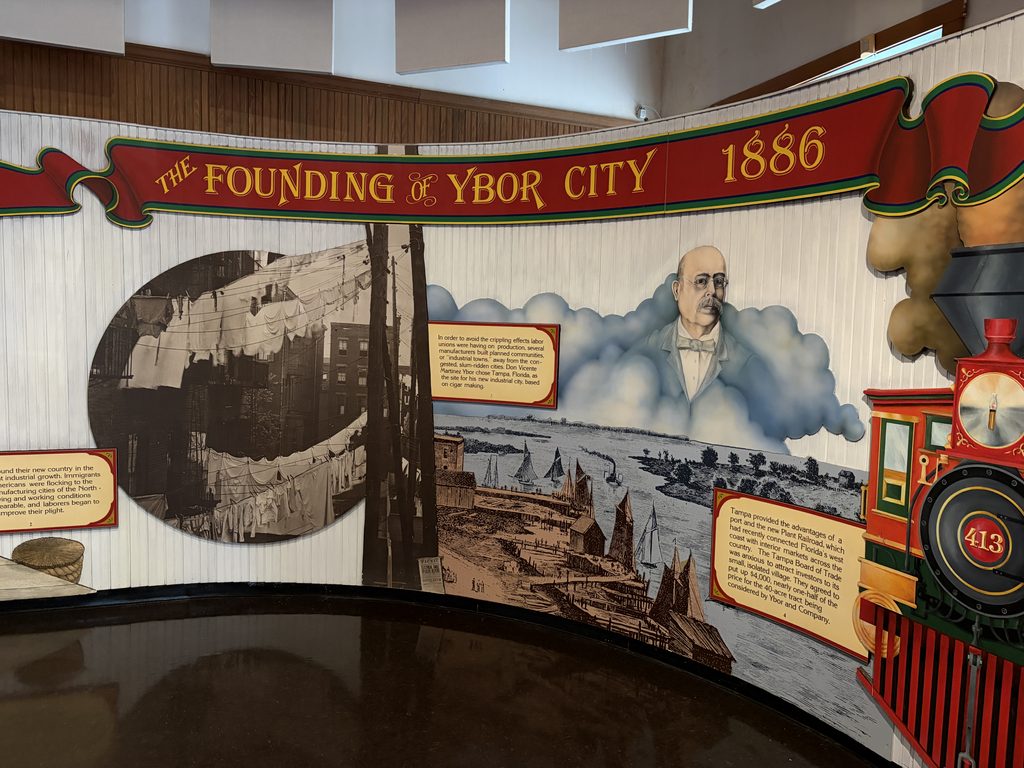
Tampa was transforming from a small settlement into a commercial center.
And the land once occupied by Fort Brooke was becoming valuable real estate.
The old military grounds were gradually redeveloped.
Streets appeared.
Buildings replaced barracks.
The waterfront changed.
And eventually, almost every visible trace of the fort disappeared.
The city that had grown beside Fort Brooke had expanded right over its footprint.
Which brings us back to my parking garage.
Returning to Fort Brooke: Round Two
After my first unsuccessful attempt to find Fort Brooke’s historical markers, I decided to return.
This time, Dusty came along.
We had a plan.
We would park downtown, walk to the Riverwalk, and visit the historical markers associated with the old fort.
Simple enough.
Except we couldn’t find the entrance to the parking garage we’d originally planned to use.
So much for that.
Eventually, we found another garage on Whiting Street and started walking toward the Riverwalk through Cotanchobee Fort Brooke Park.
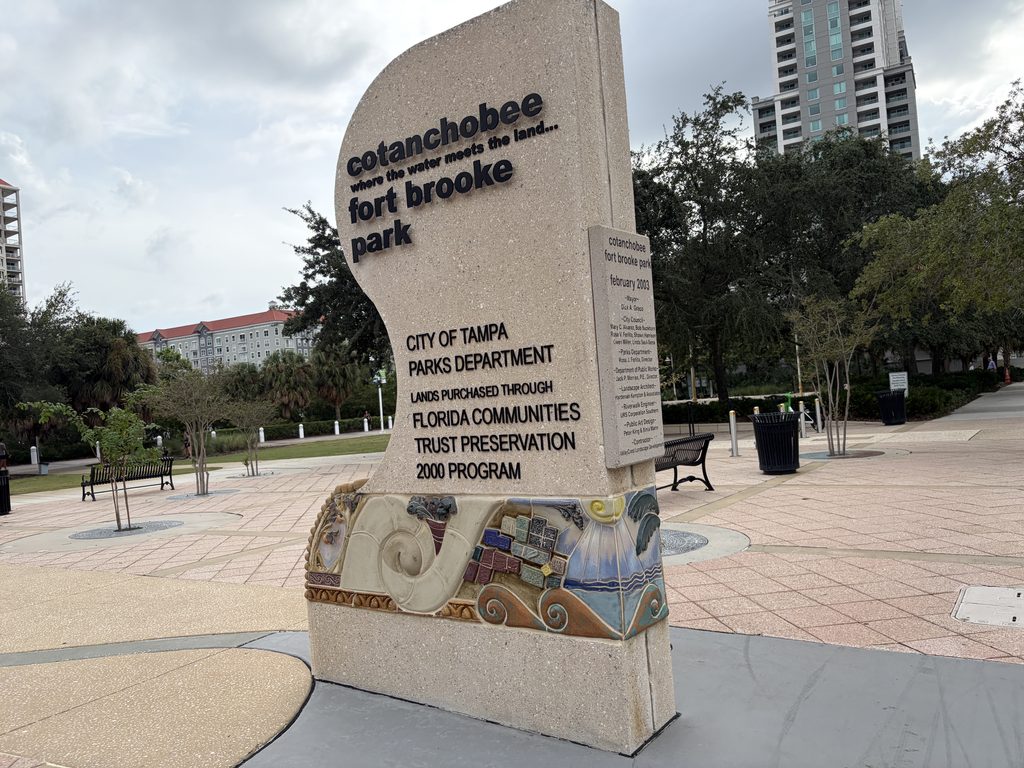
And this was where I encountered my first disappointment of the day.
Not because the park was unpleasant.
It was actually a perfectly nice modern waterfront park.
People could walk their dogs, exercise, bring their children to play, or simply enjoy the river.
But considering that the park carries Fort Brooke’s name, I expected to find some obvious connection to the fort’s history.
And during our visit, I couldn’t.
I checked the maps along the Riverwalk, hoping to find something directing visitors toward a historical area, memorial, or interpretive display.
Everything I saw seemed focused on the modern park.
I didn’t find anything that helped me imagine the military post that once occupied this part of Tampa.
Now, to be fair, we didn’t thoroughly explore every corner.
Both of us needed a restroom, and there wasn’t one in sight.
And when nature calls, historical interpretation sometimes has to wait.
So we continued toward our next stop.
Finally! The Fort Brooke Historical Markers
Our next destination was the Tampa Convention Center.
And this time, success!
We found the historical marker identifying the site of Fort Brooke.
After my first visit, when the GPS had delivered me to a parking garage, actually standing in front of a marker felt like a victory.
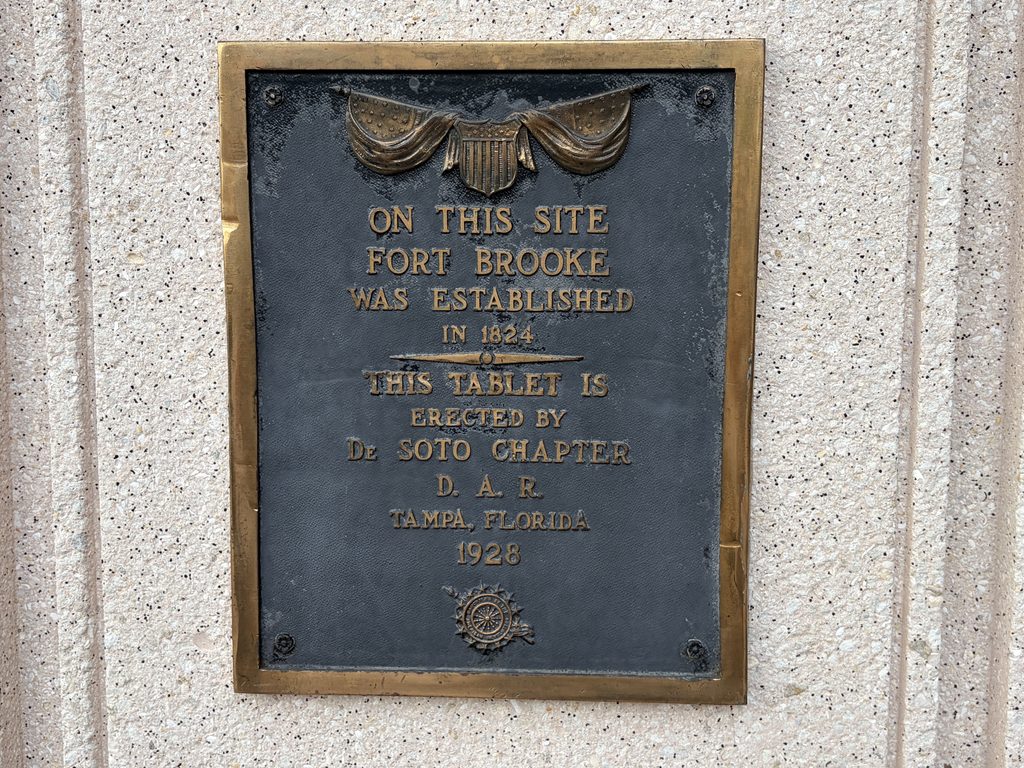
Here was something tangible connecting modern Tampa to its nineteenth-century beginnings.
We photographed the marker and prepared to continue our exploration.
And that’s when the GPS decided we’d had things entirely too easy.
It sent us the wrong way.
Through a tunnel.
Across a drawbridge.
And away from the next marker we were trying to find.
By this point, our feet were getting sore, and the restroom situation was becoming increasingly urgent.
Fortunately, we found a Publix.
A beautiful, glorious Publix.
We went inside, took care of the necessities, and sat down for a much-needed break.
Then we had to walk our sore asses right back across the stupid drawbridge and through the tunnel.
Apparently, Fort Brooke wasn’t going to surrender its history without making us work for it.
Finding the Officers’ Quarters Marker
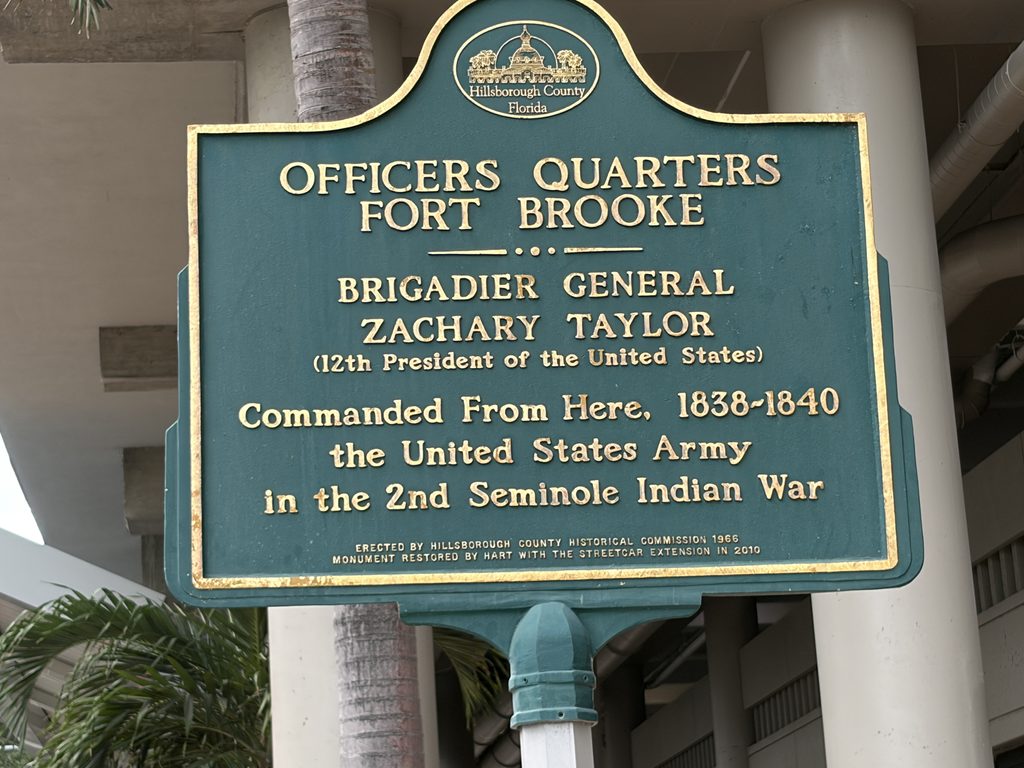
Eventually, we reached the historical marker for Fort Brooke’s officers’ quarters.
And this was where I finally started feeling the connection to the place I’d been looking for.
The marker identifies a location associated with the fort’s military leadership, including Brigadier General Zachary Taylor, who commanded United States forces during part of the Second Seminole War.
Standing there, surrounded by modern Tampa, I tried to imagine what the landscape might have looked like in the nineteenth century.
The barracks.
The officers’ quarters.
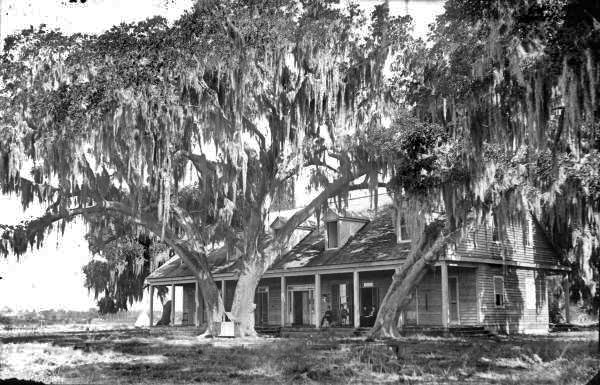
The soldiers moving through the installation.
The families and civilians living nearby.
None of those original structures were standing in front of me.
But the marker provided a connection between the place I could see and the history I had come to explore.
And sometimes, that’s all it takes.
A small reminder that something important happened on the ground beneath your feet.
The Fort Brooke Cemetery
Our next stop was the Fort Brooke Cemetery historical marker.
And this one carried a different kind of significance.
Military forts weren’t just places where soldiers trained and prepared for battle.
People lived there.
They became sick.
They raised families.
And they died.
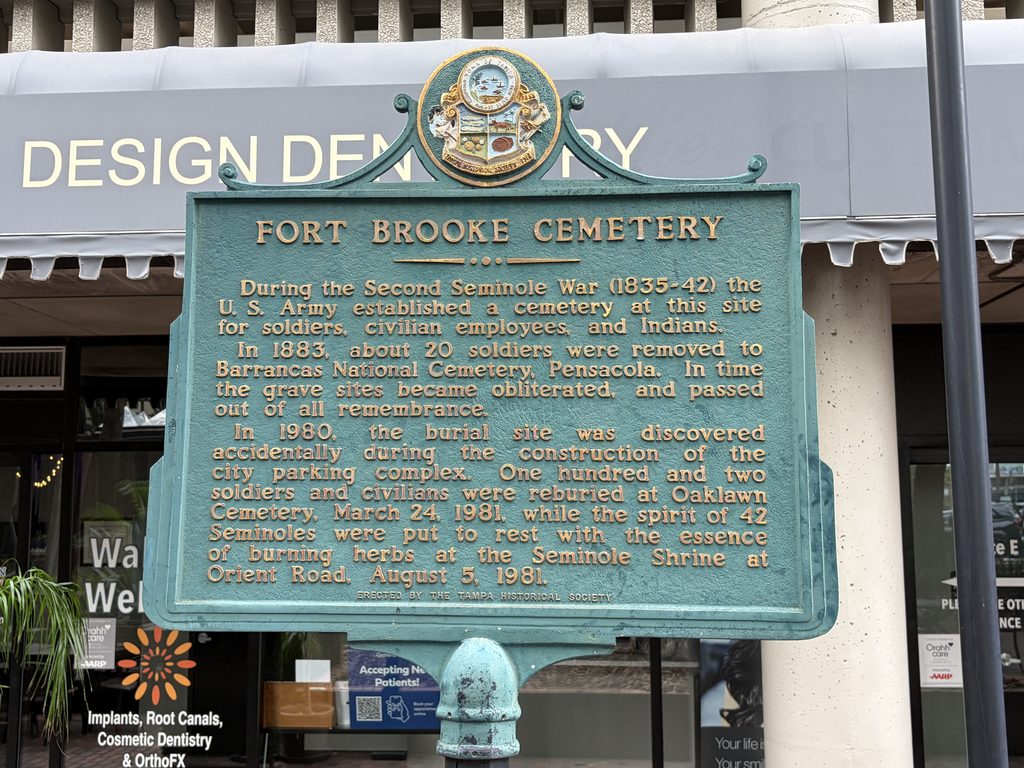
Fort Brooke had its own cemetery, and its burial history became particularly important when construction work uncovered remains from the former military grounds.
The remains of 102 soldiers and settlers originally buried at Fort Brooke were later reinterred at Oaklawn Cemetery.
Today, a mass grave at Oaklawn preserves their memory.
And that’s one of the things I find so compelling about old cemeteries.
They’re reminders that history isn’t just a collection of dates, battles, and buildings.
It’s people.
People who had families.
People who experienced hardship.
People whose lives ended long before the modern city surrounding their resting places existed.
The cemetery marker helped connect those individual lives to a place that had otherwise almost completely disappeared.
And standing there, I finally felt that I’d found something of the Fort Brooke I’d been searching for.
An Unexpected Detour into the Great 1909 Auto Race
Of course, we couldn’t spend an afternoon wandering through downtown Tampa without stumbling across another historical marker.
This one commemorated the Great 1909 Auto Race.
On November 23, 1909, an automobile endurance run from Tampa to Jacksonville began near the Tampa Daily Times building.
And naturally, I had to stop.
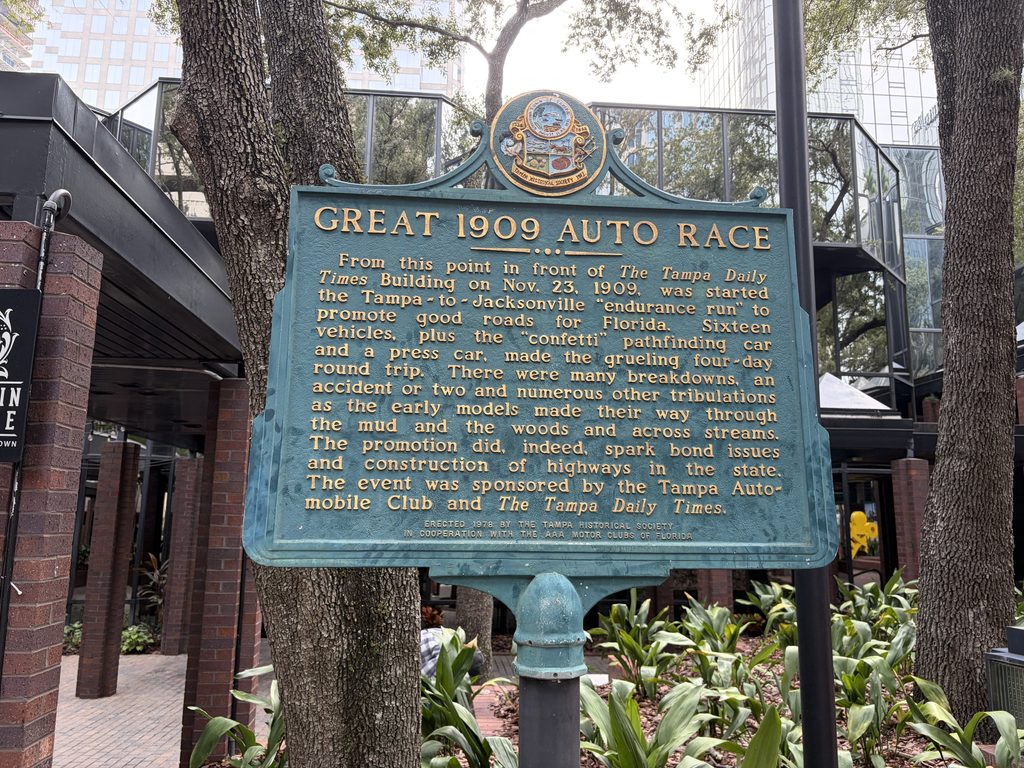
Because apparently I’m physically incapable of walking past a historical marker without reading it.
There is no known cure for this condition.
Here we were, exploring a military fort established in 1824, and suddenly we’d found ourselves standing in front of another piece of Tampa’s transportation history.
Different century.
Different story.
Same city.
Another little reminder that history has a habit of appearing when you’re looking for something else.
Dusty Finds the Visitor Center
And then Dusty spotted a visitor center.
Now, after all that walking, you might think we’d be ready to head back to the car.
But no.
A visitor center means souvenirs.
And souvenirs mean I need to go inside.
By the time we reached the checkout counter, I’d managed to collect $129 worth of trinkets.
One hundred and twenty-nine dollars.
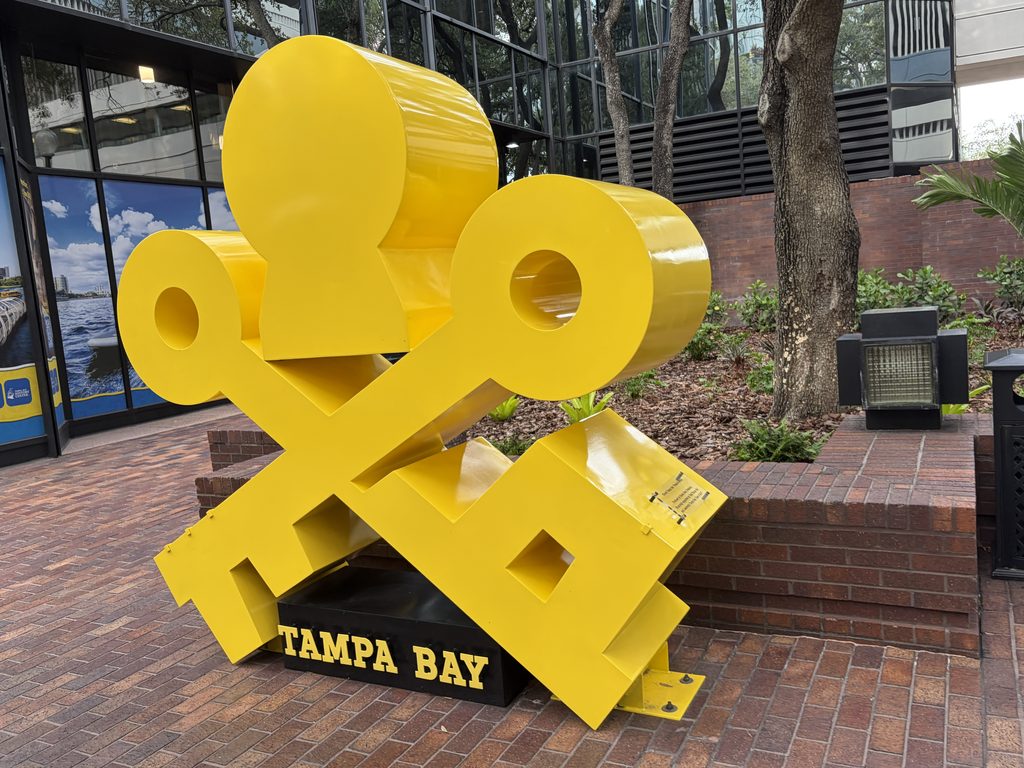
Apparently, this historical expedition had developed an admission fee.
But the best part happened while we were checking out.
I noticed a rack of stickers.
One of them featured the silhouette of Bigfoot.
So naturally, I pointed at it and said to Dusty:
“Oh look, it’s your boyfriend!”
Dusty started laughing.
The two sales associates behind the counter looked absolutely bewildered.
The kind of bewilderment that happens when two strangers wander into your workplace, spend $129 on souvenirs, and casually introduce Bigfoot as someone’s romantic partner.
Neither one seemed to know quite what to do with that information.
And honestly, their expressions were priceless.
Just another perfectly normal Travel Made Personal expedition.
What Stayed With Me About Fort Brooke
My first visit to Fort Brooke left me feeling that Tampa had completely erased the military post that helped give rise to the city.
I found a parking garage.
I circled the block twice.
And I left without finding the history I’d come looking for.
But my second visit changed that impression.
The historical markers were there.
The stories were still being acknowledged.
And with enough persistence, I could follow pieces of Fort Brooke’s history through modern downtown Tampa.
But that second visit also left me thinking about something else.
How easy should it be to find the history of the place that helped create a city?
Because I wasn’t casually wandering around Tampa hoping to stumble across something interesting.
I went there specifically to find Fort Brooke.
I knew the fort existed.
I knew its historical significance.
And even with that knowledge, it took two visits, several GPS destinations, a parking garage, a tunnel, a drawbridge, and a considerable amount of walking to find the markers.
At Cotanchobee Fort Brooke Park, I expected a clearer connection to the fort’s history than I found during my visit.
At the Convention Center, officers’ quarters, and cemetery markers, I finally discovered the physical reminders I’d been searching for.
But those reminders were scattered throughout a busy modern city.
They didn’t feel like one connected historical experience.
And maybe that’s the real story of Fort Brooke today.
Its history hasn’t disappeared completely.
It’s become fragmented.
You have to know it exists.
You have to know where to look.
And sometimes, you have to be stubborn enough to return for a second attempt.
Fortunately, stubbornness has never been a problem for me.
Planning Your Own Visit to Fort Brooke
If you’re interested in exploring the history of Fort Brooke, don’t expect to find a preserved military fort waiting for you in downtown Tampa.
The original structures are gone, and the former military reservation has been extensively redeveloped.
But several historical markers and nearby locations can help you piece together its story.
The Tampa Convention Center area includes a marker identifying the site of Fort Brooke.
Additional markers commemorate the officers’ quarters and the former cemetery.
Cotanchobee Fort Brooke Park occupies part of the broader historic area, although I found the connection to the fort less obvious than I’d expected during my visit.
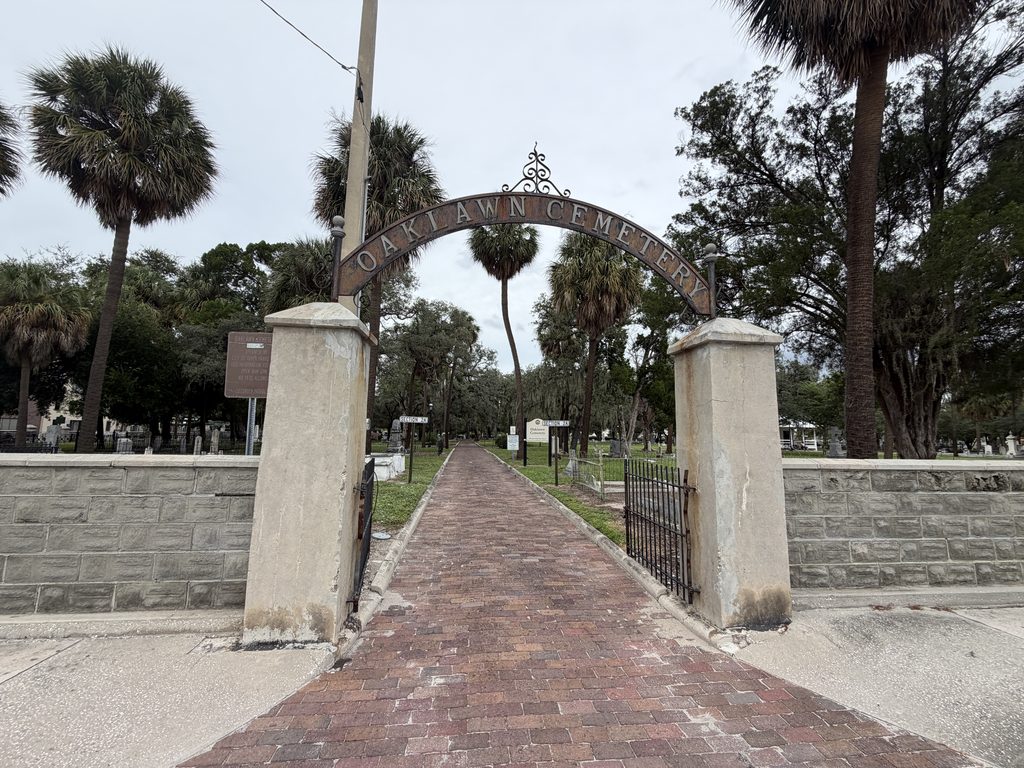
Oaklawn Cemetery also preserves an important part of Fort Brooke’s history, including the reinterred remains of soldiers and settlers from the old military cemetery.
I’d recommend researching the marker locations before visiting rather than relying entirely on your GPS.
Trust me on that one.
And if you’re planning to explore several locations on foot, wear comfortable shoes, bring water, and identify your restroom options ahead of time.
Especially the restroom options.
Because apparently downtown Tampa believes historical exploration should be an endurance sport.
Final Thoughts: The Fort That Built Tampa
Fort Brooke was established in 1824 to support the United States military presence in Florida.
It became a major installation during the Seminole Wars and played a role in the forced removal of Seminoles from their homeland.
It served again during the Civil War.
And while all of that was happening, a civilian community gradually developed beside its boundaries.
That community became Tampa.
Then Tampa expanded.
The fort closed.
Its land was developed.
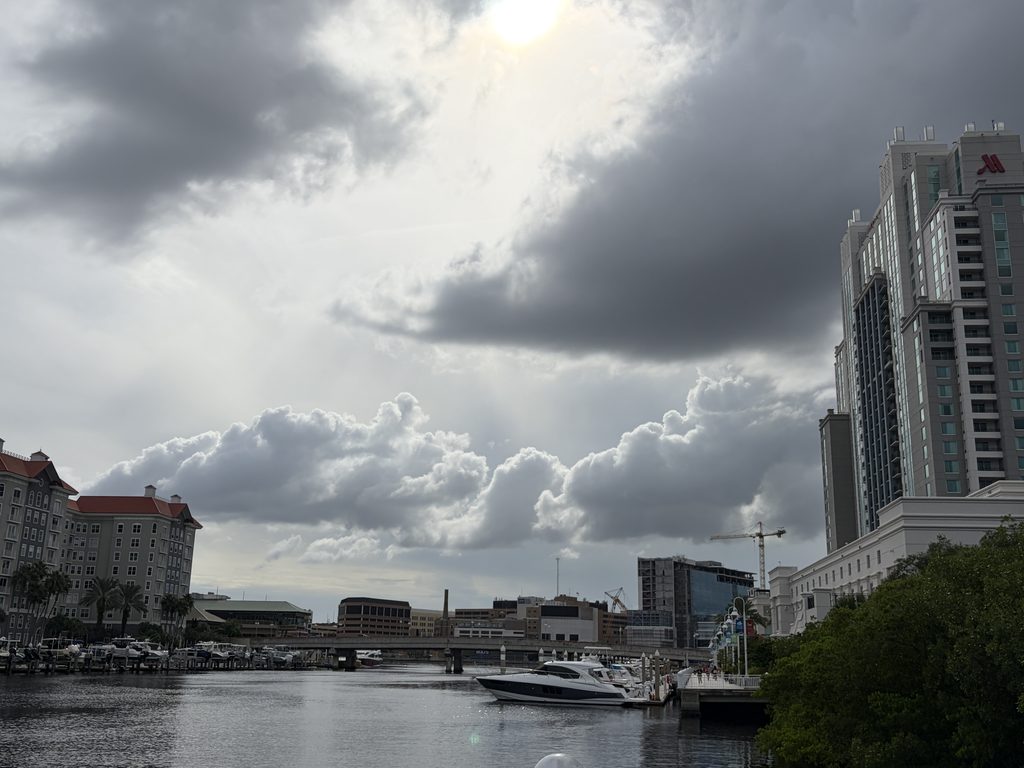
And the military installation that helped shape the city’s beginnings gradually disappeared beneath the streets and buildings of modern downtown.
But its history didn’t vanish entirely.
It survives in historical records, archaeological discoveries, cemetery memorials, and the markers scattered throughout the city.
And after two visits, I finally found some of those reminders for myself.
What stayed with me wasn’t simply that Fort Brooke had disappeared.
It was the realization that a place doesn’t have to vanish completely to become forgotten.
Sometimes its history is still there.
Quietly waiting.
Tucked between modern buildings.
Standing beside busy streets.
Preserved on a small marker that hundreds of people might walk past without noticing.
And sometimes, finding that history requires a little persistence.
A couple of wrong turns.
A drawbridge or two.
And possibly a $129 souvenir budget.
Fort Brooke may be gone.
But its story is still here.
And this time, we actually found it.
Have you ever gone looking for a historic site only to discover that almost nothing remained? Or returned for a second visit and found something you’d missed the first time? I’d love to hear about your experience in the comments.
For more forgotten Florida history, overlooked cemeteries, historic places, and occasional GPS-related misadventures, follow along with Travel Made Personal and our Forgotten Friday series.
History has a way of hiding in plain sight. 🧭
Sometimes it’s tucked away in an overgrown cemetery. Sometimes it’s buried beneath a modern city. And sometimes your GPS insists it’s a parking garage. 😂
Join the Travel Made Personal mailing list for more forgotten places, fascinating history, behind-the-scenes adventures, and stories from the road delivered straight to your inbox.
Because every forgotten place has a story worth remembering.
If you see this after your page is loaded completely, leafletJS files are missing.