
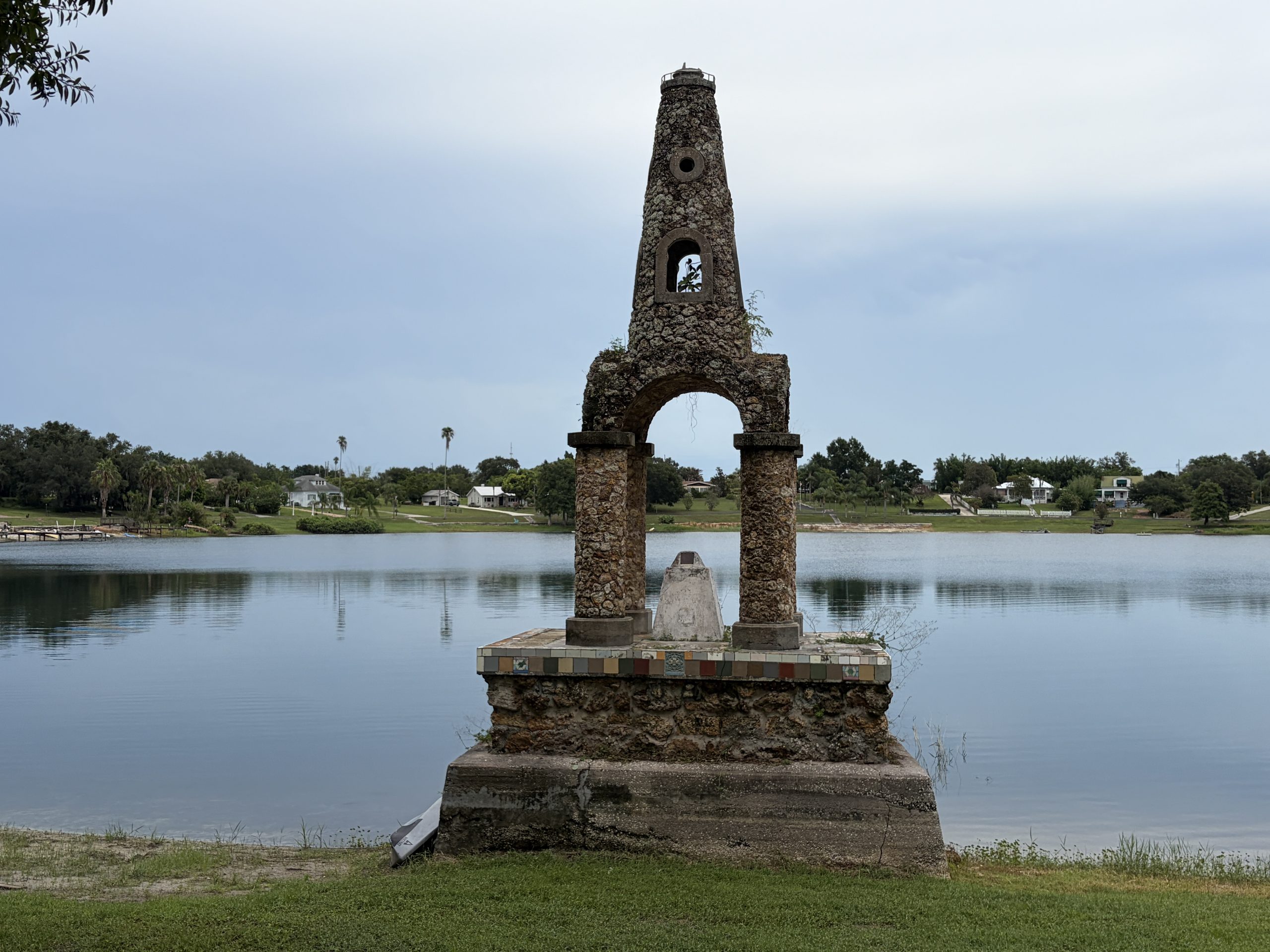
Along the shores of a quiet lake near Lake Wales, Florida, stand the weathered stone remnants of a place that once attracted thousands of religious pilgrims.
Today, homes surround the lake. Residents go about their daily lives, and cars travel past the surviving monuments. Without knowing the history, you might mistake the unusual stone structures for decorative remnants of an old estate.
But these stones tell a much different story.
Nearly a century ago, this was a destination for people seeking healing, comfort, and spiritual renewal. There was a church, religious artwork, elaborate monuments, and an annual pilgrimage that brought thousands of worshippers to this little corner of Central Florida.
Today, much of that history has faded from public memory.
Welcome to St. Anne’s Shrine.
The Beginning of St. Anne’s Shrine
The story of St. Anne’s Shrine begins in the early 1920s, when a community of French Canadian Catholics settled near a lake outside Lake Wales in Polk County, Florida.
Among the stories surrounding the shrine’s origins is that of a father who brought his seriously ill son to Florida, hoping the warmer climate would help restore his health.
According to local tradition, the boy recovered, and his recovery became associated with the lake and its waters.
Historical accounts differ regarding the identities of those involved, but the story of healing became an important part of the shrine’s identity.
In 1921, the community established a small Catholic church known as Sainte Anne des Lacs, or St. Anne of the Lakes.
The church was dedicated to St. Anne, traditionally recognized as the mother of the Virgin Mary and grandmother of Jesus.
What began as a modest place of worship for a small community would eventually become a religious destination that attracted visitors from far beyond Polk County.
Religious communities have left fascinating architectural reminders of their faith throughout the American South. During our exploration of the Chapel of Ease ruins on St. Helena Island, South Carolina, we discovered another beautiful example of how the remnants of a place of worship can preserve the story of an entire community.
A Pilgrimage Destination in the Florida Wilderness
By 1928, organized pilgrimages were bringing worshippers to St. Anne’s Shrine.
Visitors came to pray, seek healing, give thanks, and participate in religious celebrations. Among the most important occasions was the annual Feast of St. Anne, celebrated on July 26th.
During the shrine’s most popular years, thousands of people gathered along the shores of the lake.
It’s difficult to imagine those crowds when standing beside the quiet waters today.
The shrine eventually expanded beyond its original church. Religious statues, monuments, a grotto inspired by Lourdes, and Stations of the Cross transformed the surrounding landscape into a place of devotion.
A Biblical museum also became part of the complex, displaying religious artwork and artifacts.
French artist Francis Marsollier contributed to the shrine’s artistic development. His involvement has also been associated with accounts of his son’s recovery from tuberculosis.
The grounds became a remarkable combination of faith, art, architecture, and Florida’s natural landscape.
Many of the distinctive stone structures that survive today offer glimpses of the craftsmanship that once characterized this sacred destination.
The Decline of St. Anne’s Shrine
Unfortunately, the crowds that once gathered along the lake would not continue forever.
World War II disrupted international travel, making it more difficult for Canadian pilgrims to visit Florida. The shrine experienced a decline in attendance, and the pilgrimages never fully recovered their earlier popularity.
Accounts of the shrine’s later years also describe concerns about the commercialization of the religious destination.
By the 1960s, the church had been deconsecrated. It was eventually demolished, and many of the religious statues and monuments were removed.
Some religious objects reportedly found new homes at Holy Spirit Catholic Church in Lake Wales.
Others disappeared.
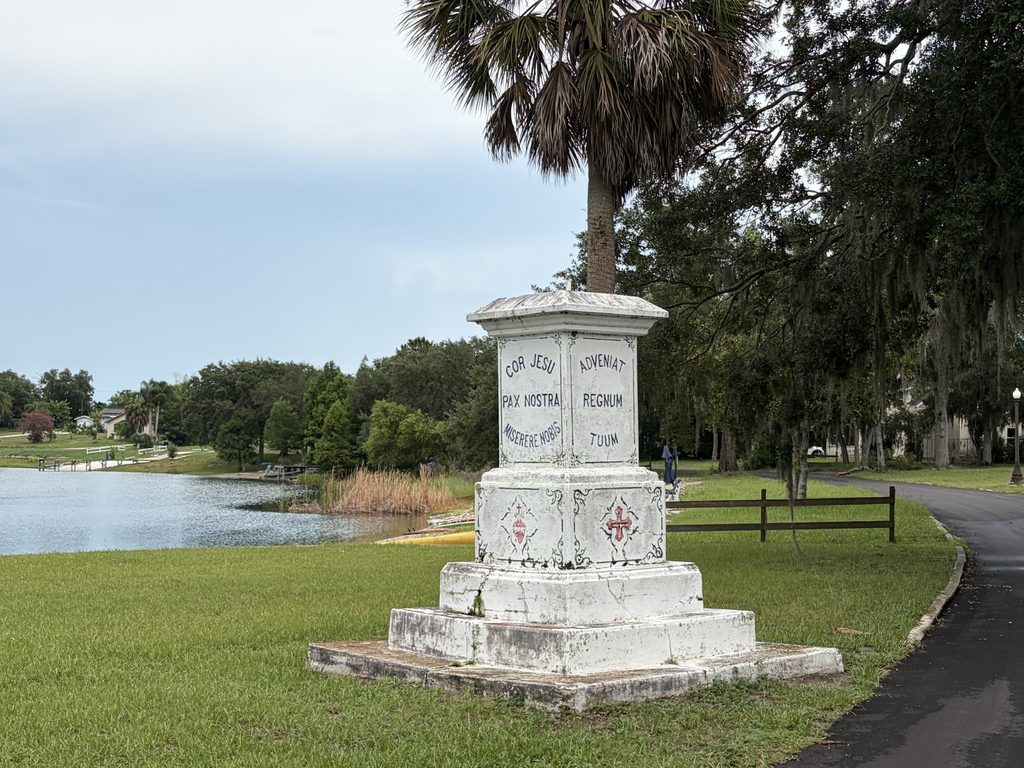
As the surrounding area developed into a residential neighborhood, the physical landscape changed dramatically.
The church was gone. The crowds were gone. The religious destination that had once drawn thousands of visitors gradually faded from public memory.
But not everything disappeared.
The disappearance of a church doesn’t necessarily mean the disappearance of its story. The Old Sheldon Church ruins in South Carolina offer another powerful example of how surviving architecture can continue to connect generations to the history of a sacred place, long after its congregation has gone.
Scattered throughout the neighborhood, pieces of the original shrine remained.
And decades later, those surviving pieces would catch the attention of two women on an Exploration Friday adventure.
Our Second Exploration Friday
Dusty and I visited St. Anne’s Shrine on July 10, 2026, during our second Exploration Friday together.
Dusty had always wanted to visit Bok Tower Gardens, so that became the anchor for our adventure that day.
Naturally, I started looking for other interesting places to explore between her house and Bok Tower.
There was, however, one important consideration.
It was July.
In Florida.
Anyone who has spent a summer in Florida understands why I was looking for places that didn’t require an extensive hike through the wilderness. There is a fine line between historical exploration and becoming a historical artifact yourself.
The ruins of St. Anne’s Shrine seemed perfect.
I didn’t know the history behind them at the time. I simply knew there were old stone ruins beside a lake, and we could park practically next to them.
And really, how much more convincing did I need?
Exploring the Lakeside Ruins
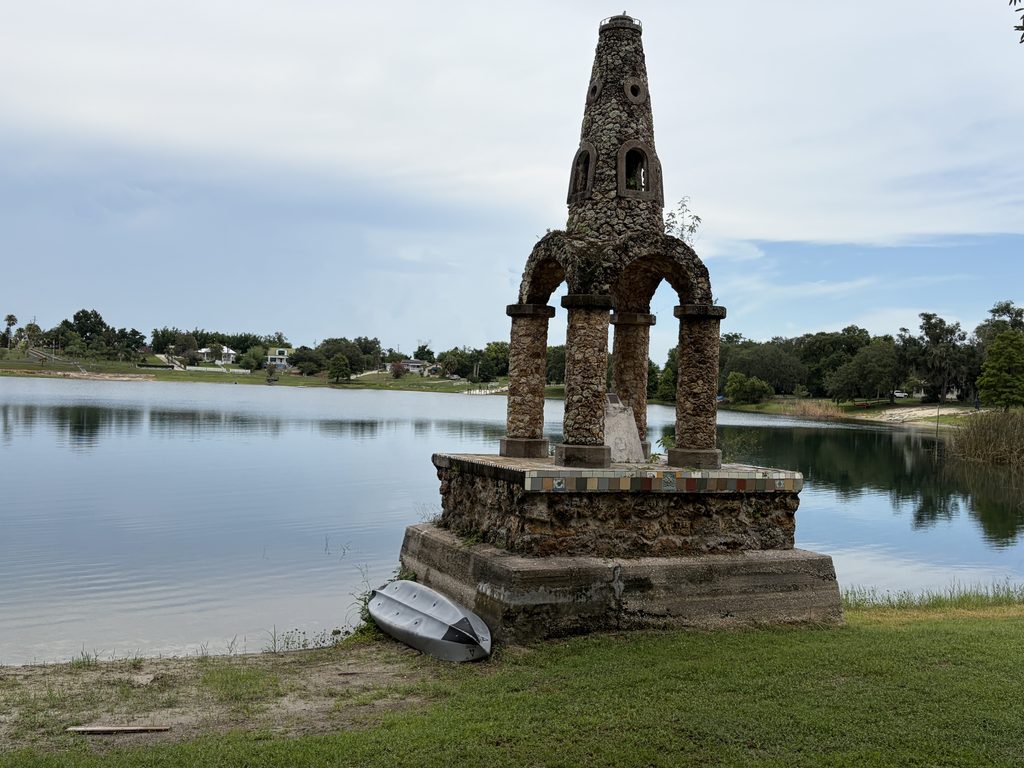
When we arrived, we found the ruins sitting along the edge of the lake, surrounded by a modern residential neighborhood.
We parked the truck, climbed out, and began taking photographs and recording footage.
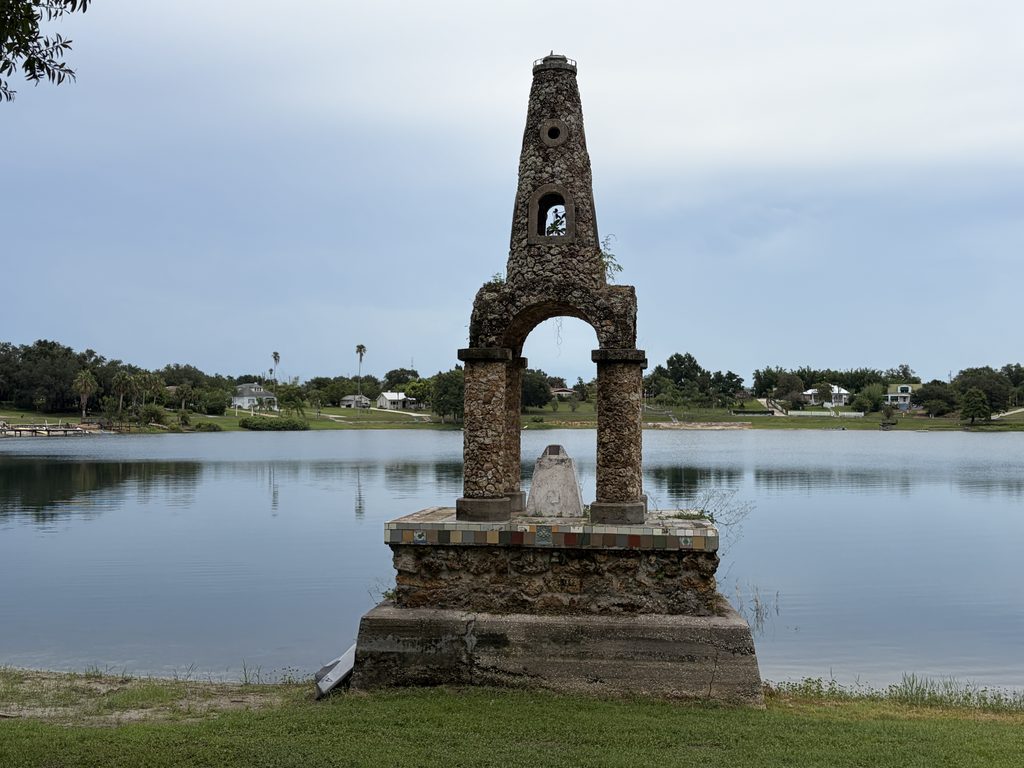
One of the most striking structures was a tall, narrow stone monument supported by columns and rounded arches. Decorative tiles still lined portions of its base, offering little glimpses of the artistic detail that once characterized the shrine.
The weathered stonework was beautiful against the peaceful backdrop of the lake.
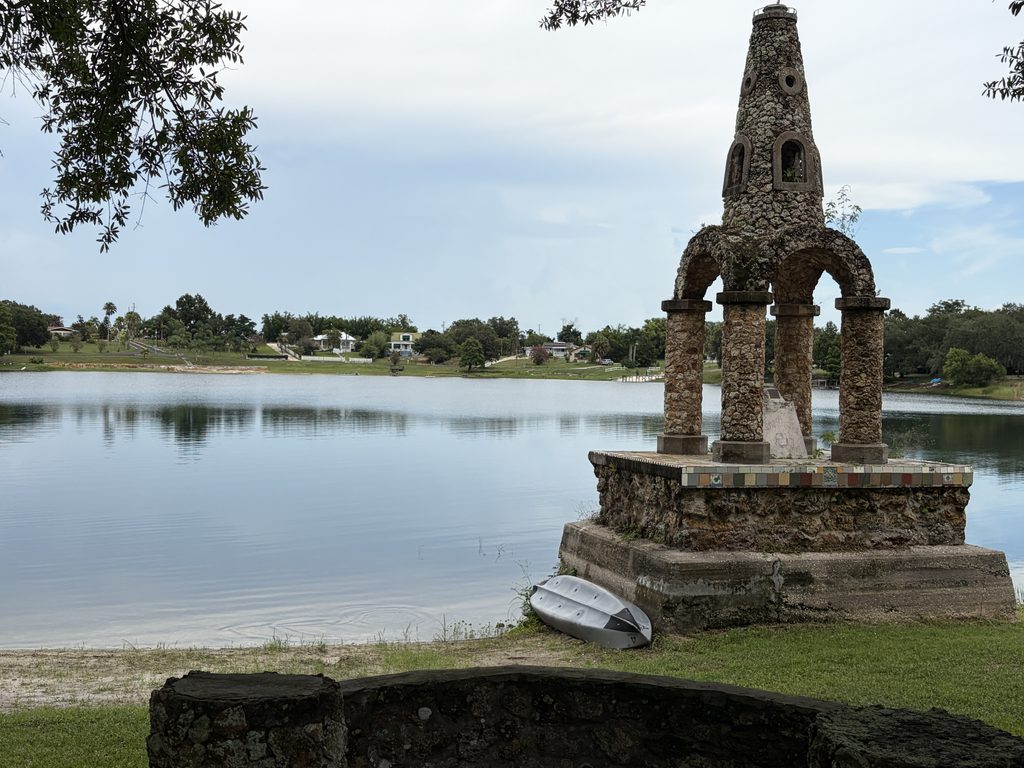
Dusty and I spent several minutes admiring the ruins, capturing their details, and enjoying this unexpected little piece of Florida history.
At the time, I had no idea that thousands of people had once traveled here.
I didn’t know about the annual pilgrimages, the healing traditions, or the church that had disappeared.
I was simply enjoying the opportunity to explore something old, unusual, and fascinating.
Sometimes, the most remarkable discoveries happen long after an adventure ends, when I finally sit down to research the places we’ve visited.
St. Anne’s Shrine was certainly one of those discoveries.
The Stone Bridge and the Unexpected Discovery
After exploring the lakeside ruins, Dusty and I returned to the truck and continued along the neighborhood road.
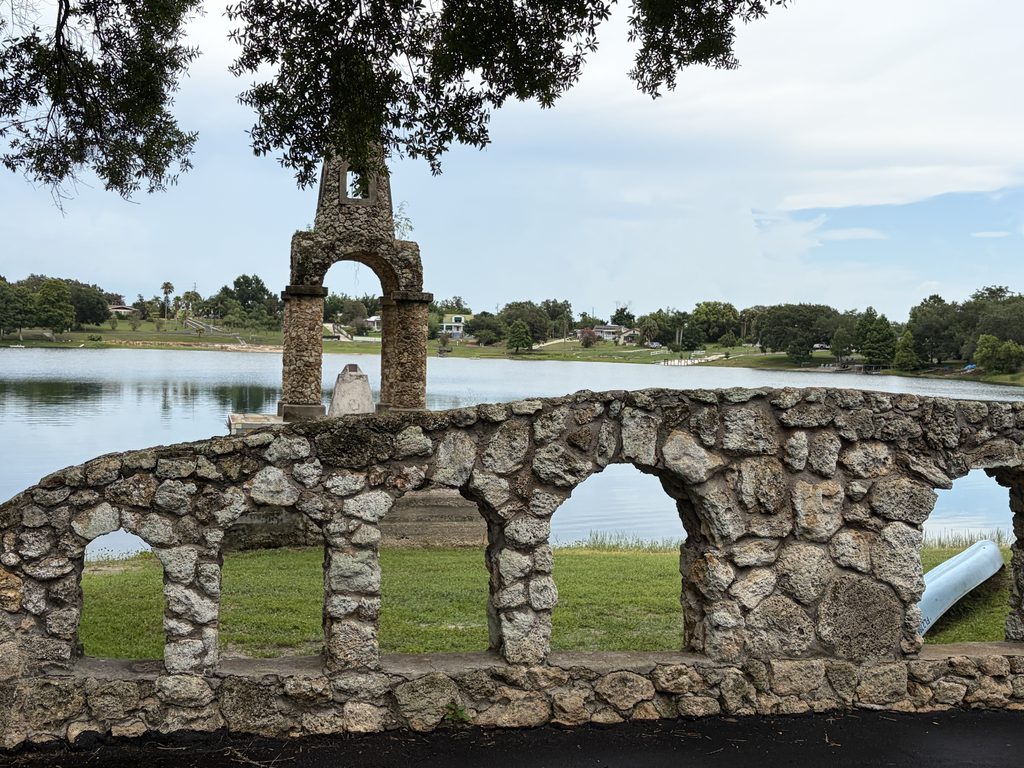
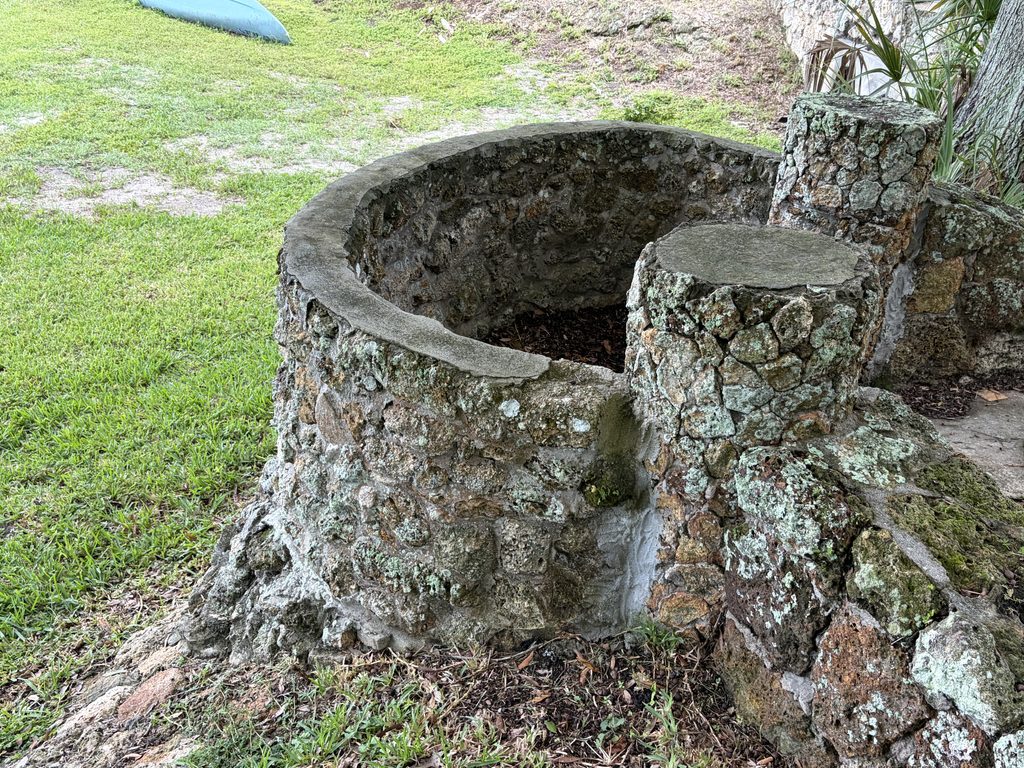
Part of the surviving stonework formed the walls along the sides of a very small bridge in the street.
The bridge was another reminder that the original shrine complex had once extended beyond the monuments standing beside the lake.
But shortly after driving past the bridge, we noticed something else.
There appeared to be additional stone ruins in someone’s front yard.
Well, naturally, we needed photographs.
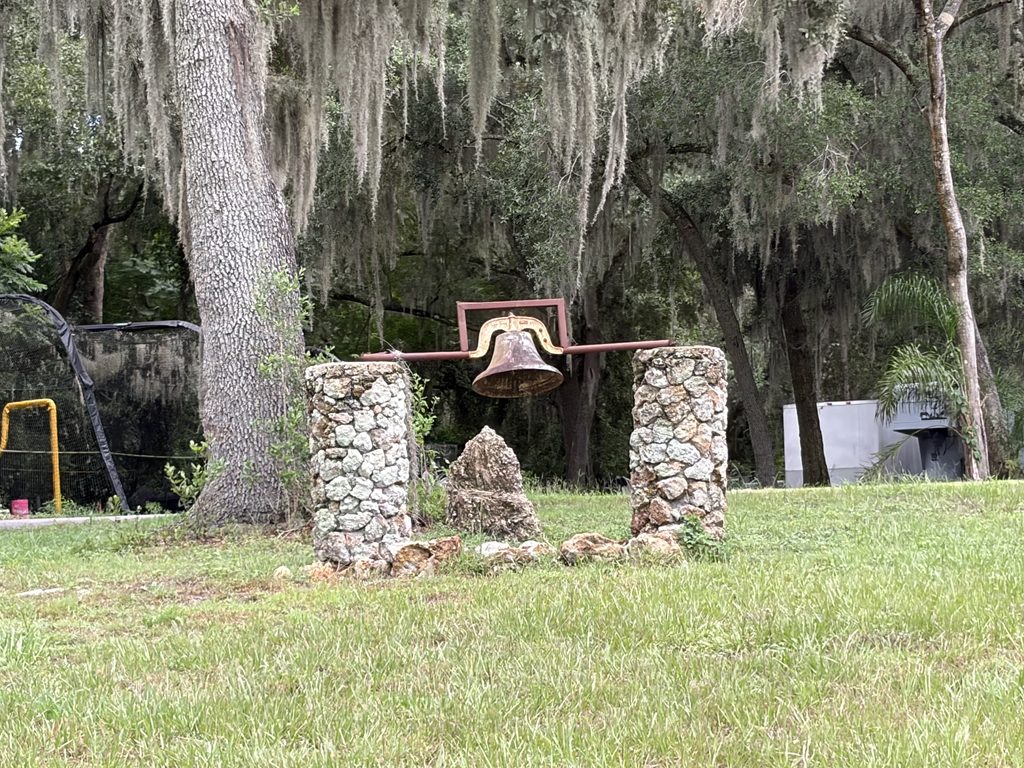
And so, we activated what we affectionately refer to as stalker mode.
For anyone unfamiliar with our particular brand of historical exploration, stalker mode involves briefly stopping the truck to photograph something interesting from the road.
No trespassing. No wandering through someone’s yard. Just two curious history enthusiasts attempting to document something before continuing on their way.
We stopped long enough to capture a few photographs.
Then we noticed the occupants of the house walking out toward the road.
That seemed like an excellent time to continue our adventure.
Photographs acquired. Mission accomplished. Time to go!
Although I haven’t confirmed the original purpose of those particular structures, their appearance made me wonder how many other pieces of the shrine might still be hiding throughout the neighborhood.
What Remains of St. Anne’s Shrine Today?
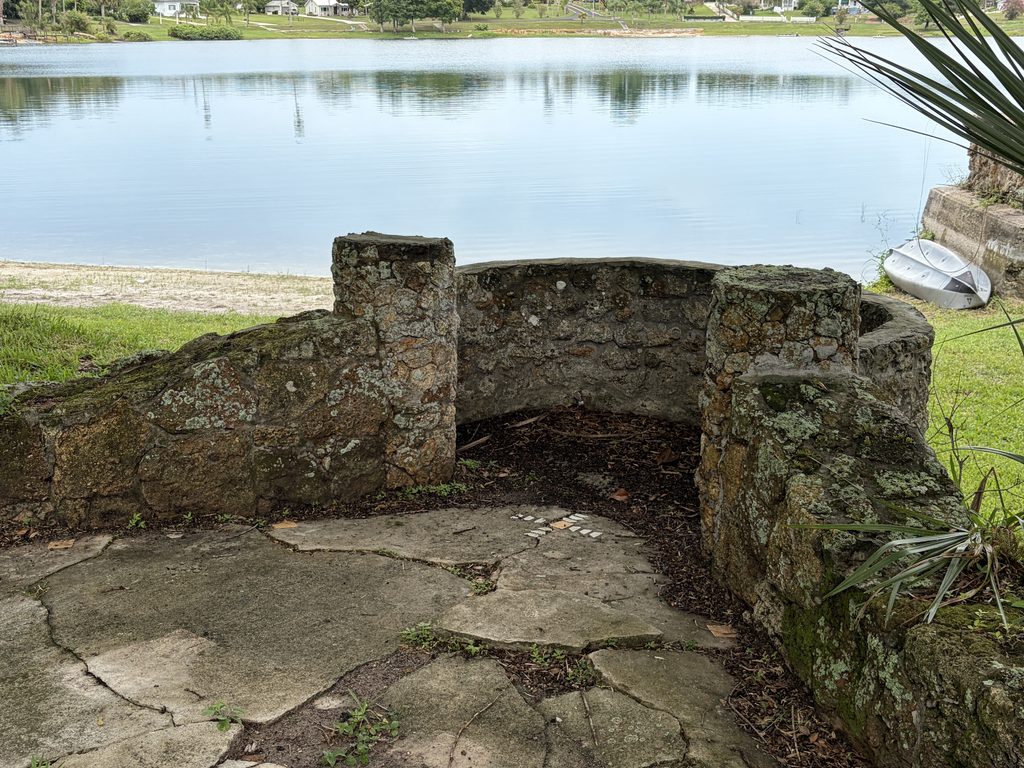
Although the original church no longer stands, portions of the shrine’s distinctive stonework have survived.
Among the documented remnants are religious monuments, the stone bridge, and architectural features associated with the original complex.
The surviving structures provide a fascinating opportunity to imagine what the area might have looked like during the shrine’s most popular years.
Historic photographs and postcards preserved by the State Archives of Florida also offer glimpses of the shrine before much of it disappeared.
Comparing those historical images with the modern neighborhood reveals just how dramatically the landscape has changed.
Yet the shrine’s religious significance hasn’t been entirely forgotten. The history of Holy Spirit Catholic Church includes references to religious services being held at the original shrine site.
The great pilgrimages may belong to another era, but the connection between this place and the faith that inspired its creation has endured.
A Date That Made Our Visit Even More Meaningful
One of my favorite discoveries while researching St. Anne’s Shrine was learning about the annual Feast of St. Anne on July 26th.
Dusty and I had visited on July 10th.
Just sixteen days before the date that once brought pilgrims to the shores of this lake.
We had no idea.
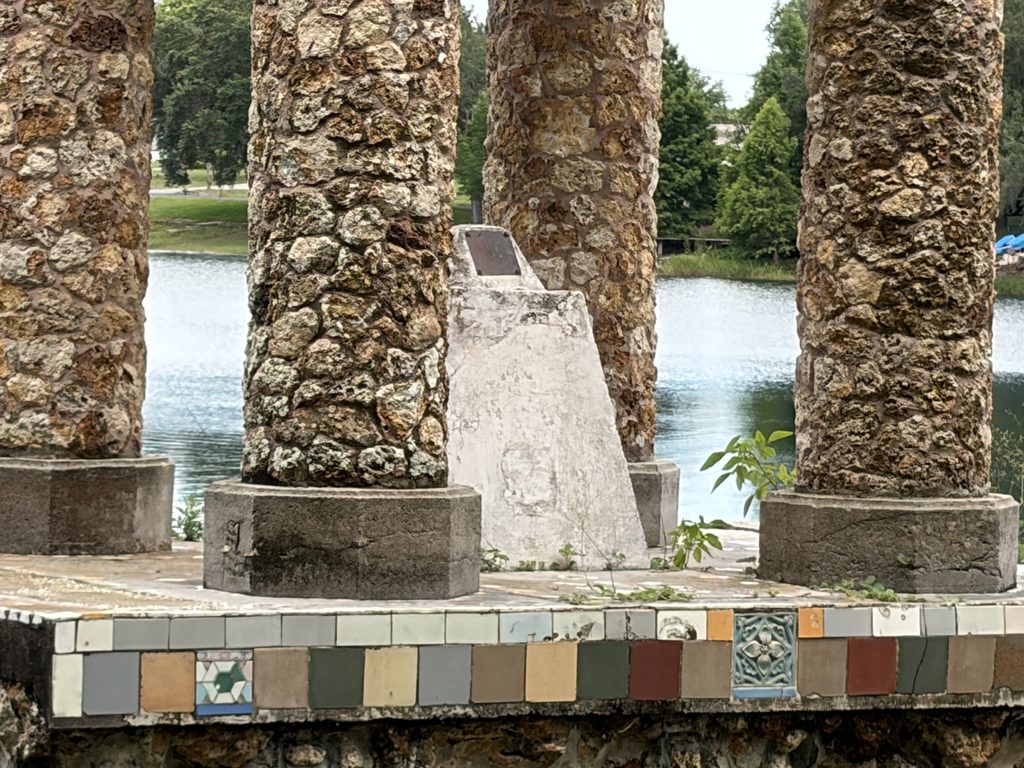
While we were wandering around taking photographs and trying not to melt in the Florida heat, we were visiting during the very month that had once held such significance for the shrine.
Nearly a century earlier, families would have been preparing to make their journeys here. People carrying hopes, prayers, gratitude, and perhaps the belief that something extraordinary might happen beside these waters.
And there we were, decades after the crowds had disappeared, admiring the stones they had left behind.
It’s a small connection, but one that made the experience feel even more meaningful after learning the history.
What Stayed With Me
When I think back on our visit to St. Anne’s Shrine, I’m struck by how ordinary the surrounding neighborhood appeared.
There were houses, lawns, roads, and a peaceful lake.
And right in the middle of it all were the remnants of a place that once meant so much to so many people.
When we visited, I saw beautiful old stonework.
Now, knowing the history, I see something more.
I think about the French Canadian families who established a community far from their homeland.
I think about the parents who traveled here carrying hopes for their children’s recovery.
I think about the artists who helped transform the landscape into a place of devotion.
And I think about the thousands of pilgrims who once gathered along these shores, each carrying a story of their own.
Of course, a place of worship doesn’t need elaborate monuments or thousands of visitors to hold meaning. Our visit to the Smallest Church in America in Townsend, Georgia, offered a wonderfully different perspective on the relationship between faith and architecture. Whether grand or humble, these sacred spaces reflect the hopes and devotion of the people who created them.
The structures that survive are only fragments of what once existed.
But even fragments can tell extraordinary stories when we take the time to understand them.
Planning Your Own Visit to St. Anne’s Shrine
The ruins of St. Anne’s Shrine are located near Lake Wales in Polk County, Florida.
Unlike many historic attractions, the surviving structures are situated within a residential neighborhood rather than a traditional museum or historic park.
During our visit, we were able to park near the lakeside ruins and photograph them without an extensive walk.
If you’re planning your own visit, remember:
- Respect private property and surrounding residences.
- Observe posted parking restrictions and access signs.
- Photograph privately owned structures from lawful public areas.
- Avoid climbing on or disturbing the historic stonework.
- Bring water, especially if you’re exploring during the Florida summer.
- Consider researching historic photographs before visiting to better understand what once stood here.
The shrine can make an interesting addition to a Lake Wales history adventure, particularly if you’re already planning to explore the surrounding area.
Just remember that this is someone’s neighborhood as well as a piece of Florida history.
Watch the Full Forgotten Friday Episode
Join Dusty and me as we explore the surviving ruins of St. Anne’s Shrine, uncover the history of Florida’s forgotten pilgrimage destination, and discover unexpected pieces of the past hiding in a modern neighborhood.
And yes, there’s a little Exploration Friday mischief along the way.
[Embed Forgotten Friday: St. Anne’s Shrine — Florida’s Forgotten Pilgrimage Site video here]
Final Thoughts
St. Anne’s Shrine may never again see the thousands of pilgrims who once gathered along its shores.
The church is gone. Many of its monuments have disappeared. And the landscape surrounding the lake has changed dramatically.
But the surviving stones still carry a story.
A story of faith, hope, healing, community, and the remarkable things people create when they believe in something greater than themselves.
I’m grateful that our second Exploration Friday brought us to this little corner of Polk County.
What began as a convenient roadside stop on our way to Bok Tower became an opportunity to rediscover a fascinating chapter of Florida’s religious history.
And that’s what Forgotten Friday is all about.
Finding the places that history has nearly forgotten and giving their stories another chance to be heard.
Until next time, keep exploring.
Because history is everywhere.
Sometimes, it’s hiding right in someone’s front yard.
History is hiding in plain sight. Are you ready to discover it?
From forgotten pilgrimage sites and weathered ruins to lost communities and overlooked landmarks, there’s always another story waiting to be told.
Join the Travel Made Personal mailing list for our monthly newsletter, historical discoveries, upcoming adventures, and a little mischief along the way.
Because forgotten doesn’t have to mean lost forever.

If you see this after your page is loaded completely, leafletJS files are missing.