

Florida is not a state known for whitewater.
Beaches? Absolutely.
Springs? We have some of the most beautiful in the world.
Swamps? More than enough, thank you.
Mountains, dramatic elevation changes, and raging rivers?
Not so much.
And yet, hidden along the Suwannee River near White Springs is a place where Florida breaks its own rules.
Big Shoals State Park is home to the largest whitewater rapids in Florida.

That’s what brought us there.
It isn’t what made me remember the place.
Because somewhere between a muddy murder road, a disembodied voice at a bathroom, a surprise bat tower, and the crumbling remains of an old bridge, our hike to see the rapids became something much more interesting.
We had walked straight into another layer of Florida history.
Big Shoals State Park sits just outside White Springs, a small North Florida town whose history has always been intertwined with the Suwannee River.
I Had a Very Reasonable Plan
When I started researching Big Shoals, one particular phrase immediately caught my attention:
More than 28 miles of trails.
Nope.
We were not doing that.
The actual plan was considerably less ambitious.
We’d drive what we could, hike approximately half a mile to Little Shoals, then tackle the roughly one-mile trail to Big Shoals.
See both sets of rapids. Enjoy the scenery. Learn some history.
Less than two hours.
Easy.
There was absolutely nothing about this plan that could possibly go wrong.
Murph apparently took that personally.
Down the Muddy Murder Road
Getting into Big Shoals involved driving down a long dirt road that had become muddy enough to earn one of my favorite classifications of Florida backroads:
Murder road.
You know the kind.
The farther you drive, the more you begin wondering whether Google Maps has made a terrible mistake and whether anyone will ever find the truck.
Somewhere along this adventure, we accidentally passed the turn for Little Shoals.
No problem.
We’d come back.
We continued to the Big Shoals trailhead, parked, and prepared for our hike.
But first?
Bathroom.
Because nothing says fearless wilderness explorer quite like making sure everyone pees before leaving the parking lot.
The Bathroom Ghost of Big Shoals
Dusty went first while I changed into my hiking boots.
When she came out, she commented that the bathroom was surprisingly clean.
And somewhere nearby, a woman’s voice suddenly called:
“Thank you!”
Excuse me?
For a very brief and magnificent moment, I thought we’d discovered the world’s most courteous bathroom ghost.
It turned out there was a woman staying in an RV nearby who apparently cleaned the bathrooms every morning.
She had simply overheard Dusty’s compliment.
So…
Thanks, Chica!
And thank you for giving us one of the funniest moments of the trip before we’d even reached the trail.
And Then There Was a Bat Tower
We hadn’t walked very far before Big Shoals delivered another surprise.
A bat tower.
Obviously, we stopped for pictures.

Structures like this were historically designed to provide roosting habitat for bats, sometimes with the hope that a large bat population would help control mosquitoes.
And frankly, in Florida, I support anyone willing to report for mosquito-eating duty.
But eventually, we had to stop admiring the bat architecture and actually begin the hike we’d come here to do.
The Big Shoals Trail runs for roughly a mile toward the river.
I wouldn’t describe it as particularly strenuous.
I would describe it as rooty.
Very, very rooty.
The forest floor apparently had strong opinions about ankles.
Still, much of the trail follows the Suwannee River, and as we walked, the history of Big Shoals began revealing itself.
A River People Have Followed for Thousands of Years
Long before anyone called this Big Shoals State Park, people were living along the Suwannee.
Archaeological evidence throughout the region documents human occupation stretching back thousands of years. Later Indigenous cultures, including peoples associated with the Timucua and Apalachee, inhabited the broader region surrounding the river.
The Suwannee wasn’t simply scenery.

And Big Shoals isn’t the only place where those layers survive. Farther along the river, Suwannee River State Park preserves another remarkable collection of natural and historic remnants along its banks.
It provided food, water, transportation, and access to the resources found along its banks.
The geology around Big Shoals also made this landscape distinctive. Limestone bluffs rise dramatically above portions of the river, and stone resources within the region could be used to create tools and projectile points.
Humans have therefore been interacting with this landscape for far longer than the modern trails might suggest.
But the Suwannee provided something else.
A barrier.
And as Florida changed, people repeatedly confronted the same problem:
How do we get across this river?
William Brinton Hooker and the Suwannee Crossing
By the 1830s, American settlement was changing North Florida.
One of the people who established himself near this section of the Suwannee was William Brinton Hooker.
Born in Georgia in 1800, Hooker became a prominent figure in territorial Florida. During his life, he served in roles including surveyor, sheriff, and militia captain.
He also became one of Florida’s early cattle barons.

Hooker raised cattle and black-seed cotton near the Suwannee, eventually controlling a herd that reportedly numbered in the thousands.
But raising livestock near a major river created a logistical problem.
You still had to cross it.
Hooker operated a ferry across the Suwannee, creating an important connection for moving people, goods, and livestock.
The ferry belonged to an era before bridges could make crossing the river relatively routine.
But eventually, people wanted something more permanent.
And that’s where one of my favorite discoveries of our hike enters the story.
We Found a Bridge in the Woods
Well…
Pieces of one.
As we followed the trail toward Big Shoals, we came across old concrete and stone remnants near the river.
They’re associated with the old Godwin Bridge, a former crossing of the Suwannee.
Suddenly, I wasn’t nearly as interested in getting to the rapids.

Because this is precisely the kind of thing I love finding.
There isn’t an intact bridge dramatically spanning the river anymore.
Instead, you’re left with fragments.
And fragments make you ask questions.
Who built this?
Where did it go?
Why did people need a bridge here?
What did this place look like when it was being used?
Around the turn of the 20th century, North Florida’s economy depended heavily on industries such as agriculture, logging, and naval stores. Roads, ferries, and bridges connected rural communities with markets and one another.
Today, the forest around the Godwin Bridge remnants is quiet.
But imagine standing here when this was an active crossing.
People, horses, wagons, livestock, and goods once moved through a landscape that now feels almost completely reclaimed by nature.
The ruins are easy to dismiss as chunks of old concrete.
But once you know what you’re looking at, the forest changes.
It isn’t empty anymore.
The Suwannee Wasn’t Easy to Tame
The Godwin Bridge wasn’t the only crossing attempted in this area.
Evidence near Little Shoals has also been associated with an older transportation route and earlier efforts to cross the river.
And that pattern became one of my favorite parts of researching Big Shoals.
For generation after generation, people looked at the Suwannee and tried to solve the same problem.
Ferries.
Roads.
Bridges.
Different technology. Different eras. Same river.
Today, only pieces of some of those efforts remain.
Nature is exceptionally good at reminding us which one of us has more patience.
When the Forest Became an Industry
By the late 19th and early 20th centuries, people weren’t only trying to cross these woods.
They were harvesting them.
North Florida became deeply connected to the naval stores industry, particularly the production of turpentine and rosin from pine resin.
Workers cut distinctive patterns into pine trees to encourage resin to flow. These scars became known as cat faces, and traces of that industry can still survive on old trees.
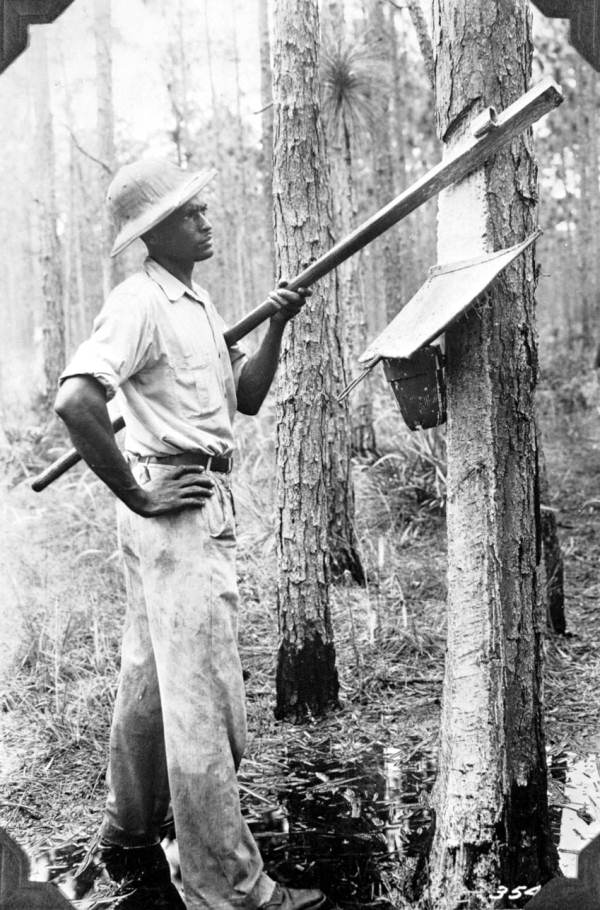
The resin was collected and transported to stills, where it was processed into products used in paints, varnishes, soaps, and numerous other goods.
Within the land that eventually became Big Shoals, operations including the Downing and Tippins Turpentine Camp became part of that story.
It’s difficult to reconcile that industrial landscape with the forest you walk through today.
That’s part of what makes it fascinating.
Places recover.
Trees grow.
Buildings collapse.
Roads disappear.
And eventually, you can stand somewhere that feels wild without realizing how many generations of people worked that exact ground.
Finally, Florida’s Whitewater Rapids
Eventually, after all the tree roots and historical distractions, we reached the reason we’d come.
Big Shoals.
And yes.
Florida really does have whitewater rapids.

The normally dark, relatively peaceful Suwannee behaves very differently here because of the geology beneath the river.
When water levels are right—generally around 59 to 61 feet above mean sea level—the Big Shoals rapids can earn a Class III whitewater classification.
That makes them the largest whitewater rapids in Florida.
The surrounding limestone bluffs can rise as much as 80 feet above the river, creating scenery that feels distinctly un-Florida-like.
As for the water during our visit?
Brown.
Very brown.
Possibly even a little yucky.
I still loved it.
There was something surreal about standing in the woods watching the Suwannee churn through actual rapids after spending most of my life associating Florida rivers with slow-moving water.
And after learning how many human stories had unfolded along this stretch of river, the view meant something different.
We weren’t simply looking at rapids anymore.
We were looking at the reason so much of this history happened here.
The Long Walk Back
There is one unfortunate problem with hiking a mile into the woods.
You also have to hike a mile out.
Rude.
By the time we turned around, I was hurting.
The trail hadn’t felt particularly strenuous, but the distance combined with the roots and everything else had taken its toll. By the time we finally made it back to the truck, I was in quite a bit of pain.
Remember Little Shoals?
The place we’d accidentally passed and planned to visit afterward?
Yeah.
No.
Little Shoals could remain mysterious.
Sometimes successful exploration includes knowing when you’ve explored enough.
From Working the Land to Protecting It
For much of its recorded history, people looked at the land surrounding Big Shoals in terms of what it could provide.
Cattle.
Cotton.
Transportation.
Timber.
Turpentine.
Even the area’s mineral springs attracted attempts at tourism development, including a hotel and bathhouse associated with the Sheffield family.
That fascination with mineral water became an even bigger part of nearby White Springs, where the remains of the White Sulphur Springs Bathhouse still tell the story of the town’s days as a health resort.
But eventually, the relationship between people and this landscape began changing.
Instead of asking what could be extracted from it, people began asking what should be preserved.

Florida began acquiring land around Big Shoals in the late 1980s.
Today, the larger Big Shoals Public Lands are protected and managed through cooperation among public agencies, preserving both the unusual natural landscape surrounding the Suwannee and the history embedded within it.
Those 28-plus miles of trails now give visitors a chance to experience that landscape for themselves.
Twenty-six of them without me.
The Story Hiding Beside the Trail
Big Shoals was supposed to be about rapids.
And the rapids were absolutely worth seeing.
But they aren’t what stayed with me.
I remember the muddy road.
The mysterious voice outside the bathroom.
The unexpected bat tower.
The endless tree roots.
The pain in my feet.
And those pieces of an old bridge sitting quietly beside the Suwannee.
Because those ruins changed the way I saw the entire park.

This landscape has been home, transportation corridor, cattle country, industrial workplace, tourist dream, and eventually protected public land.
People have tried to cross the river.
Use it.
Build beside it.
Build over it.
And through every era, the Suwannee just kept flowing.
The bridges disappeared.
The camps faded.
The forest reclaimed what people left behind.
The river remained.
That’s why I love places like Big Shoals.
You can visit because somebody told you there are whitewater rapids in Florida.
But if you slow down and pay attention to what’s hiding beside the trail, you might discover that the attraction you came to see is only the beginning of the story.
And sometimes?
The ruins you weren’t looking for become the reason you’ll remember the place.
Until next time, keep exploring.
Florida has whitewater rapids?!
That’s what brought us to Big Shoals State Park—but somewhere between a muddy murder road, a surprise bat tower, and a two-mile hike along the Suwannee River, we found something I wasn’t expecting: the remnants of a forgotten bridge hiding in the woods.
And, naturally, I needed to know its story.
This week on Travel Made Personal, we’re heading into Big Shoals to uncover the history hiding along the trail—and discover why Florida’s largest whitewater rapids are only part of what makes this place fascinating.
📬 Want stories like this delivered straight to your inbox? Join the Travel Made Personal mailing list and come explore the history hiding in plain sight.

If you see this after your page is loaded completely, leafletJS files are missing.