

We weren’t looking for a Civil War fort.
We weren’t even looking for a historical site.
Dusty and I were driving through the mountains of Virginia on our way to West Virginia when we rounded a curve and I saw an absolutely breathtaking view stretching across the mountains.

Then I saw the sign.
1862 Confederate Breastworks.
Well.
Obviously, I pulled over.
At first glance, there wasn’t much there. A historic marker. A spectacular overlook. And a trail disappearing into the woods.
But hidden beneath those trees were the remains of Fort Edward Johnson, a Confederate defensive position built across Shenandoah Mountain in the spring of 1862.
Thousands of soldiers had once prepared this mountain for a battle.
They dug trenches. Built breastworks. Cleared trees.
Then they left.
Union soldiers came.
They left too.
The Confederates returned.
And then they left again.
The great battle this fort had been built to withstand never happened here at all.
More than 160 years later, the mountain still carries the scars.
And during October, when the ghosts are allowed into our stories, I can’t think of a better description for Fort Edward Johnson than this:
A ghost fort on the mountain.
A Road Through the Virginia Mountains
Today, U.S. Route 250 winds across Shenandoah Mountain, carrying travelers through some truly beautiful stretches of Virginia.
In 1862, however, this route was known as the Staunton and Parkersburg Turnpike.
And it mattered.

The turnpike crossed the rugged mountains of western Virginia and provided an important route toward Staunton and the Shenandoah Valley.
The Shenandoah Valley was agriculturally important to the Confederacy, but its geography mattered just as much. The long valley created a natural corridor through Virginia, making the roads and mountain passes leading into it strategically valuable.
By the spring of 1862, Federal forces were pushing east through the mountains.
Confederate forces needed to stop them.
One of the officers tasked with doing that was Brigadier General Edward “Alleghany” Johnson.
And Johnson chose Shenandoah Mountain as the place to make a stand.
Building Fort Edward Johnson
Beginning in early April 1862, Johnson’s soldiers went to work fortifying the mountain.
The word fort might conjure images of stone walls, gates, towers, or even the heavy masonry fortifications found along the coast.
Fort Edward Johnson was nothing like that.
This was a field fortification built directly into the landscape.

Soldiers dug roughly a mile of trenches and breastworks through the rocky mountain terrain. Logs and earth were used to strengthen the defenses, while trees were cleared along approaches to reduce the cover available to attacking troops.
The position guarded the turnpike as it crossed the crest of Shenandoah Mountain.
The men were preparing for an attack from the west.
And for weeks, they worked.
Imagine digging into this mountain without modern equipment. Cutting timber. Moving earth. Preparing defenses while knowing an enemy army could eventually appear along that road.
By the time the work was finished, Fort Edward Johnson was waiting for its battle.
The battle never came.
Strangely enough, this wasn’t the only fort we encountered on this trip that had been built for a battle it would never fight. At Fort Fremont in South Carolina, massive concrete defenses were constructed to protect the coast during the Spanish-American War—but its guns would never fire in combat.
The Fort That Never Fought
Union Brigadier General Robert Milroy’s forces had advanced into the region, reaching McDowell west of the Confederate position.
The threat that prompted Fort Edward Johnson’s construction was very real.
But Civil War armies rarely stayed put for long.
By late April, Johnson’s troops withdrew east toward Staunton.
And just like that, the fort they had spent weeks constructing was empty.
Federal troops subsequently occupied the abandoned Confederate position without having to fight their way through the defenses built to stop them.
That alone would make Fort Edward Johnson an unusual little piece of Civil War history.
Except the story gets stranger.
Because the Confederates came back.
Stonewall Jackson Enters the Story
By the spring of 1862, Major General Thomas J. “Stonewall” Jackson was beginning the campaign that would make his operations in the Shenandoah Valley legendary.
Jackson faced multiple Federal forces operating across the region. Rather than remaining anchored to a single defensive position, Confederate troops moved repeatedly through the valley and surrounding mountains as Jackson sought opportunities to confront separated Union commands.
Edward Johnson and his men became part of that larger movement.

In early May, Johnson marched west again.
And on May 7, his troops passed back through the fortifications they had constructed only weeks earlier.
The Federal troops were gone.
For a brief moment, Fort Edward Johnson belonged to its builders again.
Then they kept marching.
The fort was abandoned for the second time.
Because the battle everyone had been expecting on Shenandoah Mountain was finally coming.
Just not here.
The Battle Moved to McDowell
On May 8, 1862, Confederate and Union forces met near the small community of McDowell, Virginia.
Johnson’s men fought alongside Jackson’s forces in the Battle of McDowell, an engagement generally regarded as the first Confederate victory of Jackson’s 1862 Valley Campaign.
Johnson himself was badly wounded during the fighting when a bullet struck his ankle.
The soldiers who had spent weeks preparing to fight from trenches on Shenandoah Mountain ultimately fought their battle several miles away.
Fort Edward Johnson never experienced the great attack its defenses had been built to repel.
Instead, the war moved around it.
And eventually, it moved away completely.
The mountain began reclaiming what the soldiers left behind.
More Than 160 Years Later, We Pulled Over
Which brings us back to two travelers who had absolutely no idea any of this was here.
All I knew when I pulled over was that I had seen a sign for Confederate breastworks and one heck of a mountain view.

There was a historical marker at the overlook, and nearby was a nature trail leading into the mountain.
So naturally, we explored.
A little.
Let’s not get carried away here.
We didn’t come here to hike.
We had somewhere to be.
Specifically, we were on our way to visit the Trans-Allegheny Lunatic Asylum, which is the sort of sentence that probably tells you everything you need to know about how our trips work.
Still, we followed the trail far enough to get a glimpse of what survives.
And that may be the most remarkable thing about Fort Edward Johnson.
There isn’t some enormous ruin waiting in the woods.
There aren’t stone walls towering over the road.
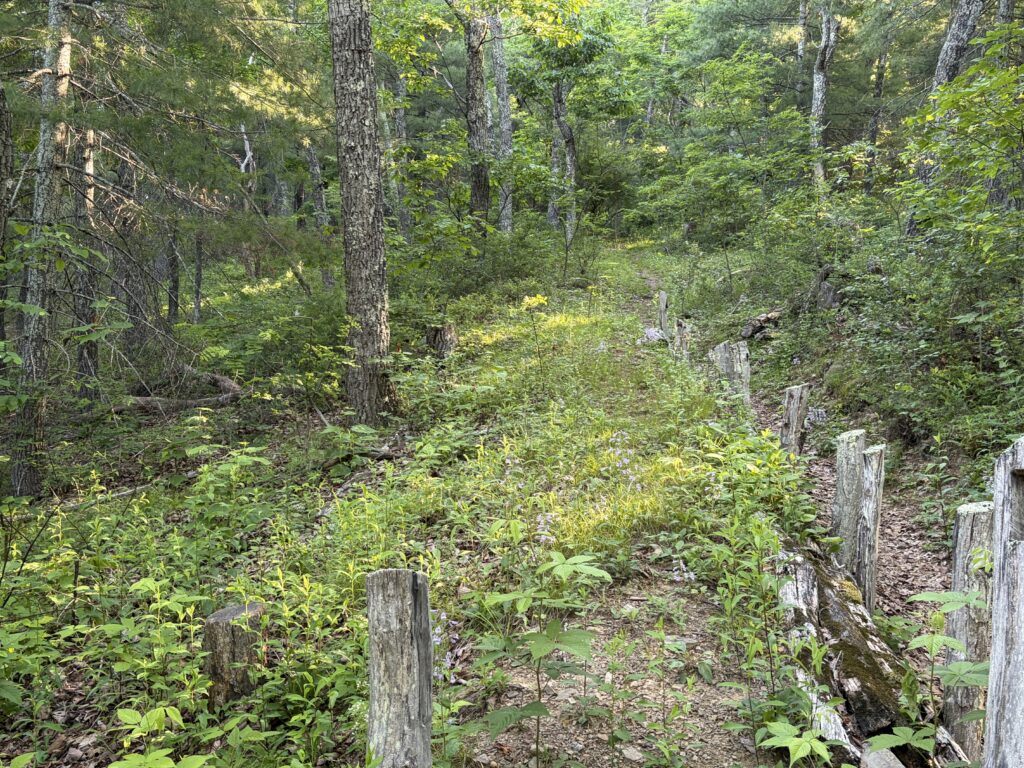
There are depressions, trenches, raised earth and subtle changes in the landscape.
Unless you know what you’re looking at, you could easily walk straight past them.
History hasn’t disappeared here.
But it has faded.
Is Fort Edward Johnson Haunted?
Since this particular Forgotten Friday falls during October, the ghosts have officially been invited into the story.
So…
Is Fort Edward Johnson haunted?
I couldn’t find a well-documented historical tradition of paranormal activity associated specifically with the fort, and I’m not going to invent one just because it’s October.
But I don’t think this place needs a ghost story.
The history is haunting enough.
Thousands of soldiers arrived on this mountain.
They dug into the earth.
They felled trees.
They prepared for an enemy.
Then they disappeared.
Another army came and occupied what they had built.
Those soldiers disappeared too.
The original builders returned.
Then they vanished once more.
The battle moved somewhere else.
What remained was an empty defensive position waiting for an attack that would never come.
A fort without its soldiers.
Trenches without their battle.
Earthworks slowly sinking back into the mountain.
A ghost fort.
Not because someone claims spirits walk through the woods at night.
Because the fort itself became a ghost of what was supposed to happen here.
What Stayed With Me
Some historical sites require planning.
You buy tickets. Research opening hours. Map the route. Read about the history before you arrive.
And then there are places like this.

Five minutes before we stopped, I didn’t know Fort Edward Johnson existed.
Then I saw four words beside the highway:
1862 Confederate Breastworks.
And suddenly, we were walking through the remains of a Civil War fort.
It’s how we ended up stopping in Enfield, North Carolina, too—a place that wasn’t on our itinerary until the road put it in front of us.
Those are some of my favorite discoveries when we travel.
They’re reminders that history isn’t confined to museums or famous battlefields.
It’s under our feet.
It’s behind buildings.
It’s buried beneath towns.
And sometimes it’s hiding in the woods beside a road you’ve never traveled before.
You just have to notice the sign.
And be willing to pull over.
Visiting the 1862 Confederate Breastworks
The remains of Fort Edward Johnson are located along U.S. Route 250 on Shenandoah Mountain, near the boundary between Augusta and Highland counties in Virginia.
A short interpretive trail allows visitors to explore portions of the surviving Confederate breastworks, while the roadside overlook offers spectacular views across the surrounding mountains.

This isn’t the kind of historical site where you’ll find a reconstructed fortress waiting for you.
That’s part of its appeal.
What remains is subtle.
You have to look.
And when you do, you’re seeing scars in the landscape left by soldiers in 1862—still visible more than a century and a half later.
If you visit, remember that surviving earthworks are historic resources. Stay on established trails, avoid climbing on or disturbing the fortifications, and leave archaeological and natural materials where you find them.
Yes.
I am aware of the irony of that final sentence.
Moving on. 😂
A Forgotten Fort in the Virginia Mountains
Fort Edward Johnson was built to stop an army.
Instead, it became a place armies passed through.
Confederates built it.
Federal troops occupied it.
Confederates returned.
Then everyone moved on.

The battle came to McDowell instead, and the mountain fort slowly faded into the landscape.
Today, thousands of travelers drive U.S. 250 across Shenandoah Mountain.
Some probably never notice what’s hiding beside them.
We almost didn’t.
But that’s exactly why places like this belong on Forgotten Friday.
Not every historic place has a visitor center.
Not every battlefield has monuments.
And not every fort looks like a fort anymore.
Sometimes all that’s left is a trench beneath the trees…
and four words on a roadside sign waiting for someone curious enough to stop.
Keep exploring the places history almost forgot.
Some of the best stories were never on the itinerary.
A roadside sign, an unexpected turn, or four little words—1862 Confederate Breastworks—can send us straight into a piece of history we didn’t know was waiting.
Join the Travel Made Personal mailing list for forgotten places, behind-the-scenes discoveries, upcoming adventures, and the stories that don’t always fit into the videos.
Come explore the places history almost forgot.

If you see this after your page is loaded completely, leafletJS files are missing.